Feeds:
Posts
Comments

Ramius Capital has disclosed an activist holding in Aviat Networks, Inc. (NASDAQ:AVNW) (Hat tip Oozing Alpha). I covered Ramius Capital’s white paper The case for activist strategies around 18 months ago. I think the AVNW position, as described by Ramius in the letter annexed to the 13D, is compelling.

Ramius’s “Purpose” set out in the 13D is as follows:

On July 7, 2010, Ramius delivered a letter to the Issuer’s Chairman and CEO, Charles Kissner, the Issuer’s Board of Directors (the “Board”) and the Issuer’s Chief Financial Officer, Thomas L. Cronan III (the “July 7 Letter”). In the July 7 Letter, Ramius expressed its belief that the Issuer’s Shares are deeply undervalued and significant opportunities exist to improve the Issuer’s operating performance based on actions within the control of management and the Board. Ramius stated that the Issuer’s current market price clearly indicates that the public market is attributing essentially no value for the Issuer’s operating business and reflects a lack of confidence in the Issuer’s business strategy. Ramius also expressed its concern that the Issuer has taken little action, to date, to adjust the cost structure in-line with current business prospects, specifically noting that, while revenues have declined since fiscal year 2008, operating expenses have actually increased over the same period. Ramius further stated it believes a significant opportunity exists to adjust the cost structure of the Issuer to achieve acceptable operating margins, even at the current revenue run rate, and urged management and the Board to focus its attention on driving cost improvements by re-focusing on the Company’s core businesses and de-emphasizing growth investments in non-core product lines such as WiMAX. Ramius concluded the July 7 letter by stating it has a strong vested interest in the performance of the Issuer as one of the largest shareholders and hopes to work constructively with management and the Board to unlock value for all shareholders. A copy of the July 7 Letter is attached hereto as Exhibit 99.1 and is incorporated herein by reference.

The July 7 letter is as follows:

July 7, 2010

Mr. Charles D. Kissner
Chairman and Chief Executive Officer
Aviat Networks Inc.
5200 Great America Parkway
Santa Clara, CA 95054
CC: Aviat Networks Board of Directors
Thomas L. Cronan III, Chief Financial Officer

Dear Chuck:

As reported this morning in a 13D filing with the Securities and Exchange Commission, Ramius Value and Opportunity Advisors LLC, a subsidiary of Ramius LLC, and certain of its affiliates (collectively, “Ramius”) owns approximately 6.2% of the shares outstanding of Aviat Networks Inc. (“Aviat” or the “Company”), making us one of the Company’s largest shareholders. As we have outlined below, we believe that Aviat is deeply undervalued and significant opportunities exist to improve the operating performance of the Company based on actions within the control of management and the Board of Directors (the “Board”). Over the past several months, we have had in-depth discussions with the Company’s former Chief Executive Officer, Harald Braun, as well as the Company’s Chief Financial Officer, Tom Cronan, regarding our concerns about the deteriorating financial performance of the Company and the lack of action to adjust operating expenses in-line with the Company’s current business prospects. We look forward to continuing these discussions with you and expect that swift actions will be taken to address these concerns and unlock shareholder value.

At the current time, the public market is attributing almost no value for the operating business at Aviat. As depicted in the table below, the Company ended the last quarter with approximately $390 million of current assets including assets such as cash and cash equivalents, accounts receivables, and inventory. After subtracting the total liabilities of the Company from this amount, the Company is left with nearly $200 million of net current assets, or $3.35 per share. We believe this methodology provides for a fair assessment of the potential liquidation value of the Company’s balance sheet. The current stock price of $3.46 represents a mere 3.3% premium to this value clearly indicating that the public market is attributing essentially no value for the Company’s operating business. This analysis does not even take into account the value of Aviat’s long-term assets of $61 million, or $1.02 per share, which, when added to net current assets of $3.35 per share, equates to tangible book value of $4.37 per share.

We believe the current market price reflects a lack of confidence in the business strategy at Aviat. Over the past two years since FY 2008, revenues have declined by over $200 million. Yet, as shown in the table below, operating expenses have actually increased over the period by approximately $3 million. This has resulted in nearly a 70% decline in Adjusted EBITDA in just the past two years.

Aviat has taken little action, to date, to adjust the cost structure in-line with current business prospects. In fact, the Company has publicly stated that the current cost structure is designed to achieve a target operating margin of 10% only if quarterly revenues reach $150 million. For each of the past three quarters, revenues have been approximately $120 million and revenue guidance for 4Q 2010 is in a range of $120 million to $130 million.

Based on our research and analysis, we believe a significant opportunity exists to adjust the cost structure of Aviat to achieve acceptable operating margins even at the current revenue run rate. This can be achieved by re-focusing the Company on its core wireless backhaul and private network businesses and de-emphasizing growth investments in non-core product lines such as WiMAX. Our estimates indicate that the Company is currently spending between $15 million and $20 million per year on the WiMAX initiative. To date, the Company has recognized negligible revenues from this business making it a substantial drain on Company resources.

Additionally, the Company has made substantial investments in sales and marketing and research and development to drive penetration into new geographic markets. We believe the Company should focus its resources on markets where it has substantial penetration, a large installed base, and a stable pricing environment. In other non-core markets the Company should look for opportunities to utilize distribution partners or exit.

Even if you assume that the Company can only reach 50% to 75% of its target operating margin of 10% due to lower revenue levels and less absorption of overhead costs, the results still imply that Aviat is significantly undervalued. As demonstrated in the table below, at an annualized revenue run rate of $120 million per quarter and a 5.0% to 7.5% operating margin, Aviat would be trading at an Enterprise Value / EBITDA multiple of between 1.3x and 1.6x. The two closest public competitors, Ceragon Networks Ltd. (CRNT) and DragonWave Inc. (DRWI), currently trade at Enterprise Value / forward EBITDA multiples of 6.5x and 3.5x, respectively.

We believe this analysis clearly demonstrates that with prudent cost management, Aviat has the potential to generate substantial earnings and cash flow implying an extremely low valuation both on an absolute basis and relative to its peers. To that end, we urge management and the Board to focus its attention on driving cost improvements by re-focusing on the Company’s core businesses.

We greatly appreciate the time that Mr. Braun and Mr. Cronan have spent with us over the past several months and look forward to having an active and productive dialogue with you going forward. As one of the largest shareholders of Aviat, we have a strong vested interest in the performance of the Company and hope to work constructively with management and the Board to unlock value for all shareholders.

Best Regards,

Peter A. Feld

Jeffrey C. Smith

Ramius LLC

[Full Disclosure:  I hold AVNW. This is neither a recommendation to buy or sell any securities. All information provided believed to be reliable and presented for information purposes only. Do your own research before investing in any security.]
Berkshire Hathaway Inc. (NYSE:BRK.A BRK.B) has been in the news recently as Goldman Sachs initiated coverage on the stock with a “Buy” rating and then Stifel Nicolaus & Co. followed with a “Sell.” It’s not often that the street gets so polarized about a stock, tending to the more tepid “Hold,” so I thought I’d set out the long and short arguments below.

Long

Goldman Sachs’s view is summarized as follows:

Valuation disconnect at a multi-decade high

We initiate coverage of Berkshire Hathaway (BRK.A/BRK.B) with a Buy rating, as the disconnect between the market value of the stock and the intrinsic value of the business is close to a multi-decade high. With the recent inclusion of Berkshire in the S&P 500 and Russell indices and increased investor focus, we attempt to provide a framework for how to invest in the stock. In our view, the company is a unique collection of assets that over time earns a return on those assets – and as such should be valued accordingly.

Transformation: Key shifts in value mix

Post the acquisition of Burlington Northern, we estimate close to half of Berkshire’s intrinsic value will be derived from “operating” entities (as opposed to “securities investments”). This accomplishes two key things, in our view: (a) it reduces the long-term reliance on senior management’s equity investing decisions, and (b) provides greater clarity into the source of future value for the company as a whole.

Structural growth in largest segments

Structurally, Berkshire’s earnings will benefit from the ongoing shift in consumers’ auto insurance buying habits (via the direct-to-consumer GEICO subsidiary), the continuing change in the way goods are transported across the country (via the large intermodal operations at Burlington Northern), and the enduring growth in energy and power demand (via MidAmerican).

Levered to cyclical economic recovery

Cyclically, the non-insurance entities are tied to GDP growth and to a lesser extent, industrial production. Thus, as the economy continues to emerge from its cyclical downturn, we would expect earnings to grow at a faster rate than what appears to be currently discounted in the stock.

Price targets and risks

Our 12-month intrinsic value-based price target is $152,000 for BRK.A and $101 for BRK.B, implying over 25% upside. Key risks include an economic downturn, insured catastrophes, and management succession.

The Goldman report also sets out Goldman’s rationale for calculating BRK intrinsic value with a very interesting back-test of the reasoning:

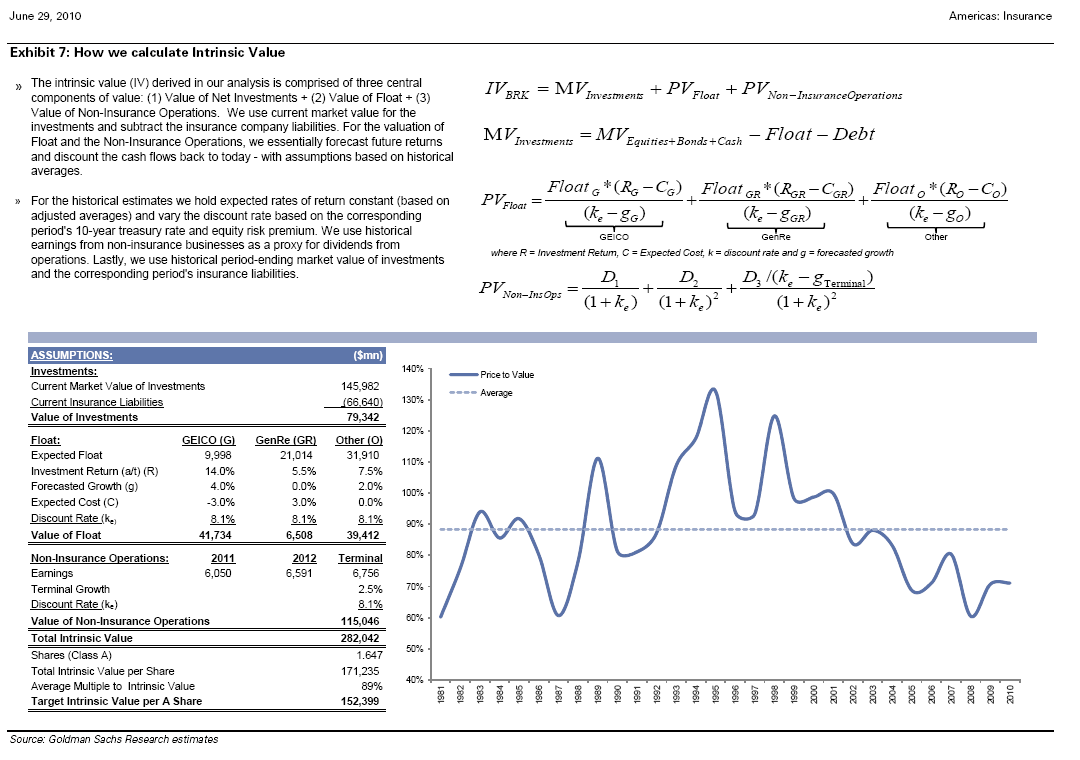
(1) Intrinsic Value

While Berkshire is a unique set of assets, we believe intrinsic value can be calculated in a manner similar to other companies. In our view the company is a collection of assets which earns a return on those assets over time – and thus the present value of such returns should equal the intrinsic value. Using historical drivers of returns (i.e. historical operating profits, market value of investments, interest rates, etc.) we can assess how Berkshire’s stock has tracked a derived intrinsic value over time. Importantly, however, the company has a long track record of producing significantly above-average returns on its assets and thus – while previous investment returns are no guarantee of future performance – we believe it is appropriate to factor above-average yields into intrinsic value. Specifically, we assess the intrinsic value as comprised of three main components:

1. The value of the investment portfolio (minus the insurance liabilities). This would be akin to a “book value” metric for other financial institutions. In other words, after liquidating the assets and having repaid all of the insurance obligations, the remainder would be the value left for shareholders.

2. The value of the float within the insurance operations. Float is the amount of funds an insurance company holds for future obligations and which can be invested for its own account. We ascribe a value to the float based on estimated future returns and growth. We will describe this analysis in more detail within the Insurance section below, however we would note this is the most unique component to the value of Berkshire, as there are few, if any, financial institutions with a track record of generating similar levels of consistent returns (see Exhibits 11-14 below).

3. The value of the non-insurance operating businesses. Outside of insurance, Berkshire owns majority stakes in a wide array of businesses. While the underlying operations are very diverse (i.e. railroads, utilities, carpet manufacturers, and even Dairy Queen), the businesses tend to share a common characteristic in that almost all maintain leading market share for either their industry or their geography. This is important when ascribing an intrinsic or long-term value to the operations, as the risk of obsolescence for the majority of the operations is considerably lower than other individual companies within the market. The idea of a real competitive advantage – or “moat” – suggests that at worst the companies will grow with the economy and at best will continue to compound returns at a rate higher than their peers. When valuing the non-insurance operations of Berkshire, we utilize a discounted cash flow model by aggregating expected earnings and applying a modest (and declining) 3-year growth rate and then a terminal growth rate of 2.5%.

Other key points to note:

  • Historically, the majority of the value derived from Berkshire has been sourced from the insurance operations – i.e. components one and two above. However, post the Burlington Northern acquisition, the contribution from non-insurance earnings will be larger than at any previous time in BRK’s history. We believe this is likely a concerted effort by current management over the past few years to allow for the “investing” component of BRK’s value to become less of a variable in the future – and thereby reducing the risk of lower investment returns impacting the value of Berkshire in the future (see Exhibits 5 and 6 below).
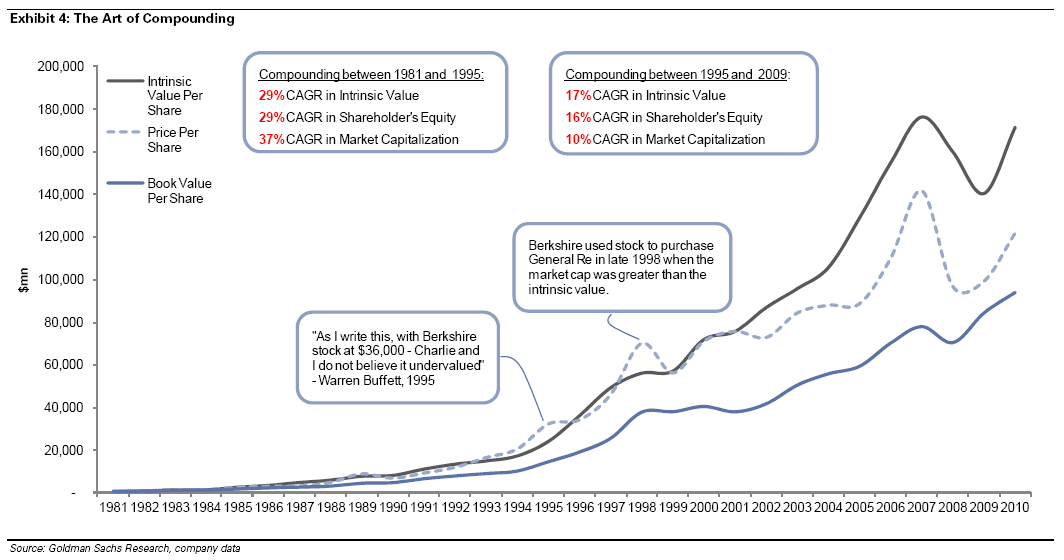
  • When we back-test our intrinsic value (as seen in Exhibit 4 above), we can show that comments or actions (as highlighted in the exhibit) made by Berkshire are consistent with the relationship depicted between intrinsic value and the market value ascribed to Berkshire stock. For example, in 1998, when Berkshire purchased General Re with stock, our analysis clearly shows the market value of the stock exceeded the intrinsic value of the company – thus, making the acquisition with “share currency” a significant value addition to the overall shares (ignoring however the future liability problems that General Re wound up disclosing).
  • When we back-test our intrinsic value model, we use a market cost of equity – i.e. the 10-year risk free rate and an applied equity risk premium for the US stock market. Not surprisingly, the general declining cost of capital over the past 30 years has helped to raise the value of Berkshire as well as the market.
  • While Berkshire can be shown to be largely impacted by cyclical industrial forces within the US, we note that the dual nature of the operations (i.e. insurance and non-insurance) allows for uncorrelated value creation opportunities. In other words, despite the recent recession’s negative impact on the future cash flows of the noninsurance businesses, the continued increase in insurance float (and the corresponding high-yielding investments made with that float) helped to mute the negative impact on the overall value of Berkshire.

Here’s Goldman’s calculation of intrinsic value:

The best part of the Goldman analysis is their comparison of BRK market price to Goldman’s calculation of intrinsic value since 1981:

Click here to see Goldman Sachs’s BRK report.

Short

The short argument for BRK is described by Meyer Shields of Stifel Nicolaus & Co.. Shields’s view, from the WSJ’s Market Beat column, is as follows:

Q: Meyer, thanks a lot for taking the time to parry a few of our questions. First things first, does it feel strange to hit the sell button on Buffett?

A: It does, because it sounds like I’m saying that I know more about investing or markets than Buffett does, which is nuts. All I’m saying is that I think the share price underperforms in the near-term.

Q: And from the looks of your note, you’re not saying that the Buffmeister has lost his edge. A lot of your analysis is about your outlook for the economy right? So, put simply: The slower the economy, the slower the results at all the multivarious businesses Berkshire owns?

A: With the exception of insurance, which is pretty well-insulated from the economy, yes. Berkshire’s more exposed to homebuilding and less exposed to technology than the overall economy, but the bottom line is that if unemployment stays high, spending stays low, both for the U.S. in general and Berkshire in particular.

Q: So, if a weak economy is bad for both Berkshire and the U.S. in general. Why would Berkshire underperform in the near-term?

A: On top of its own businesses’ exposure to the economy, Berkshire sold some equity index put options that are marked to market every quarter, so its book value gets hit twice.

Q: Ahah! So Berkshire sold puts — options that make money when the underlying falls in price. That means essentially Berkshire is on the hook to pay-up for the falloff we saw during the correction. Right?

A: Yes, except that it would only be on the hook for that sort of falloff if there’s no recovery until 2018 and beyond. In the meanwhile, the only issue is the mark-to-market, but in March 2009, that was enough to spook investors.

Q: Ah, ok. So, Berkshire is going to have to take a paper loss this quarter on those puts it sold. Got it. You note that Berkshire has been outperforming the S&P 500 by about 26% year-to-date. I’m wondering how much of that may have to do with the Baby Berks being added to the S&P 500? (A lot of index funds had to buy.) Wondering if you have any other thoughts on what Berkshire’s addition to the index might mean for the shares?

A: I think there were three implications of the addition to the S&P. First, a lot of funds had to buy the stock. Second, the resulting share price appreciation meant that it cost Buffett fewer Berkshire shares to purchase Burlington Northern. Third (and this is less positive), with widespread professional ownership, the “cult-stock” aspect (some investors use valuation methods for Berkshire that don’t work for any other name) will weaken, making the shares more “normal.”

Q: Interesting. You mean “cult,” like, less of the long-term loyalists that stick with the stock through thick and thin?

A: Exactly. I think we’ll see bigger reactions to good and bad quarters than we’ve seen in the past.

Q: Good stuff. Thanks a lot for taking the time. We’ll be watching to see how the call pans out. We’d wish you good luck, but then some of Buffett’s cult following might attack us in the comments section, and accuse us of anti-Buffett bias. So, we’ll just wish you a generalized, not-specific-to-this-call, good luck.

A: I love Warren Buffett, and I look forward to the stock trading down to a point where I can rate it a Buy.

[Full Disclosure:  No positions. This is neither a recommendation to buy or sell any securities. All information provided believed to be reliable and presented for information purposes only. Do your own research before investing in any security.]

In St. Joe can afford to be patient, Morningstar analyst Anthony Dayrit shares his thoughts on The St. Joe Company (NYSE:JOE) with Phil Guziec, Co-Editor and Portfolio Manager of Morningstar’s OptionInvestor research service. I’ve written about JOE previously (see The long and short of The St. Joe Company (NYSE:JOE)) arguing that it’s undervalued at present.

Morningstar’s valuations

On an assets basis:

Guziec: So it actually brings us to how we value the company. Could you talk about the couple of ways you come up with a value for St. Joe?

Dayrit: Yeah. Well, our main valuation, it’s pretty simple is that, we take the – we’d use the net asset value and we take the roughly 400,000 of coastal acres, coastal land and assign that a per acre value of $10,000. And then we take the remaining 172,000 acres and assign that a value of $1,500 an acre and we consider that to be either rural or swampland, and the $1,500 estimate is pretty much where the land has been going – rural land has been selling for around these last few years and when we net out the liabilities, we get an equity value of $4.4 billion, which is right around our $50 fair value estimate.

Guziec: And the share is trading in the low 20s right now?

Dayrit: Yes. The share is trading at the low 20s, and at that valuation, we’d assume a per acre value of all of St. Joe’s land at roughly $3,400 an acre.

On a cash flow basis:

Guziec: Okay. Now, the land is really, for an investor, only worth the eventual cash flows that come from it.

Dayrit: Yes.

Guziec: Could you talk about the other way that you look at the valuation for the company?

Dayrit: Sure. The other way that we’ve tried to look at St. Joe is by basically isolating the West Bay Sector. Now, there is around…

Guziec: And that’s the land around that airport that they drive at?

Dayrit: Yes. Yes. It’s around the New Panama City Airport, which has just opened at the end of May. And we take the 35,000 acres around that airport, and we assume that the company will be able to sell 700 acres per year over the next 50 years and assume that they can sell each acre for around $100,000 an acre.

And when we use that model, we get a per share value for just that West Bay project of $13, and if we take everything else of St. Joe’s land and put that into a $1,500 per acre bucket, we get an additional $9. So that also gets us to around $22, $23. And we think those are both pretty conservative assumptions.

Despite Dayrit’s assertion that the cash flow assumptions are conservative, I think Morningstar’s assumptions are pretty heroic (700 acres per year over the next 50 years for around $100,000 an acre? Ha ha ha, that’s a good one.). Those assumptions only get a valuation around the present stock price on a cash flow basis, which gives me some pause. Perhaps Jon Heller is right. Still, they’re only discussing a very small portion of JOE’s land, so I prefer the assets valuation, but I’ll bear in mind Jon Heller’s warning that “the assets need to be converted into cash in order for value to be realized”.

See St. Joe can afford to be patient to hear Dayrit and Guziec discuss JOE in more detail.

[Full Disclosure:  I hold JOE. This is neither a recommendation to buy or sell any securities. All information provided believed to be reliable and presented for information purposes only. Do your own research before investing in any security.]

In my original post about The St. Joe Company (NYSE:JOE) (see The long and short of The St. Joe Company (NYSE:JOE) I mentioned that Jon Heller of Cheap Stocks had been a past holder. Jon has clarified his position in a post on Cheap Stocks and provided some useful comments on where he sees the value:

For the record, while I believe that there is value in St. Joe’s assets, I have not owned the name since 2008. I originally purhased shares in the mid $20’s back in the early 2000’s, watched it run past $80, and finally had the position closed at around $40.

You may recall the back and forth between David Einhorn and I that appeared on this site nearly 3 years ago. David was short JOE, while I presented the bullish case. Einhorn had a $15 price target on the stock, and JOE bottomed at $16 and change in March of 2009, so David nailed it.

The reason that I don’t own St. Joe’s now is my skepticism about the company’s ability to convert it’s land holdings into cash, and how quickly it will be able to do so given the continuing Florida land depression. The oil spill, and how it will effect the Florida panhandle, is another concern.

With 577,000 acres, St. Joes currently trades at $3518 on the Enterprise Value/Acre metric that I typically calculate for companies with vast land holdings. While that may seem very cheap,it’s not that far below 2007 ($3956)and 2008 levels ($4016).

Bruce Berkowitz, whose firm Fairholme Capital Management owned nearly 29% of the company as of 3/31, laid out the bullish case for JOE at the recent Value Investing Congress West in Pasadena. While Berkowitz is way smarter than I’ll ever be, he used a lot of the same reasoning that I did when I was a shareholder, in order to present his case. I’ve just grown skeptical.

This may be the epitome of the value investor’s dilemna: a company with extremely valuable assets, but the assets need to be converted into cash in order for value to be realized. Can St. Joe’s pull it off?

I’d be an aggressive buyer of the stock at $2000 on an EV/acre basis, in order to provide a wider margin of safety. That would put the share price at about $13. That’s a long way from current levels, and it’s doubtful that we’ll get there.

[Full Disclosure:  I hold JOE. This is neither a recommendation to buy or sell any securities. All information provided believed to be reliable and presented for information purposes only. Do your own research before investing in any security.]

Street Capitalist has a beautiful post on Gyrodyne Company of America Inc (NASDAQ:GYRO). It’s trading at its 52-week highs, but its settlement of a court case with the State of New York means that it’s at a greater than 60% discount to its liquidation value on a sum-of-the-parts basis. It’s also got some activists on the register.

Here’s the background:

Gyro just announced that they won a court settlement from the State of New York. Here’s what happened:

“ST. JAMES, N.Y., June 30, 2010 – Gyrodyne Company of America, Inc. (NASDAQ:GYRO), a Long Island-based real estate investment trust, announced today that the Court of Claims of the State of New York issued an opinion requiring the State to pay to Gyrodyne an additional $98,685,000 for land appropriated in 2005. Under New York’s eminent domain law (the “EDPL”), Gyrodyne is also entitled, subject to EDPL Section 514, to statutory simple interest on the additional amount at a rate not to exceed nine percent (9%) per annum from November 2, 2005, the date of the taking, to the date of payment.

The opinion was issued in connection with Gyrodyne’s claim brought in April 2006 for just compensation for the 245.5 acres of its Flowerfield property in St. James and Stony Brook, New York (the “Property”), taken by the State. The State had paid Gyrodyne $26,315,000 for the Property at the time of the taking, which Gyrodyne elected, under the eminent domain law, to treat as an advance payment while it pursued its claim.

In its opinion, the Court agreed that the State had improperly valued the Property and misapplied the eminent domain law’s requirement that just compensation be determined based upon the highest and best use and the probability that such use could have been achieved. Applying this standard, the Court determined that there was a reasonable probability that the Property would have been rezoned from light industrial use to a planned development district, thereby resulting in the aforementioned award to Gyrodyne.”

Gyrodyne Press Release

Here’s Tariq’s valuation:

I look at situations where a court verdict is announced, a drug trial passes, or a certain earnings target is met as milestones in my investment process. So if I think a stock is undervalued, I will look at whether or not the company meets the milestones that I put up to, check its progress against my thesis. The benefit is that when a company meets its milestones, part of the uncertainty or risk behind your thesis goes away. Gyrodyne is a good case of that.

So let’s look at this on a sum of the parts basis:

$99.0 (settlement)

+ 41.0 (interest payments)

+ 34.0 (book value of real estate)

+ 1.10 (cash & cash equivalents)

– 21.5 (total liabilities)

= 153.6 / 1.29 shares outstanding

= $119 per share.

With the shares currently trading around $73, you get a potential gain of 63%. To me, this is a conservative estimate of liquidation value because the real estate is booked at cost. My guess is that some of it may have appreciated since they acquired it, but would rather not speculate. The company also owns an interest of a bit less than 9% in a Florida orange grove. Again, I would rather not speculate as to what the value of that interest really is.

And the activists:

Typically, whenever a company has a large cash balance, they tend to be greeted with skepticism. One of the risks companies with high cash balances is the fact that they might squander the cash horde. I think there are two reasons for why I would handicap this as a low possibility:

1. Shareholder Activists

Phil Goldstein of Bulldog Investors owns 17.46% of the stock. Two other partnerships own a combined 15% of the stock (River Road Asset Management, Leap Tide Capital). Phil Goldstein is a notoriously tough activist, he has been pretty big on forcing close-ended funds to liquidate when trading at discounts to NAV. I think there is a good chance Goldstein and the other investors will make sure the money from the court case is used in an accretive manner.

See the rest of the post at Street Capitalist.

[Full Disclosure: I hold GYRO. This is neither a recommendation to buy or sell any securities. All information provided believed to be reliable and presented for information purposes only. Do your own research before investing in any security.]

Further to my Seahawk Drilling, Inc. (NASDAQ:HAWK) liquidation value post, I set out below the slightly more optimistic valuation of HAWK’s rigs if they can be sold as operating rigs. Here is a guide to the second-hand market for rigs (click to enlarge):

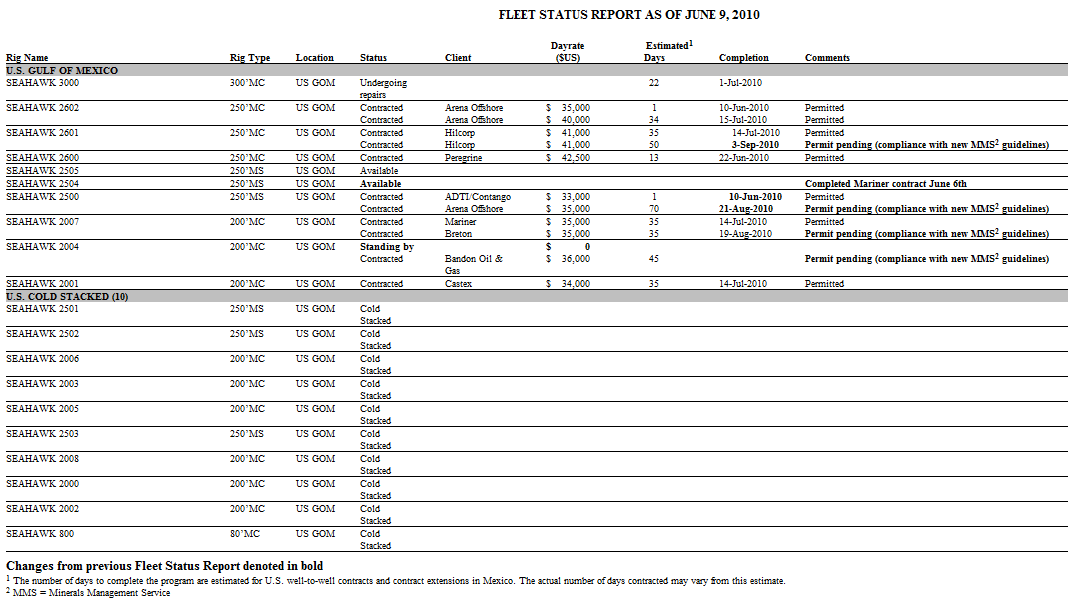
I’ve combined it with the list of HAWK’s rigs and their operating status from the July 2 Drilling Fleet Status Report to calculate the approximate second-hand market value of HAWK’s rigs:


Assumptions

Although a handful of HAWK’s rigs were built prior to 1980, I’ve assumed that the recent upgrades make the rigs saleable in the second-hand market. There is no market value for the 300′ MC (mat cantilever). 250′ MCs sell for around half the market price of 250′ ICs, so I’ve assumed that 300′  MCs might sell for half the price of 300′ ICs, which is $60M. I’ve also assumed that most of the cold-stacked rigs can be made operational with little expense, as Randy Stiller indicated in the presentation to the Macquarie Securities Small and Mid-Cap Conference. Stiller mentioned that two rigs require significant cap ex to be returned to operational status, although it isn’t clear which two or what “significant” means in practice. I’ve assumed that the 80′ MC is saleable only for scrap at $5M.

Valuation

I calculated that HAWK was worth around $154M in the more dour liquidation scenario, assuming that the rig value was $230M. This valuation suggests HAWK could be worth another ~$150M in rig value if most of the rigs can be sold as operational, which implies a liquidation value around $300M or around $25 per share. The risks are the cash burn and the Mexican tax issue, both of which I’ll examine in detail at a later date.

Hat tip John.

[Full Disclosure: I hold HAWK. This is neither a recommendation to buy or sell any securities. All information provided believed to be reliable and presented for information purposes only. Do your own research before investing in any security.]
Enoch Ko’s Blog has a superb english translation of Li Lu’s introduction to Poor Charlie’s Almanac. Li Lu’s story is nothing short of awe inspiring. He was born in China, survived 1976 Tangshan earthquake, participated in the Tiananmen Square student protests, and became one of the student leaders before escaping to the US after China cracked down on the movement. He then went on to study at Columbia University, where he was one of the first students to receive three degrees simultaneously: a B.A. in Economics from Columbia College, a J.D. from Columbia Law School, and an M.B.A. from Columbia Business School. He is now touted as a potential CIO candidate for Berkshire Hathaway and counts Charlie Munger as an investor in his fund. He’s also the source for Berkshire’s investment in BYD (for more on Li Lu’s methodology, Street Capitalist has a great set of notes from his 2010 lecture to the Columbia Business School).  Here’s the translation:

My Teacher: Charlie Munger

Author:Louis Li

May 21, 2010

Source: “Chinese Entrepreneurs”

Twenty years ago, as a young student coming to the United States, I couldn’t have imagined having a career in investments and would never have thought that I’d be fortunate enough to meet with the contemporary investment guru, Mr. Charlie Munger. In 2004, Mr. Munger became my investment partner and has since become my lifelong mentor and friend — an opportunity I would have never dared to dream about.

I graduated from Columbia University in 1996 and founded my investment company in 1997, thus starting my professional investment career. Till this day, the vast majority of individual investors and institutional investors still follow investment philosophies that are based on “bad theories.” For example, they believe in the efficient market hypothesis, and therefore believe that the volatility of stock prices is equivalent to real risk, and they place a strong emphasis on volatility when they judge your performance. In my view, the biggest investment risk is not the volatility of prices, but whether you will suffer a permanent loss of capital. Not only is the mere drop in stock prices not risk, but it is an opportunity. Where else do you look for cheap stocks? But I found that while, on the surface, famous fund managers appear to accept the theories of Buffett and Munger and show great respect for their performance, they are in actual practice the exact opposite because their clients are also the exact opposite to Buffett and Munger. They still accept the theories that say “volatility is risk” and “the market is always right.”

A serendipitous opportunity led me to meet my lifelong mentor and friend, Mr. Charlie Munger.

Charlie and I first met at a mutual friend’s house while I was working on investments in LA after graduating from college. The first impression he gave me was “distant” — he often appeared to be absent-minded to the presence of his conversation partners and was, instead, very focused on his own topics. But this old man spoke succinctly; his words full of wisdom for you to mull over.

Seven years after we’ve known each other, at a Thanksgiving gathering in 2003, we had a long heart-to-heart conversation. I introduced every single company I have invested in, or researched, or am interested in to Charlie and he commented on each one of them. I also asked for his advice on the problems I’ve encountered. Towards the end, he told me that the problems I’ve encountered were practically all the problems of Wall Street. The problem is with the way the Wall Street thinks. Even though Berkshire Hathaway has been such a success, there isn’t any company on Wall Street that truly imitates it. If I continue on this path, my worries will never be eliminated. But if I was willing to give up this path right then, to take a path different from Wall Street, he was willing to invest. This really flattered me.

With Charlie’s help, I completely reorganized the company I founded. The structure was changed into that of the early investment partnerships of Buffett and Munger (note: Buffett and Munger each had partnerships to manage their own investment portfolios) and all the shortcomings of the typical hedge funds were eliminated. Investors who stayed made long-term investment guarantees and we no longer accepted new investors.

Thus I entered another golden period in my investment career. I was no longer restricted by the various limitations of Wall Street. The numbers still fluctuate as before, but eventual result is substantial growth. From the fourth quarter of 2004 to the end of 2009, the new fund returned an annual compound growth rate of 36% after deducting operating costs. From the inception of the fund in January 1998, the fund returned an annual compound growth rate in excess of 29%. In 12 years, the capital grew more than 20 folds.

Buffett said that, despite the countless people he has met in his life, he has never encountered anyone else like Charlie. And in the years that I’ve known Charlie, and was fortunate to be able to intimately understand him, I am also deeply convinced that. Even from all the biographies of people from all ages, I have yet to see anyone similar to him. Charlie is such a unique man — his uniqueness is in his thinking and, also, in his personality.

When Charlie thinks about things, he starts by inverting. To understand how to be happy in life, Charlie will study how to make life miserable; to examine how business become big and strong, Charlie first studies how businesses decline and die; most people care more about how to succeed in the stock market, Charlie is most concerned about why most have failed in the stock market. His way of thinking comes from the saying in the farmer’s philosophy: I want to know is where I’m going to die, so I will never go there.

Charlie constantly collects and researches the notable failures in each and every type of people, business, government, and academia, and arranges the causes of failures into a decision-making checklist for making the right decisions. Because of this, he has avoided major mistakes in his decision making in his life and in his career. The importance of this on the performance of Buffett and Berkshire Hathaway over the past 50 years cannot be emphasized enough.

Charlie’s mind is original and creative, never subject to any restrictions, shackles, or dogmas. He has the curiosity of children and possesses the qualities of a top-notch scientists and their scientific research methods. He has a strong thirst for knowledge throughout his life and is interested in practically all areas. To him, with the right approach, any problem can be understood through self-study, building innovations on the foundation laid by those who came earlier. His thinking radiates out to every corner of business, life, and [areas of] knowledge. In his view, everything in the universe is an interactive whole, and all of human knowledge are just pieces to the study of the comprehensive whole. Only by combining of these knowledge through a latticework of mental models can they become useful in decision-making and in developing the proper understanding of things. So he advocates studying all the truly important theories in all disciplines, and building on this foundation the so-called “worldly wisdom” as a tool for studying the important issues in business and investments.

Charlie’s way of thinking is based on being honest about knowledge. He believes that in this complex and changing world, there will always be limitations to human cognition and understanding, so you must use all the tools at your disposal. And, at the same time, you must constantly collect new verifiable evidences, correcting and updating your knowledge, and knowing what you know and what you don’t know.

But even so, the true insights a person can get in life is still very limited, so correct decision-making must necessarily be confined to your “circle of competence”. A “competence” that has no defined borders cannot be called a true competence. How do you define your own circle of competence? Charlie said, if I want to hold a view, if I cannot refute or disprove this view better than the smartest, most capable, most qualified person on Earth, then I’m not worthy of holding that view. So when Charlie truly holds a certain point of view, his thinking is not only original and unique, but also almost never wrong.

Read the rest of the english translation of Li Lu’s introduction to Poor Charlie’s Almanac.

Hat tip Toby and SD.

I love a stock-index-to-gold ratio (see my earlier Chart of the DJIA priced in gold). Zero Hedge has calculated the performance of the S&P500 in gold over the last 18 months. It’s scary stuff. Here, in his inimitable style, is Tyler:

It may come as a surprise to some that when the market’s performance is expressed in the opposite of infinitely dilutable paper, we are currently just barely 15% higher than the generational S&P low of 666. As the chart below demonstrates, the S&P expressed in gold is plunging, and has dropped 22% from its 2010 highs, down 18% from the beginning of the year, and just 15% higher than March 5, 2009. As Russia and GLD have been demonstrating so aptly over the past 5 months, gold is not dilutable, and can not be contaminated with various Greek sovereign bond holdings. It is, in summary, pure, and is immune from that strain of 100% lethal, and printerborne, Central Banking syphilis where one’s paper rots off. Which is why the Dow may easily pass 36,000. The issue is that at or about that time, the Dow to Gold ratio will be 1. Note also, the downward channel in the SPX/Gold index: each day this channel is not broken, is another day that Bernanke pops a few extra Ambien.

S&P500 in gold since January 2009:

S&P500 in gold since 2005:

Seahawk Drilling, Inc. (NASDAQ:HAWK), which I’ve posted about before, has taken a pounding over the last few days, down over 11% just yesterday to close at $9.61. It seems crazy to me. HAWK is cheap as a going concern, but with its market capitalization at $113M, it’s now at a hefty discount to its liquidation value. Here’s how I figure it:

Here’s a list of HAWK’s rigs and their operating status from the June 9 Drilling Fleet Status Report:

There are two possible liquidation values for HAWK rigs. In the slightly more optimistic scenario, HAWK’s rigs are sold off as operating rigs to other drillers in the Gulf of Mexico. In the other more dour scenario, some of HAWK’s rigs are sold for scrap. HAWK is trading at a discount to both values.

Rig resale values

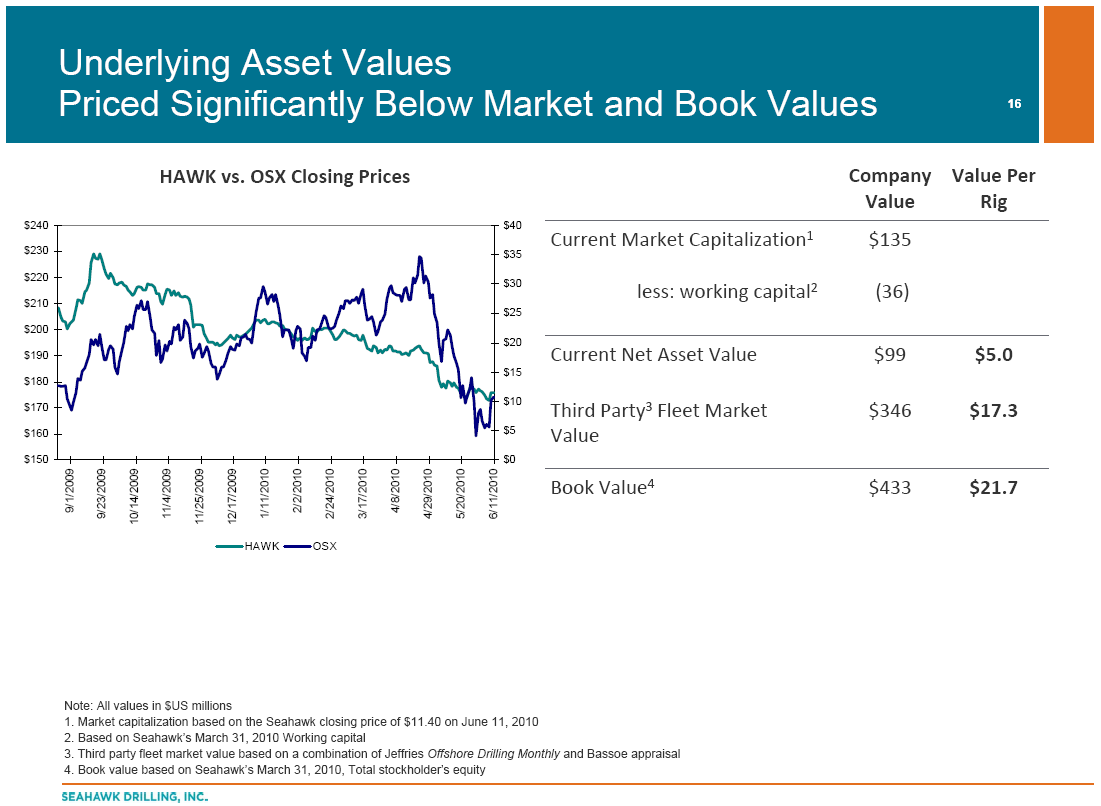
In March and April this year, ENSCO Plc (NYSE:ESV) sold three 300′ ILC rigs from the same vintage as HAWK’s rigs for ~$48M a piece (see press releases here and here). These are clearly higher specification and therefore more valuable than HAWK’s rigs, but the sales do provide some insight into recent market conditions. Here’s a chart from HAWK’s presentation (.pdf) to the Macquarie Securities Small and Mid-Cap Conference on June 15 and 16 showing comparable sales since 2004:

When 300′ ILCs have sold in the past for ~$48M, rigs comparable to HAWK’s have sold for around $15M each. HAWK is presently trading as if its rigs are worth only $6M each. Retired rigs have sold recently for between $5M and more. Hercules Offshore, Inc.’s (NASDAQ:HERO) 31 December, 2009 10K is illustrative:

Additionally, the Company recently entered into an agreement to sell our retired jackups Hercules 191 and Hercules 255 for $5.0 million each.

In June 2009, the Company entered into an agreement to sell its Hercules 100 and Hercules 110 jackup drilling rigs for a total purchase price of $12.0 million. The Hercules 100 was classified as “retired” and was stacked in Sabine Pass, Texas, and the Hercules 110 was cold-stacked in Trinidad. The closing of the sale of the Hercules 100 and Hercules 110 occurred in August 2009 and the net proceeds of $11.8 million from the sale were used to repay a portion of the Company’s term loan facility. The Company realized approximately $26.9 million ($13.1 million, net of tax) of impairment charges related to the write-down of the Hercules 110 to fair value less costs to sell during the second quarter of 2009 (See Note 12). The financial information for the Hercules 100 has historically been reported as part of the Domestic Offshore Segment and the Hercules 110 financial information has been reported as part of the International Offshore Segment. In addition, the assets associated with the Hercules 100 and Hercules 110 are included in Assets Held for Sale on the Consolidated Balance Sheet at December 31, 2008.

During the second quarter of 2008, the Company sold Hercules 256 for gross proceeds of $8.5 million, which approximated the carrying value of this asset.

The rigs have a resale value well beyond the price implied by the company’s stock. Not convinced they can all be sold as operating rigs? How about as scrap?

Scrap value

In this audio of the presentation to the Macquarie Securities Small and Mid-Cap Conference, Randy Stilley, the President and CEO of HAWK, says in relation to the slide below, that the value of the scrap steel and equipment on HAWK’s rigs is worth roughly $8M to $9M each:

Randy Stilley (at about 21 minutes into the presentation):

This is something that is just kind of amazing in a way. If you look at the underlying asset value of our rigs: five million dollars. The scrap value of a jackup is about eight or nine [million dollars], and that’s assuming that you get almost nothing for the steel and you just start taking stuff off of there; mud pumps, engines, top drives, cranes, draw works. If you start adding all that up, that alone is worth more than our current asset values based on our equity.

Now you can also say, “Well, if they’re not working, they’re not worth much,” and we’re not likely to just start cutting them up for scrap, but I think that’s kind of an interesting reference point that you don’t want to forget about because we’re trading at a very low value today.

Conclusion

If the ten cold stacked rigs are worth $80M in scrap, and the ten other operating rigs are worth $150M ($15M each), HAWK has $230M in rig value. Add HAWK’s $88M in cash and receivables, and deduct HAWK’s $164M in total liabilities, and HAWK is worth $154M in the most dour liquidation scenario. With a market capitalization of $113m, HAWK is trading at a hefty discount to this value, and HAWK is too cheap. It’s burning cash, it’s got a chunky payable to Pride and some Mexican tax issues, but subliquidation value never materializes without hair.

Hat tip BB.

[Full Disclosure: I hold HAWK. This is neither a recommendation to buy or sell any securities. All information provided believed to be reliable and presented for information purposes only. Do your own research before investing in any security.]

Further to my post yesterday on The St. Joe Company (NYSE:JOE) Chris Pavese of Broyhill Asset Management has submitted to Zero Hedge a comprehensive take on JOE:

Baron Rothschild, an 18th century British nobleman, is credited with saying, “The time to buy is when there’s blood in the streets.” Fast forward to today, and one might suggest that, “The time to buy is when there’s oil in the water.” Crisis creates opportunity for the disciplined investor, and the unfortunate disaster caused by the BP Blunder has produced one of the most compelling long term values we have ever come across. As they say, “ever” is quite a long time.

We recently watched a certain TV personality jumping up and down, like Jo-Jo The Idiot Circus Boy with a pretty new pet, and yelling at his viewers to “Sell, Sell, Sell” The St. Joe Company (JOE) after the stock had lost nearly half of its market capitalization in under two months. Viewers were told, “I know it’s got a strong balance sheet. SO WHAT! It may have acquired 477,000 acres of land in North West Florida at a very low cost. SO WHAT! . . . The risk from the oil spill is no longer a question of if, it’s not even a question of when. Now the only question is how much is this going to hurt? Could it wipe out the company??”

We’ll spare the suspense here and answer that one right up front – not a chance. The St. Joe Company has $39.5MM in debt, $27.1MM of which is offset by pledged treasury securities, and $30.6MM in maturities after 2014. The company has total liquidity of $286MM comprised of $164MM and $122MM of cash and credit facilities, respectively. A strong balance sheet may not be of much importance to speculators, but it provides long term investors with a comfortable security blanket. Not to mention, the company has 577,000 acres of land, but what’s a 100,000 acres if you’re not interested in the assets a company holds anyhow?

Later in the segment, the audience is told that, “I am not saying this company is going to go bankrupt. It’s probably not. That’s what I’m saying about BP.” We thought that last comment was particularly interesting, considering that on May 3rd, with BP trading over $50, our favorite TV personality explained that “BP’s debt to capital is really incredible” and on May 10, he told viewers that he was purchasing shares of BP for his charitable trust at just under $50. “If you get any good news at all, you’re at the bottom.”

Which leads us to our next question – why doesn’t the same hold true for JOE, a stock that is already selling at half the price it was trading at less than two months ago, with ZERO responsibility for the spill? Instead, viewers are told, “We cannot quantify the downside.” While this is certainly the case for BP, who’s costs and liabilities are rising by the day, anyone remotely interested in buying discounted Florida property, and willing to take the time to actually analyze the company’s assets, can “quantify the downside” in JOE pretty easily. At a minimum, we can get a sense for what the stock is currently pricing in. To help us determine the risk of a permanent loss of capital, we ask ourselves a few straightforward questions when considering any investment opportunity:

  1. Is the investment within our Circle of Confidence? Can we describe our thesis in one paragraph?
  2. Can we confidently estimate value in relation to price? What is an appropriate Margin of Safety?
  3. Does the business have a moat? What is the firm’s competitive advantage?
  4. Is the business run by honest and able people? Is management an efficient steward of capital?
  5. What can go wrong? How much do we stand to lose?
  6. Are we willing to invest a large part of our capital in the business?

These questions form the foundation of our investment thesis in The St. Joe Company, which is outlined below:

Buy When There’s Oil in the Water (Jun-10)

[Full Disclosure:  I hold JOE. This is neither a recommendation to buy or sell any securities. All information provided believed to be reliable and presented for information purposes only. Do your own research before investing in any security.]