Feeds:
Posts
Comments

Archive for the ‘Strategy’ Category

Bruce Murison* contacted me at the start of June with an interesting proposition: He would open a dedicated account to trade the Acquirer’s Multiple All Investable Stocks Screen and post his strategy and results on the site. He thought knowing there was a public eye keeping him on the straight and narrow might assist with his discipline (the same reason I launched Greenbackd in 2008). He wondered if a real time, real money account tracking the acquirer’s multiple’s performance would be interesting to readers of the site. I of course leapt at the opportunity. Bruce hopes that his project might encourage outside the box thinking and maybe lead to others posting their strategies and ideas that could become an interactive community of users. Here begins Bruce’s first post in what I hope will be a long series:

I am dedicating a $25,000 real money account to trade stocks ranked favorably according to The Acquirers Multiple (TAM). Every stock will be chosen and traded according to these rules:

  1. For purposes of this plan, Qualifying Stock (“QS”) is defined as the stock on the All Investable Stock Screen (“Screen”) with the lowest Acquirer’s Multiple, after excluding stocks currently held in the portfolio.
  2. The fully invested portfolio will consist of ten QS and negligible cash.
  3. The initial portfolio will be constructed over the course of the first year by buying the new QS every 36 calendar days until fully invested.
  4. When any 36th day, measured from the date of the previous purchase, falls on a day U.S. markets are closed, the QS will be bought on the next trading day.
  5. Each stock will be reviewed shortly before the one year anniversary of its purchase. If its sale would result in a loss, sell just before the one year anniversary; if a gain, sell just after.
  6. Replace each stock sold with the current QS.
  7. If, however, the stock to be sold, would, if not already held, be the new QS, do not sell but hold for review again one year later.
  8. If a portfolio stock becomes the object of a takeover or merger that closes before the one year anniversary of its purchase, reinvest in the current QS as soon as the cash is received and / or any securities received in exchange are sold.
  9. Strive, at purchase, for equal dollar weightings of each stock, to the extent possible. However, no rebalancing trades will be made during a stock’s holding period.
  10. All trades will be market-on-close.
  11. No margin will be used.
  12. The performance benchmark is the total return of the Russell 3000 Index.
Read more.

Read Full Post »

A little over a month ago I travelled to Harvard at the invitation of Michael Bigger of Bigger Capital to speak to Michael Parzen’s business statistics class on Deep Value and the acquirer’s multiple. Here is the recording of that talk.

You can get a free list of the best deep value stocks in the largest 1000 names on The Acquirer’s Multiple.

Buy my new book Deep Value: Why Activist Investors and Other Contrarians Battle for Control of Losing Corporations (hardcover or Kindle, 240 pages, Wiley Finance) from Wiley Finance, Amazon, or Barnes and Noble.

Here’s your book for the fall if you’re on global Wall Street. Tobias Carlisle has hit a home run deep over left field. It’s an incredibly smart, dense, 213 pages on how to not lose money in the market. It’s your Autumn smart read. –Tom Keene, Bloomberg’s Editor-At-Large, Bloomberg Surveillance, September 9, 2014.

Click here if you’d like to read more on Deep Value, or connect with me on Twitter, LinkedIn or Facebook. Check out the best deep value stocks in the largest 1000 names for free on The Acquirer’s Multiple.

Read Full Post »

I’ve just finished the rough draft of a new book about concentrated value investing and the investors who practice it. One of the side-effects of extreme concentration is idiosyncratic portfolio performance–concentrated portfolios behave differently from the market. This makes sense. To beat the market one must hold stocks in a different composition to the market, which in turn means performance that’s different, both to the upside and the downside. The investors interviewed in the book all have very long track records (more than 25 years) of massive outperformance, but all have endured regular and extended periods of underperformance. Such is the toll of concentrated investing.

The performance of the market–let’s say the S&P 500–is the market capitalization-weighted average performance of the largest 500 stocks in the US. In most years the performance of the aggregate doesn’t tell you a great deal about the performance of the underlying stocks. The extent to which the performance of the best stocks in the market outperform the worst stocks is known as dispersion.

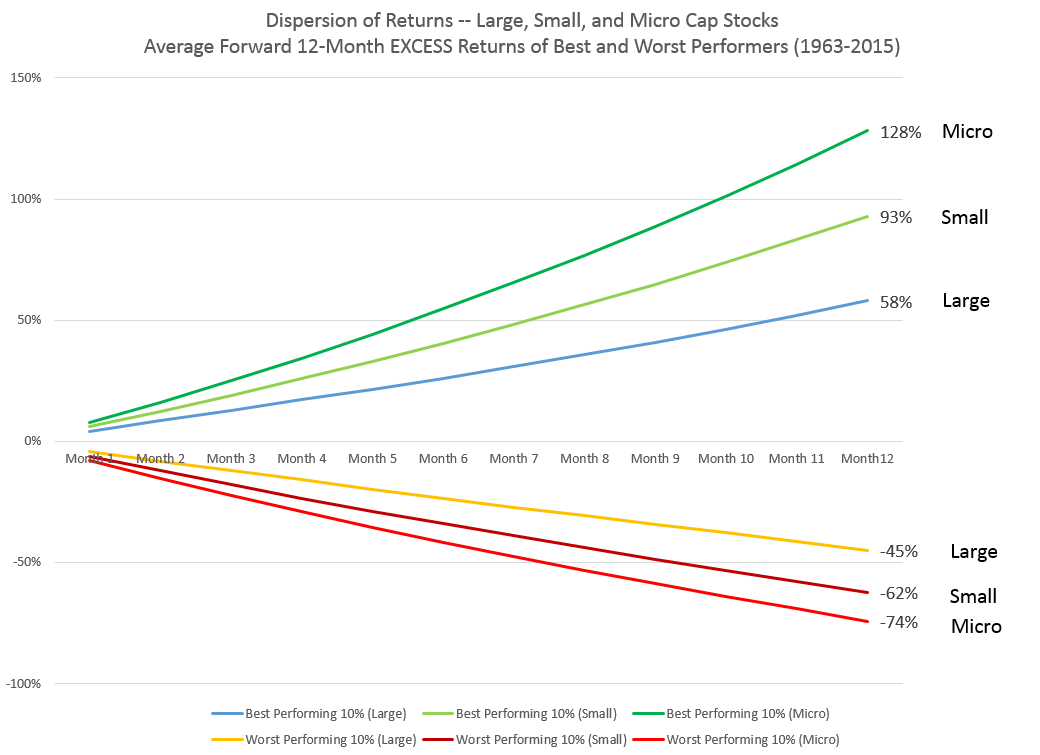
Patrick O’Shaughnessy has a great new site called The Investor’s Field Guide where he shares the results of backtests and other research he conducts. In Is Being Different Better? Dispersion and Active Management he takes a look at dispersion. In the chart below he compares the average excess returns for the best and worst performing 10 percent of stocks in three different market capitalization ranges–large, small and micro–over the last 50 years.

dispersion-of-returns-by-cap-space

These are excess total returns measured against an equal-weighted benchmark, which means, for example, the +58 percent result for the Best Performing 10% (Large) means that those stocks beat the market by 58 percent in any given year. As the chart makes clear, the smaller the stocks in the universe, the greater the magnitude of outperformance (or underperformance). Micro cap stocks offer the best opportunity for skilled stocks pickers (and the greatest opportunity to trip over). That’s dispersion.

O’Shaughnessy notes:

Since our goal is earning the highest returns possible above the market, it stands to reason that we should prefer parts of the market which offer the greatest chance of earning huge returns. … [T]hese results highlight an opportunity in micro- and small-cap investing. This is especially true for smaller, individual investors who don’t have to worry about market impact when trading. Large institutions simply can’t run meaningfully large micro-cap portfolios, and so many small stocks go unnoticed.

Check his new site The Investor’s Field Guide or read more Is Being Different Better? Dispersion and Active Management.

You can get a free list of the best deep value stocks in the largest 1000 names on The Acquirer’s Multiple.

Buy my new book Deep Value: Why Activist Investors and Other Contrarians Battle for Control of Losing Corporations (hardcover or Kindle, 240 pages, Wiley Finance) from Wiley Finance, Amazon, or Barnes and Noble.

Here’s your book for the fall if you’re on global Wall Street. Tobias Carlisle has hit a home run deep over left field. It’s an incredibly smart, dense, 213 pages on how to not lose money in the market. It’s your Autumn smart read. –Tom Keene, Bloomberg’s Editor-At-Large, Bloomberg Surveillance, September 9, 2014.

Click here if you’d like to read more on Deep Value, or connect with me on Twitter, LinkedIn or Facebook. Check out the best deep value stocks in the largest 1000 names for free on The Acquirer’s Multiple.

Read Full Post »

Josh Payne and the folks at Quantopian ran some tests on the performance of the acquirer’s multiple and Joel Greenblatt’s Magic Formula.

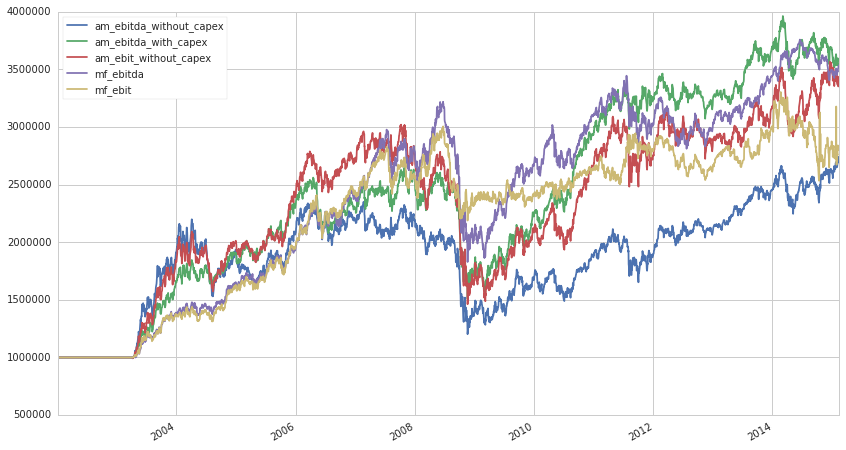
I have argued in Deep Value and Quantitative Value that the acquirer’s multiple (enterprise value / operating earnings) tends to outperform the better known Magic Formula although it is only one-half of the Magic Formula, which also includes return on invested capital. Josh and Quantopian wanted to test that idea in the Quantopian backtester.

They tested a few variations of operating earnings, including EBIT, EBITDA, and EBITDA – Cap Ex. The results were recorded in their notebook, which you can view on the site by clicking here and finding the red “View Notebook” button to the bottom right of the first screen. Here are some of the backtest results:

Quantopian Backtest

After optimizing the results, Josh and Quantopian conclude:

Taking a look at the Cumulative Returns, Sharpe Ratios, Max Drawdown, Calmar Ratios, Annual Returns, and Annual Volatility we see that the Acquirer’s Multiple beats the Magic Formula in almost every category except drawdown and annual volatility. However, given the Sharpe ratio and Calmar ratio, it seems that the volatility and drawdown is for good measure.

..

In short, Magic Formula has slightly better performance with defensive metrics like volatility and drawdawn, but the superior returns that the Acquirer’s Multiple provides proves to be worth it, as encapsulated in metrics like Sharpe Ratio and Calmar Ratio.

Simpler, it seems, really is better in this case.

Quantopian has a really cool feature: You can grab the source code for the acquirer’s multiple backtest and run variations of it using Quantopian’s backtest data, or test your own ideas. Check it out here.

You can also check out the top acquirer’s multiple stocks in the largest 1000 names for free on the acquirer’s multiple site.

Buy Deep Value: Why Activist Investors and Other Contrarians Battle for Control of Losing Corporations (hardcover or Kindle, 240 pages, Wiley Finance) from Wiley Finance, Amazon, or Barnes and Noble.

Here’s your book for the fall if you’re on global Wall Street. Tobias Carlisle has hit a home run deep over left field. It’s an incredibly smart, dense, 213 pages on how to not lose money in the market. It’s your Autumn smart read. –Tom Keene, Bloomberg’s Editor-At-Large, Bloomberg Surveillance, September 9, 2014.

Click here if you’d like to read more on Deep Value, or connect with me on Twitter, LinkedIn or Facebook.

Read Full Post »

[Sponsored Post]

The London Value Investor conference is the largest gathering of Value Investors in Europe and is Moderated by Richard Oldfield and David Shapiro. It will take place on Wednesday 20th May at the Queen Elizabeth II Conference Centre in Westminster, London. The conference will feature well known investors such as Charles Brandes, Dato’ CHEAH Cheng Hye, Jonathan Ruffer and Neil Woodford.

At the 2015 Conference, the following speakers will provide valuable insights in to their methods and approaches as well as giving specific investment ideas. The full line-up:

  • Neil Woodford, Woodford Investment Management
  • Charles Brandes, Brandes Investment Partners
  • Jonathan Ruffer, Ruffer LLP and Auckland Castle Trust
  • Dato’ CHEAH Cheng Hye, Value Partners Group
  • Hassan Elmasry, Independent Franchise Partners
  • Nathaniel Dalton, Affiliated Managers Group
  • Tim Hartch, Brown Brothers Harriman
  • Johan Du Preez, Eastspring Investments
  • Bernd Ondruch, Astellon Capital Partners
  • David Shapiro, Towers Watson (Moderator)
  • Richard Oldfield, Oldfield Partners (Moderator)

A key feature of the conference is the 10-15 minutes dedicated to audience Q&A which is led by Richard Oldfield of Oldfield Partners and David Shapiro from Towers Watson.

This will also be a unique networking opportunity as this conference is the largest gathering of value investors in Europe, we expect there will be 400 paying delegates present this year.

Click here to learn more.


Read Full Post »

The Investors Podcast

I had a lot of fun recording an interview with Stig Brodersen and Preston Pysh of The Investors Podcast on one of my favorite subjects, deep value investing. Click this link or the caricature of my head to be taken to The Investors Podcast:

The Investors Podcast Caricature


Buy Deep Value: Why Activist Investors and Other Contrarians Battle for Control of Losing Corporations (hardcover or Kindle, 240 pages, Wiley Finance) from Wiley Finance, Amazon, or Barnes and Noble.

Here’s your book for the fall if you’re on global Wall Street. Tobias Carlisle has hit a home run deep over left field. It’s an incredibly smart, dense, 213 pages on how to not lose money in the market. It’s your Autumn smart read. –Tom Keene, Bloomberg’s Editor-At-Large, Bloomberg Surveillance, September 9, 2014.

Click here if you’d like to read more on Deep Value, or connect with me on Twitter, LinkedIn or Facebook.

Read Full Post »

[Sponsored Post]

The London Value Investor conference is the largest gathering of Value Investors in Europe and is Moderated by Richard Oldfield and David Shapiro. It will take place on Wednesday 20th May at the Queen Elizabeth II Conference Centre in Westminster, London. The conference will feature well known investors such as Charles Brandes, Dato’ CHEAH Cheng Hye, Jonathan Ruffer and Neil Woodford.

Discounted tickets are available through Greenbackd–see below for more information.

At the 2015 Conference, the following speakers will provide valuable insights in to their methods and approaches as well as giving specific investment ideas. The full line-up:

  • Neil Woodford, Woodford Investment Management
  • Charles Brandes, Brandes Investment Partners
  • Jonathan Ruffer, Ruffer LLP and Auckland Castle Trust
  • Dato’ CHEAH Cheng Hye, Value Partners Group
  • Hassan Elmasry, Independent Franchise Partners
  • Nathaniel Dalton, Affiliated Managers Group
  • Tim Hartch, Brown Brothers Harriman
  • Johan Du Preez, Eastspring Investments
  • Bernd Ondruch, Astellon Capital Partners
  • David Shapiro, Towers Watson (Moderator)
  • Richard Oldfield, Oldfield Partners (Moderator)

A key feature of the conference is the 10-15 minutes dedicated to audience Q&A which is led by Richard Oldfield of Oldfield Partners and David Shapiro from Towers Watson.

For a short time you can get a£120 discount by using “GREENBACKD-20MAY” when booking (expires 14th March 2015). Click here to use the discount code.

This will also be a unique networking opportunity as this conference is the largest gathering of value investors in Europe, we expect there will be 400 paying delegates present this year.

Click here to learn more.


Read Full Post »

Click here to watch a recording of last night’s seminar on “Portfolio Construction, Concentration and Diversification for Value Investors.”

Click here to take advantage of the offer–the first month with Singular Diligence for just $10before midnight tonight.

Read Full Post »

Just a quick reminder that my webinar“Portfolio Construction, Concentration, and Diversification for Value Investors” starts in 30 minutes.

Seats are filling up fast so you’ll want to join the webinar room now to secure your spot.

Click here to register now.

Already register for today’s webinar? You should have received a custom link via email when you registered.

Can’t find the link? Click the registration link above to get a new one.

Read Full Post »

Tomorrow I’m hosting the live webinar Portfolio Construction, Concentration, and Diversification for Value Investors.” 

There are only a few spots available in the room. The webinar will focus on portfolio construction and position sizing for value investors, including the philosophy of concentrated investing and the application of Kelly theory.

The webinar is tomorrow at 7pmET.

Click here to secure your spot in this free, educational event.

Read Full Post »

« Newer Posts - Older Posts »