March 1, 2009 marked the end of Greenbackd’s first quarter, so we thought we’d take the opportunity to update you on the performance of the Greenbackd Portfolio and the positions in the portfolio, discuss some changes in our valuation methodology since our first post and outline the future direction of Greenbackd.com.
First quarter performance of the Greenbackd Portfolio
We get many questions about the content and performance of the portfolio. We had originally planned to report on a six-monthly basis, but we have now decided to report on a quarterly basis so that we can address these questions on a more frequent basis. Although it is still too early to determine how Greenbackd’s strategy of investing in undervalued asset situations with a catalyst is performing, we’ve set out below a list of all the stocks we’ve included in the Greenbackd Portfolio and the absolute and relative performance of each at the close on the last trading day in our first quarter, Friday, February 28, 2009:
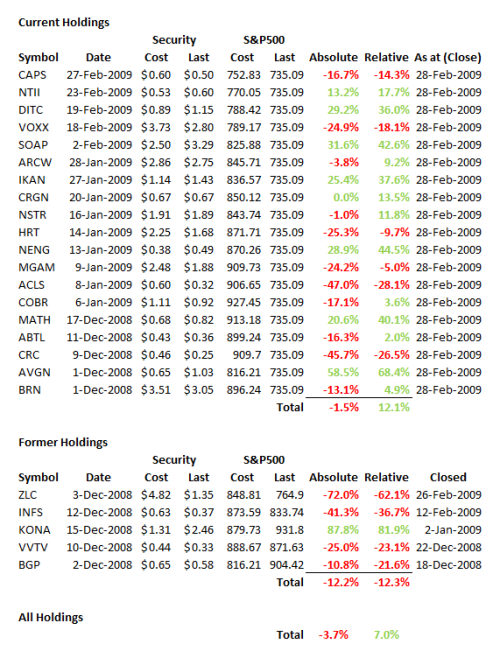 The absolute total return across the current and former positions as at February 28, 2009 was -3.7%, which was +7.0% higher than the S&P500’s return over the same periods. A negative return for the first period is disappointing, but we are heartened by the fact that we outperformed the market by a small margin.
You may have noticed something odd about our presentation of performance. The S&P500 index declined by 18.0% in our first quarter (from 896.24 to 735.09). Our -3.7% performance might suggest an outperformance over the S&P500 index of +14.3%. We calculate our performance on a slightly different basis, recording the level of the S&P500 index on the day each stock is added to the portfolio and then comparing the performance of each stock against the index for the same holding period. The Total Relative performance, therefore, is the average performance of each stock against the performance of the S&P500 index for the same periods. As we discussed above, the holding period for Greenbackd’s positions has been too short to provide any meaningful information about the likely performance of the strategy over the long term (2 to 5 years), but we believe that the strategy should outperform the market by a small margin.
Greenbackd’s valuation methodology
We started Greenbackd in an effort to extend our understanding of asset-based valuation described by Benjamin Graham in the 1934 Edition of Security Analysis. Through some great discussion with our readers, many of whom work in the fund management industry as experienced analysts or even managing members of hedge funds, we have had the opportunity to refine our process. We believe that what started out as a pretty unsophisticated application of Graham’s liquidation value methodology has evolved into a more realistic analysis of the balance sheet and the relationship of certain disclosures in the financial statements to asset value. We’re not yet ready to send it into space, but we believe our analyses are now qualitatively more robust than when we started and that has manifest itself quantitatively in better performance (more on this below).
The two main differences between our early analyses and our more recent ones are as follows (these are truly cringe-worthy, but that’s why we undertook the exercise):
- We didn’t take account of the effect of off-balance sheet arrangements and contractual obligations. This caused us to enter into several positions we should have avoided, including BGP and VVTV.
- We were using overly optimistic estimates for the recovery rates of assets in liquidation. For example, we started using 50% of Gross PP&E. We now use 20% of Net PP&E. We now apply Graham’s formula as the base case and deviate only when we believe that Graham’s formulation doesn’t reflect reality.
The effect of these two broad errors in analysis was to create several “false positives,” which is to say that we added stocks to the portfolio that wouldn’t have passed our current, more rigorous standards. The performance of those “false positive” stocks has been almost uniformly negative, and dragged down the performance of the portfolio. As an exercise, we went back through all the positions we have opened since we started the site and applied our current criteria, which are more stringent and dour than our earlier standards. We found that we would not have opened positions in the following eight stocks:
- BRN (-13.1% on an absolute basis and +4.9% on a relative basis)
- BGP (-10.8% on an absolute basis and -21.6% on a relative basis)
- COBR (-17.1% on an absolute basis and +3.6% on a relative basis)
- HRT (-25.3% on an absolute basis and -9.7% on a relative basis)
- KONA (+87.8% on an absolute basis and +81.9% on a relative basis)
- MGAM (-24.2% on an absolute basis and -5.0% on a relative basis)
- VVTV (-25.0% on an absolute basis and -23.1% on a relative basis)
- ZLC (-72.0% on an absolute basis and -61.1% on a relative basis)
It seems we got lucky with KONA, but the performance of the balance of the stocks was wholly negative. The performance across all stocks listed above was -12.5% on an absolute basis and -3.9% on a relative basis. Excluding these eight stocks from our portfolio (i.e. treating the portfolio as if we had not entered into these positions) would have resulted in a slightly positive absolute return of +0.7% and a relative performance over the S&P500 of +12.5%. This is a compelling reason to apply the more dour and rigorous standards.
We like to think we’ve now learned out lesson and the more dour and rigorous standards are here to stay. Set out below is an example balance sheet summary (for Chicago Rivet & Machine Co. (AMEX:CVR)) showing our present base case discounts from book value (circled in red):
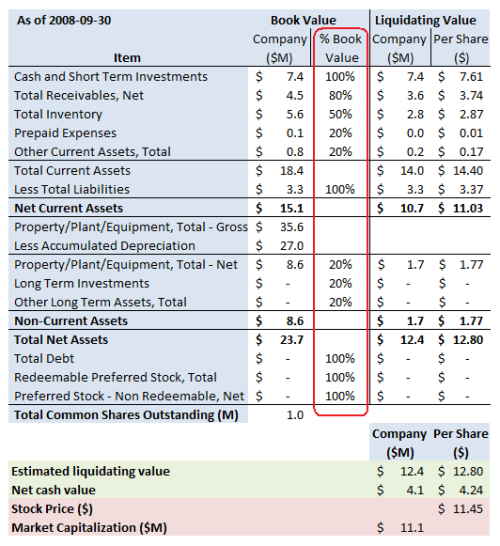
Readers will note that these are the same base case discounts from book value suggested by Benjamin Graham in the 1934 Edition of Security Analysis, more fully described in our Valuing long-term and fixed assets post under the heading “Graham’s approach to valuing long-term and fixed assets.” Why we ever deviated from these standards in the first place is beyond us.
Update on the holdings in the Greenbackd Portfolio
Leading on from our discussion above, four of the stocks we picked using the initial, overly optimistic criteria no longer meet our more stringent standards but haven’t yet been removed from the portfolio. We’re going to take our medicine now and do just that. To make it clear, these stocks aren’t being removed because the value has deteriorated, but because we made a mistake adding them to the portfolio in the first place. As much as we’d like to treat these positions as void ab initio (“invalid from the beginning”), we’re not going to do that. We’ve made a full accounting of the impact they’ve had on the portfolio in the First quarter performance of the Greenbackd Portfolio section above, but we don’t want them affecting our future performance. The stocks to be removed from the Greenbackd Portfolio and their absolute and relative returns are as follows:
- BRN (-13.1% on an absolute basis and +4.9% on a relative basis)
- HRT (-25.3% on an absolute basis and -9.7% on a relative basis)
- MGAM (-24.2% on an absolute basis and -5.0% on a relative basis)
- COBR (-17.1% on an absolute basis and +3.6% on a relative basis)
We’ll provide a more full discussion of where we went wrong with these stocks at a later date, but suffice it to say for present purposes that all were errors from the second bullet point in the Greenbackd’s valuation methodology section above (i.e. overly optimistic estimates for the recovery rates of assets in liquidation).
There are fifteen stocks remaining in the Greenbackd Portfolio:
Eight of these positions (ABTL, ACLS, ARCW, CAPS, CRC, CRGN, NSTR, and VOXX) are trading at or below our nominal purchase price and initial valuations. The remaining seven positions (AVGN, DITC, IKAN, MATH, NENG, NTII, and SOAP) are trading above our intial purchase price but are still at varying discounts to our valuations. We’ll provide a more full update on these positions over the course of this week.
The future of Greenbackd.com
We are going to trial some small changes to the layout of the site over the next few weeks. We’ve already made the first change: the newest comments now appear at the top of the list. We’ll also be amalgamating some pages and adding some new ones, including a page dedicated to tracking the portfolio with links to the analyses. We’re also considering some options for generating income from the site. At the moment, Greenbackd is a labor of love. We try to create new content every week day, and to get the stock analyses up just after midnight Eastern Standard Time, so that they’re available before the markets open the following day. More than 80% of the stocks that are currently trading at a premium to the price at which we originally identified them (NTII, SOAP, IKAN, DITC, NENG, MATH and AVGN) traded for a period at a discount to the price at which we identified them. This means that there are plenty of opportunities to trade on our ideas (not that we suggest you do that). If you find the ideas here compelling and you get some value from them, you can support our efforts by making a donation via PayPal.
We look forward to bringing you the best undervalued asset situations we can dig up in the next quarter.


 Greenbackd