Feeds:
Posts
Comments

Archive for the ‘Net Cash Stocks’ Category

Vanda Pharmaceuticals Inc. (NASDAQ:VNDA) has reported its results for the first quarter ended March 31, 2009.

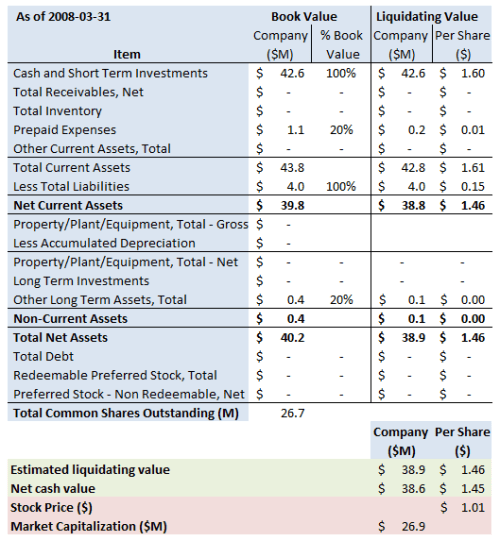
We’ve been following VNDA (see our post archive here) because it’s trading below its net cash value and Tang Capital Partners (TCP) has called for the company to “cease operations immediately, liquidate [VNDA]’s assets and distribute all remaining capital to the Stockholders.” TCP has now filed a preliminary proxy statement for the 2009 Annual Meeting urging stockholders to support TCP’s slate of two director nominees, Kevin C. Tang and Andrew D. Levin, M.D., Ph.D. The stock is up 29.5% since we initiated the position to close yesterday at $1.01, giving the company a market capitalization of $24.3M. We initially estimated the net cash value to be around $42.6M or $1.60 per share. We’ve now reduced our estimate of the net cash value to $38.6M or $1.45 per share. The company continues to hemorrhage cash, so the investment turns on TCP’s ability to get control of the board at the Annual Meeting and staunch the bleeding. If TCP cannot get onto the board quickly, the company will continue to burn cash and the investment will be a dud. VNDA has a staggered board, which makes TCP’s task difficult.

The value proposition updated

In the first quarter of 2009 VNDA burned through $3.8M in cash, which reduces our estimate of the net cash value from $42.6M to $38.6M or $1.45 per share (the remaining difference is due to the slight increase in shares on issue). Set out below is our summary balance sheet  (the “Book Value” column shows the assets as they are carried in the financial statements, and the “Liquidating Value” column shows our estimate of the value of the assets in a liquidation):

vnda-summary-2009-12-31

Conclusion

VNDA continues to be an interesting play. While the stock is up nearly 30% since we initiated the position, it is still trading at a 45% discount to our estimate of its $1.45 per share net cash value. That value is of course deteriorating rapidly, and the challenge for investors is to determine which of two outcomes is more likely: If TCP can get on the board quickly, stop the cash burn and liquidate the company, we’re likely to see a good return. If TCP cannot get onto the board quickly or at all, the company will continue to burn cash and the investment will be a dud. VNDA has a staggered board, so this will make TCP’s task difficult. We’re inclined to maintain our position and see how this plays out.

[Full Disclosure:  We do not have a holding in VNDA. This is neither a recommendation to buy or sell any securities. All information provided believed to be reliable and presented for information purposes only. Do your own research before investing in any security.]

Read Full Post »
Autobytel Inc’s (NASDAQ:ABTL) board has responded to Trilogy, Inc’s $0.35 per share tender offer, calling it “grossly inadequate” and “unequivocally” recommending that stockholders reject it.

We started following ABTL (see our post archive here) because it was trading at a substantial discount to its liquidation and net cash values and Trilogy had filed a 13D notice disclosing a 7.4% holding. Trilogy has now launched a tender offer for ABTL at $0.35 per share, which is at our estimate of ABTL’s $15.4M or $0.34 per share net cash value, but at a substantial discount to our estimate of ABTL’s $24.3M or $0.54 per share liquidation value. When Trilogy launched its offer, we wrote that we believed that $0.35 per share was only the opening salvo and a higher price was possible if the board terminated the rights plan poison pill. The stock closed yesterday at $0.515, which is a huge 47% premium to Trilogy’s offer price and suggests the market is also anticipating a higher offer. The stock is up 19.8% since we started following it in December.

Here’s the letter from ABTL:

April 27, 2009

Dear Stockholder:

On Monday, April 20, 2009, I received a letter from Trilogy Enterprises, Inc. (“Trilogy”) indicating that Trilogy had launched a tender offer for all of Autobytel Inc.’s (our “Company”) outstanding shares of common stock at $0.35 per share.

Our Board of Directors (our “Board”), in consultation with its legal and financial advisors, has evaluated Trilogy’s offer and has found Trilogy’s $0.35 offer price to be grossly inadequate and unequivocally recommends to stockholders that they reject Trilogy’s offer and not tender their shares to Trilogy.

Our Board also believes that the combination of actions taken by our Company as described below will result in our stockholders achieving significantly more value than the offer made by Trilogy. In reaching its decision to recommend that stockholders reject the Trilogy offer and not tender their shares to Trilogy, our Board considered many factors, including:

• Our Company’s strong balance sheet and current cash and receivables position, noting, in particular, that our Company’s cash position alone is substantially in excess of Trilogy’s offer.

• The initial reaction of the securities trading markets to Trilogy’s offer appears to support our Board’s decision that the offer price is inadequate.

• The recent thorough evaluation of strategic alternatives conducted by our Board, including the possible sale of our Company, which concluded that selling our Company in today’s environment was not in the best interest of maximizing value.

• The indications of interest received and offers from potential buyers for our Company as a result of the sale process.

• Inquiries made to our Company’s financial advisor by other interested parties in response to Trilogy’s offer.

• The reasons for the Board’s decision to terminate the sale process, including:

• The value of our Company’s websites; and

• The value of our Company’s intellectual property, particularly its patents, which resulted in a $20 million settlement with the Dealix Corporation in 2006 and most recently settlements with Edmunds.com, Internet Brands, InsWeb and Lead Point that will provide our Company with valuable content, images, shopping and interactive tools and data for our websites.

• Other strategic alternatives being evaluated by our Board and management team.

• The belief that Trilogy is being opportunist in exploiting a recent extreme price decline in our common stock and use of confidential information about our Company obtained by Trilogy under a non-disclosure agreement.

Based upon the above, our Board recommends that you reject Trilogy’s offer and not tender your shares of common stock for purchase by Trilogy.

In addition, we encourage you to read the enclosed Schedule 14D-9, which provides further details with regard to our Board’s recommendation and discusses the factors that our Board carefully considered and evaluated in making its decision to reject Trilogy’s offer.

If you have any questions, please do not hesitate to contact our information agent, MacKenzie Partners, Inc., at the following numbers: Toll-Free 1-800-322-2885 or at 1-212-929-5500 (collect) or by email at autobytel@mackenziepartners.com.

On Behalf of the Board of Directors,

Jeffrey H. Coats
President and Chief Executive Officer

At $0.515, ABTL has a market capitalization of $23.3M, which is approaching our estimate of its $0.54 per share liquidation value. We’re planning to maintain the position as we believe a higher bid is on the cards and Trilogy will know that it is unlikely to get sufficient acceptances at a discount to ABTL’s liquidation value.

[Full Disclosure:  We do not have a holding in ABTL. This is neither a recommendation to buy or sell any securities. All information provided believed to be reliable and presented for information purposes only. Do your own research before investing in any security.]

Read Full Post »
Ikanos Communications Inc (NASDAQ:IKAN) has acquired the assets of the Broadband Access product line from Conexant Systems, Inc. (NASDAQ: CNXT) for $54M partially funded by a sale of $42M in common stock at $1.75 per share to Tallwood Venture Capital. Upon completion of the transaction, Tallwood Venture Capital will own approximately 45% of IKAN, which means that the possibility of any catalytic event occurring is now remote. While IKAN is still trading at a discount to our calculation of its liquidation and net cash values, without a catalyst our investment thesis is gone, so we’re exiting the position.

We opened the IKAN position at $1.14 and it closed Friday at $1.37, which means we’re up 20.2% on an absolute basis. The S&P500 Index was at 836.57 when we opened the position and closed yesterday at 866.23, which means we’re up 16.6% on a relative basis.

Post mortem

We started following IKAN (see our post archive here) because it was trading at a discount to its net cash and had retained a financial adviser to “assist it in exploring and evaluating strategic alternatives to maximize shareholder value.” IKAN disclosed in its September 10Q that it had retained investment bankers to advise the board about IKAN’s strategic options:

We recently decided to retain Barclays Capital (formerly Lehman Brothers) to provide financial advice regarding potential strategic options for the Company. Such options include, without limitation, financing transactions, acquisitions, strategic partnerships, corporate restructuring and other activities. There can be no assurance that the evaluation of our options will result in the identification, announcement or consummation of any transaction. If the Board of Directors does decide to authorize a transaction, that decision could cause significant volatility in the price of the Company’s outstanding common stock. Moreover, any transactions we do sign may not be acceptable to our stockholders. In addition, our investigation of strategic options may result in added costs, potential loss of customers and key employees as well as management’s distraction from ordinary-course business operations.

We said at the time that there seemed to be some appetite for acquisitions in this industry giving the example of IKAN’s competitor Centillium Communications Inc (NASDAQ: CTLM), which was acquired in October last year. We were hoping that IKAN was to be the vendor, but it seems the “strategic option” favored by IKAN and its investment bankers is to be the acquisition of Conexant’s Broadband Access product line. Here’s the press release:

Ikanos Communications Announces Plans to Acquire Conexant’s Broadband Access Product Line

Tallwood Venture Capital Invests $42 Million

Webcast and Conference Call Details Included for this Event and for

First Quarter 2009 Financial Results

FREMONT, Calif., April 22, 2009, Ikanos Communications, Inc. (NASDAQ: IKAN), a leading provider of broadband semiconductor and software products for the digital home, today announced the signing of a definitive agreement to purchase the Broadband Access product line from Conexant Systems, Inc. (NASDAQ: CNXT). The combined organization will have the expertise and resources required to satisfy the demand for powerful broadband network products around the world.

Under the terms of the agreement, which was unanimously approved by the boards of directors of both companies, Ikanos will purchase Conexant’s Broadband Access product line for $54 million in cash and the assumption of certain employee and facility related liabilities. In connection with this transaction, Tallwood Venture Capital, a leading investment firm focused on the semiconductor industry, has agreed to purchase 24 million shares of Ikanos common stock for $42 million, or $1.75 per share. Tallwood will also receive warrants to purchase an additional 7.8 million shares of common stock at $1.75 per share. The warrants will have a term of five years. Upon completion of the transactions, Tallwood Venture Capital will own approximately 45 percent of the outstanding shares of Ikanos (excluding the warrants). In addition, following the transaction, George Pavlov, general partner, and Dado Banatao, managing partner, will join Ikanos’ Board of Directors.

Ikanos’ purchase of Conexant’s Broadband Access product line is subject to customary closing conditions, including stockholder and regulatory approvals, and is expected to be completed in the third quarter of calendar year 2009.

Ikanos expects that the transaction will more than double the Company’s revenue, while providing significant leverage in its cost and spending structure. Ikanos also expects that the transaction will be accretive to its non-GAAP earnings per share within the first year after the close of the transaction.

“With the number of home networks doubling to more than 400 million by 2013 according to analysts, there’s a substantial opportunity for Ikanos to address the need for delivering bandwidth to and throughout the home,” said Michael Gulett, president and CEO of Ikanos. “We’ll use our strengthened leadership in broadband access as a platform on which to build new offerings that extend multi-play services seamlessly everywhere they are needed.”

Today, Ikanos and Conexant account for a cumulative 330 million broadband access ports shipped, bringing the power of the Internet to millions of people around the world. Conexant’s Broadband Access product line has traditionally been strong in North America and China while Ikanos has led in Japan, Korea and Europe. The combined company will be well positioned to address the global market for broadband semiconductors, and better serve customers in all geographies.

“Customers should not be concerned about product transitions. Once the acquisition is complete, the combined company will continue to make available and support the products acquired from Conexant along with the products of Ikanos,” added Gulett.

The combination of Ikanos and Conexant’s Broadband Access product line brings together the industry’s most comprehensive portfolio of broadband access products. Ikanos will build on its status as the VDSL market share leader, will add substantial ADSL market share, and will have a broad product portfolio that includes SHDSL, 802.11 b/g wireless networking, Ethernet switching, and passive optical networking (PON). In addition, the combined company will have both MIPS- and ARM-based processors that are powering broadband access networks around the world.

The combined company will also have the expertise to enable service providers and network equipment manufacturers to effectively build advanced networks, and deploy multi-play services including high-speed Internet, Internet protocol television (IPTV), voice-over Internet protocol (VoIP) and fixed-mobile convergence (FMC) offerings. The combined organization’s customers will include a vast array of industry leading network equipment manufacturers and service providers from around the world.

“The combined company brings together a talented team of employees that pioneered and set the standards for the broadband market,” said Craig Garen, senior vice president and general manager of Conexant’s Broadband Access business. “Going forward, we’ll continue to innovate and create new broadband access and home networking products that deliver enhanced value to the marketplace.”

Both Ikanos and Conexant have been strong, active proponents of industry standards, and are advancing the development of next-generation technologies like ITU-T G.hn for whole-home networking, retransmission and the dynamic spectrum management. The combined company will have a portfolio of intellectual property that will include well over 400 patents and applications.

“This transaction brings together a powerful combination of leading products, strong customer relationships, and deep technical expertise, all dedicated to the broadband market,” said George Pavlov, general partner at Tallwood Venture Capital. “The new company that emerges will be able to compete more effectively in existing and emerging markets, develop exciting new products, and provide greater value for its most important stakeholders – its customers, investors and employees.”

IKAN is still trading at a discount to both its net cash and liquidation valuations, so it’s difficult to exit when the possibility of additional upside is good. IKAN is still burning cash, so that value will deteriorate, and our investment thesis was based on some catalytic event occurring before the value was dissipated. Tallwood Venture Capital’s 45% holding (excluding the 7.8M warrants) means that Tallwood has control, which in turn means the chance of a catalytic event occurring that could realize that value is now low. For those reasons, we’re out.

Hat tip to JM.

[Full Disclosure:  We have a holding in IKAN. This is neither a recommendation to buy or sell any securities. All information provided believed to be reliable and presented for information purposes only. Do your own research before investing in any security.]

Read Full Post »

Autobytel Inc (NASDAQ:ABTL) has received a tender offer from Trilogy, Inc. at $0.35 per share. ABTL’s board is reviewing the offer and will advise its acceptence or rejection of the offer “on or before April 24, 2009.”

We started following ABTL (see our post archive here) because it was trading at a discount to its liquidation and net cash value and Trilogy, Inc. had been creeping up the register. Trilogy held 7.4% of ABTL’s outstanding stock prior to launching the tender offer. ABTL closed yesterday at $0.39, which is an 11% premium to Trilogy’s offer price, but still at a substantial discount to our estimate of ABTL’s liquidation value. We estimate that value to be around 38% higher still at $24.3M or $0.54 per share and ABTL’s net cash value to be around $15.4M or $0.34 per share.

Here’s Trilogy’s press release:

TRILOGY ENTERPRISES ANNOUNCES CASH TENDER OFFER FOR AUTOBYTEL AT $0.35 NET PER SHARE

AUSTIN, Texas, April 20, 2009 – Trilogy Enterprises, Inc. (“Trilogy”), a provider of technology powered business services to the automotive industry, today announced that its wholly-owned subsidiary, Infield Acquisition, Inc., has commenced a tender offer to acquire all of the outstanding shares of common stock of Autobytel Inc. (Nasdaq: ABTL) for $0.35 net per share in cash.

The offer represents a 32% premium over the trailing 30-day average closing price of Autobytel’s common stock.

“We are pleased to offer a significant premium to Autobytel’s shareholders, ” stated Sean Fallon, Senior Vice President of Trilogy. “The automotive industry is experiencing an unprecedented decline and we believe that Autobytel must take steps now to ensure its shareholders receive the highest value. Given the significant risks of this business and the Company’s history of operating losses, we believe the premium offered is very attractive.”

“As Autobytel’s second largest stockholder and the beneficial owner of approximately 7.4% of Autobytel’s outstanding common stock, we have studied this business carefully. We have concluded that Autobytel’s ability to execute a turnaround and realize significant value for its stockholders is subject to significant and unacceptable risk. We believe that a high-premium, all-cash tender offer is the most effective way to maximize value for all stockholders. As a result, we have determined it is necessary to take the offer directly to our fellow stockholders in order to deliver significant value to them as expeditiously as possible,” added Mr. Fallon.

“We are confident our fellow stockholders will find that this compelling offer reflects a superior value for their shares, both in light of Autobytel’s current and recent trading history, as well as any realistic near or long term assessment of Autobytel’s prospects. We are committed to completing this offer and remain willing to work cooperatively with Autobytel,” concluded Mr. Fallon.

The tender offer is scheduled to expire at 12:01 A.M., New York City time, on Tuesday, May 19, 2009, unless extended. The tender offer documents, including the Offer to Purchase and related Letter of Transmittal, will be filed today with the Securities and Exchange Commission (“SEC”). Autobytel’s stockholders may obtain copies of the tender offer documents when they become available at http://www.sec.gov. Free copies of such documents can also be obtained when they become available by calling Morrow & Co., LLC, toll-free at (800) 662-5200.

The tender offer was detailed in a letter dated April 20, 2009 from Trilogy to ABTL’s President and Chief Executive Officer, Jeffrey H. Coats, and ABTL’s Board of Directors. The full text of the letter is set forth below:

April 20, 2009
Autobytel Inc.
18872 MacArthur Boulevard, Suite 200
Irvine, California 92612-1400
Attention: Mr. Jeffrey H. Coats, President and Chief Executive Officer

Ladies and Gentlemen:

Trilogy Enterprises, Inc. (“Trilogy”), through its affiliates, owns approximately 7.4% of Autobytel Inc.’s (“Autobytel” or the “Company”) stock and is Autobytel’s second largest stockholder. We have successfully created and delivered innovative solutions to the automotive industry for more than a decade.

We believe Autobytel is facing a crucial period in its corporate existence. The automotive market is undergoing a crisis so severe that it is difficult to adequately describe. Strong companies may find a way forward. Weak companies will undoubtedly fail.

Unfortunately, Autobytel has historically struggled to create an independently viable business. For example:

• In 2006, Autobytel incurred operating losses of $40MM on $85MM in revenue;

• In 2007, Autobytel incurred operating losses of $35MM (not including litigation settlement costs) on $84MM in revenue; and

• In 2008, Autobytel incurred operating losses of $36MM (before impairment charges and litigation settlement costs) on $71MM in revenue, which declined by 15% from the prior year.

Autobytel has itself acknowledged that the market is “extremely challenging” and it expects the U.S. automotive industry to decline more than 20% in 2009. Given the market outlook, what should stockholders reasonably expect from a company that has not proven itself viable historically?

We recognize that Autobytel has taken steps to address this crisis. However, we do not believe the steps taken are adequate to address the severity of the situation. Autobytel facing another corporate reorganization during potentially the worst market in history seems highly unlikely to prevail. The current plan appears akin to “let’s give this one last shot”. Unfortunately, shareholder cash and value is at stake.

Given Autobytel’s business prospects and the significant historical and recent operating losses, the Board should take steps now to preserve as much shareholder value as possible. We believe the only means to accomplish this is the immediate sale of the business.

We are aware that Autobytel had engaged a financial advisor to evaluate the possible sale of the Company. Autobytel announced that its advisor conducted an extensive process which resulted in Autobytel concluding that shareholder value could not be maximized in the current environment. We assume this means no buyer desired to pay a price required by the Board.

Today, our wholly-owned subsidiary has commenced a tender offer that provides stockholders with an opportunity to sell shares at $0.35 per share in cash. We believe this price is likely lower than the share price the Board aspired to obtain during the recent sale process. However, we believe it is a full and fair value for the Company and offers both an attractive premium for stockholders, as well as immediate liquidity for a stock that is thinly traded.

We hereby request that the Board support the proposed tender offer, and in doing so, consider the following:

• The offer represents a 32% premium on the stock’s trailing 30 day closing price;

• The offer provides immediate liquidity for all stockholders;

• The trading volume reported for April is less than 65,000 shares per day, on over 45 million shares outstanding;

• The Company is a sub-scale public company and may not be able to continue to bear the costs and obligations of a public company;

• The Company cannot withstand another shift in strategy during what may be the worst market in history;

• The Company may not be able to continue to bear the costs of its management team, including the lucrative packages offered to its recent hires;

• The Company recently issued executive stock options at $0.35 per share, which the Company must believe is fair value;

• The Company had $32MM in cash in September and only $27MM in December;

• The Company continues to burn cash and is likely to do so for the foreseeable future. It is reasonable to believe that the Company may run out of cash by the end of 2010;

• Without at least breakeven results, stockholder value will only continue to deteriorate until no stockholder value remains;

• Any acquiror must take on the Company’s cash burn and fund the Company in a highly uncertain environment; and

• Any acquirer may have to invest significant additional funds into the Company to make it operationally efficient and competitive.

It is time to stop the erosion in stockholder value. Looking at where Autobytel’s stock price traded a year ago is not indicative of the true value of the Company, but it should serve as a reminder of the value that was destroyed. Autobytel’s management should realistically evaluate the prospects for its business. A candid assessment of that situation should lead management to conclude that an all cash offer at a significant premium to all Company stockholders is in the best interests of the stockholders.

We are pleased to make this proposal to our fellow stockholders. We believe they will find it to be attractive in light of both the Company’s trading history, and a realistic assessment of the Company’s prospects. We are committed to completing this offer and hopeful that we will be able to work cooperatively with the Company in doing so.
We look forward to your timely response.

Sincerely,
Trilogy Enterprises, Inc.

Trilogy’s offer is a little disappointing given that it is pitched at ABTL’s net cash value and at a large discount to its liquidation value. The discount is a direct result of the poison pill adopted by ABTL in 2004. From the most recent 10K:

Preferred Shares Purchase Rights Plan

In July 2004, the Board of Directors approved the adoption of a stockholder rights plan under which all stockholders of record as of August 10, 2004 received rights to purchase shares of Series A Junior Participating Preferred Stock. The rights were distributed as a non-taxable dividend and will expire July 30, 2014.

The rights will be exercisable only if a person or group acquires 15% or more of the common stock of the Company or announces a tender offer for 15% or more of the common stock. If a person or group acquires 15% or more of the common stock, all rightholders, except the acquirer, will be entitled to acquire at the then exercise price of a right that number of shares of the Company’s common stock which at the time will have a market value of two times the exercise price of the right. Under certain circumstances, all rightholders, other than the acquirer, will be entitled to receive at the then exercise price of a right that number of shares of common stock of the acquiring company which at the time will have a market value of two times the exercise price of the right. The initial exercise price of a right is $65.00.

The Board of Directors may terminate the rights plan at any time or redeem the rights prior to the time a person or group acquires more than 15% of the Company’s common stock.

In January 2009, the stockholder rights plan was amended to allow Coghill Capital Management LLC and certain of its affiliates (collectively “Coghill”) to hold up to 8,118,410 shares without becoming an acquiring person under the stockholders rights, subject to various conditions set forth in the amendment, including Coghill’s execution of and compliance with a standstill agreement.

We believe this is the opening salvo in Trilogy’s tender offer, and a higher price is possible if the board terminates the rights plan. We’ll watch the developments with interest.

[Full Disclosure:  We do not have a holding in ABTL. This is neither a recommendation to buy or sell any securities. All information provided believed to be reliable and presented for information purposes only. Do your own research before investing in any security.]

Read Full Post »

Soapstone Networks Inc (NASDAQ:SOAP) has announced that it is reducing its headcount by approximately 40% “to reduce expenses and conserve cash in the current economic environment without diminishing the overall value of the Company.”

We been following SOAP (see our post archive here) because it is trading well below its net cash value with an activist investor, Mithras Capital, disclosing an 8.7% holding in October last year. The stock is up 40.0% from $2.50 when we initiated our position to close yesterday at $3.50, giving SOAP a market capitalization of $52.0M. We estimate the company’s net cash value to be $86.1M or $5.59 per share. We continue to believe that SOAP is a very good opportunity. The company’s ongoing business is small in comparison to its net cash position, so it shouldn’t dissipate its cash any time soon. It has no off-balance sheet arrangements, little in the way of ongoing contractual obligations and no material litigation, so the cash position seems reasonably certain. The company’s engagement of an investment bank to explore strategic alternatives is a promising step in the right direction. Of concern is the continued issuance of stock and options at a huge discount to liquidation value. The sooner Mithras Capital gets control of this situation the better.

The press release from SOAP is as follows:

Billerica, MA, April 14, 2009 – Soapstone Networks Inc. (NASDAQ: SOAP) today announced that it has undertaken an initiative to further reduce its total headcount by approximately 40%, in order to reduce expenses and conserve cash in the current economic environment without diminishing the overall value of the Company.

The Company expects to incur charges for severance and related costs of approximately $0.5 million in the second quarter of fiscal 2009 in connection with this action and anticipates overall incremental cost savings of approximately $3.0 million during 2009 as a result of these reductions, in addition to the $5.0 million in cost savings anticipated to result from the reduction in force previously announced February 12, 2009.

“We have taken these additional steps as we continue to aggressively explore strategic alternatives with the help of our financial advisor, Morgan Stanley & Co. Incorporated,” said Bill Leighton, Soapstone’s CEO. “We believe that this is a level at which we can continue with our PNC development and sales effort into the Carrier Ethernet market, while conserving a significant amount of cash.”

Hat tip to Double F.

[Full Disclosure:  We have a holding in SOAP. This is neither a recommendation to buy or sell any securities. All information provided believed to be reliable and presented for information purposes only. Do your own research before investing in any security.]

Read Full Post »

Tang Capital Partners has filed a preliminary proxy statement for the Vanda Pharmaceuticals Inc. (NASDAQ:VNDA) 2009 Annual Meeting of Stockholders urging stockholders to support Tang Capital Partners’ slate of two director nominees, Kevin C. Tang and Andrew D. Levin, M.D., Ph.D.

We’ve been following VNDA (see our post archive here) because it’s trading below its net cash value and Tang Capital Partners (TCP), has called for the company to “cease operations immediately, liquidate [VNDA]’s assets and distribute all remaining capital to the Stockholders.” The stock is up 16.7% since we initiated the position from $0.78 to close yesterday at $0.91, which gives the company a market capitalization of $24.3M. We estimate the net cash value to be around 75% higher at $42.6M or $1.60 per share. The company is hemorrhaging cash, so the investment turns on TCP’s ability to get control and staunch the bleeding. If TCP cannot get onto the board quickly or at all, the company will continue to burn cash and the investment will be a dud. VNDA has a staggered board, so this will make TCP’s task difficult.

The Background and reasons for the solicitation in the preliminary proxy statement is set out below:

Tang Capital has engaged in discussions with the Company and the Board with regards to the strategic direction of the Company. We believe that in order to maximize value for all stockholders, the Company must cease operations immediately, liquidate the Company’s assets and distribute all remaining capital to the Company’s stockholders.

Since the Company continues to operate as of the date of this Proxy Statement and has not publicly announced any plan of liquidation and dissolution, we believe the Board has rejected our proposal to immediately cease all operations, liquidate the Company’s assets and distribute all remaining capital to the Company’s stockholders. In light of the foregoing, and in order to preserve and maximize the diminishing value of the Company’s assets for the benefit of all stockholders, Tang Capital has nominated Kevin C. Tang and Andrew D. Levin, M.D., Ph.D. for election to the Board at the Annual Meeting and proposed a stockholder resolution to be voted on at the Annual Meeting whereby the stockholders will request that the Company cease operations immediately, liquidate the Company’s assets and distribute all remaining capital to the Company’s stockholders.

On February 13, 2009, Tang Capital delivered a letter (the “Letter”) to the Nominating and Governance Committee of the Company recommending Mr. Tang and Dr. Levin as nominees for election to the Board at the Annual Meeting. On the same date, Tang Capital also delivered a notice (the “Notice”) to the Company of its intention to, among other things, nominate Mr. Tang and Dr. Levin for election to the Board and propose the stockholder resolution described herein.

Since delivery of the Letter and Notice, the Board has failed to engage with Tang Capital in a dialogue on the merits of its recommendations. Tang Capital therefore decided to embark on this solicitation of proxies to elect the Nominees and approve the resolution described herein. See the information under the heading “Proposal 1 – Election of Directors” beginning on page • for additional information about the Nominees. Further, Tang Capital believes that the proposed resolution is the best way for the stockholders to let the Board know what the stockholders consider to be the best direction for the future of the Company in a manner that is quantitative, clear and indisputable.

[Full Disclosure:  We do not have a holding in VNDA. This is neither a recommendation to buy or sell any securities. All information provided believed to be reliable and presented for information purposes only. Do your own research before investing in any security.]

Read Full Post »

ARC Wireless Solutions (NASDAQ:ARCW) has filed its 10K for the year ended December 31, 2008. In a disappointing development, ARCW has entered into a “financial advisory engagement” with a Brean Murray Carret and Mr. Hassan Nemazee for “financial advisory and business consulting services, including restructuring services,” pursuant to which ARCW pays fees for services. Over the life of the agreement to 2013, ARCW will pay no less than $1.5M. The agreement means that Brean Murray Carret will earn more than other shareholders by running the business and has no incentive to create a catalytic event in ARCW. That means our investment thesis is gone and we’re exiting on that basis. We opened the ARCW position at $2.86 and it closed yesterday at $2.75, which means we’re down 3.85% on an absolute basis. The S&P500 Index was at 845.71 when we opened the position and closed yesterday at 843.88, which means we’re down 3.63% on a relative basis.

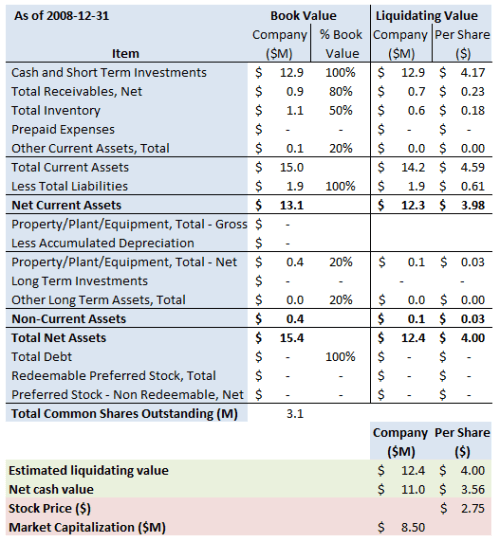
We started following ARCW on January 28, 2009 (see our post archive here) because it was a net cash stock with an activist investor, Brean Murray Carret, disclosing a 13.9% position on November 3 last year. ARCW closed yesterday at $2.75, giving it a market capitalization of just $8.5M. We initially estimated its liquidation value to be around $13.9M or $4.49 per share. After reviewing the 10K, we’ve now reduced our estimate of the liquidation value to $12.4M or $4.00 per share. The decrease is mostly attributable to cash used to fund operating losses in 2008. Brean Murray Carret’s original 13D filing disclosed its intention to tip out ARCW’s board and “nominate an alternative slate of directors for election to [ARCW’s]’s Board of Directors at the earliest possible opportunity.” Its subsequent 13D filing indicated that this occurred quickly, and Brean Murray Carret’s nominees were elected by the board of ARCW on November 12, 2008. Unfortunately for us, it seems Brean Murray Carret will run the business rather than realize the assets.

The value proposition updated

ARCW is a loss-making, generally cash-consuming company. The company’s balance sheet has, however, retained some value (the “Book Value” column shows the assets as they are carried in the financial statements, and the “Liquidating Value” column shows our estimate of the value of the assets in a liquidation):

arcw-summary-2008-12-31

Off-balance sheet arrangements and contractual obligations

According to the 10K, ARCW has no off-balance sheet arrangements and its contractual obligations are $0.9M in total.

The value remaining on ARCW’s balance sheet is as a result of its sale in 2006 of its wholly owned subsidiary Winncom for $17M. The company has since burned through some of that cash, but it does still have a net cash value of $11.0M or $3.56 per share.

The catalyst

We missed this in our initial analysis, but fortunately commenter Chad was awake. One disappointing development in ARCW since Brean Murray Carret got control of the board has been the company’s entry into a “financial advisory engagement” with Quadrant Management, Inc., which is under common control with Brean Murray Carret and Mr. Hassan Nemazee. Between them, they beneficially own 27.5% of ARCW. Pursuant to the “financial advisory engagement,” Quadrant provides to ARCW “financial advisory and business consulting services, including restructuring services.” ARCW pays the following: 1) an initial cash fee of $250,000; 2) an annual fee of the greater of (i) $250,000, or (ii) 20% of any increase in reported earnings before interest, taxes, depreciation and amortization after adjusting for one-time and non-recurring items for the current financial year over preceding year, or (iii) 20% of reported EBITDA for the current financial year, and; 3) all reasonable out-of-pocket expenses incurred by Quadrant in performing services under the engagement.

[Full Disclosure:  We do not have a holding in ARCW. This is neither a recommendation to buy or sell any securities. All information provided believed to be reliable and presented for information purposes only. Do your own research before investing in any security.]

Read Full Post »

Biotechnology Value Fund (BVF) failed in its bid to remove Avigen Inc’s (NASDAQ:AVGN) board at Friday’s special meeting of stockholders, despite 58% of stockholders voting in favor of removing the board and only 12% voting in favor of retaining the incumbents.

The outcome highlights the difficulties faced by stockholders in selecting rival slates of directors. To succeed, BVF required affirmative votes from two-thirds of all AVGN’s stockholders, which, as we’ve pointed out previously, was a very high threshold. To use the example we used last time, if only 10% of AVGN’s voters failed to vote, BVF required almost three-quarters of the vote from those actually casting a ballot. With 30% of stockholders failing to cast a ballot at the special meeting Friday, BVF’s task was herculean, requiring 96% of the ballots cast to be in BVF’s favor. It’s possible that stockholders who didn’t vote at all purposely abstained knowing that it would count against BVF, and they did therefore express their voting intentions. It’s also possible that they failed to vote for myriad other reasons, including not receiving the documents in time, not understanding the documents, not caring or not understanding that failing to vote counted as a vote for the incumbents. Of the stockholders casting a ballot, their intentions were clear. BVF received approximately 83% of the votes actually cast by AVGN stockholders (58%/70%). Excluding BVF’s own ballots from the calculation above (~30%), BVF still received approximately 70% of the votes (28%/40%). In either case, a strong endorsement of BVF’s slate, but insufficient to carry the day.

Despite BVF’s failure to remove the board, we’re going to maintain our position in AVGN. BVF has won a number of important concessions from the board that make AVGN a much more attractive stock than it was when we started following it in December last year (see archived posts here). The stock price also reflects this: AVGN is up 89% from $0.65 when we initiated the position to close on Friday at $1.23. We opened our position because AVGN was a net cash stock (i.e. it’s trading at less than the value of its cash after deducting all liabilities), albeit a cash burning net cash stock, and BVF was pushing it to liquidate and return its cash to shareholders. While BVF’s slate was not successful at the special meeting, AVGN’s board now plans to develop its own plan of liquidation, which should put a floor on AVGN’s stock at around its net cash value of $37M or $1.24 per share less wind down costs. There exists a good chance that AVGN will yield considerably more than its net cash value. The net cash estimate does not take into account AVGN’s AV411 assets and program or near term payments from Genzyme, which could be worth as much as $6M to $25M or between $0.18 or $0.75 per share more (Thanks Double F). With the downside protected, and a good chance at a substantial $0.18 or $0.75 per share upside from here, we think AVGN still represents good value, and we’re going to maintain our position accordingly.

BVF’s press release is as follows:

Biotechnology Value Fund, L.P. Announces Overwhelming Support to Remove the Board of Directors of Avigen, Inc. at Special Meeting of Stockholders

Friday March 27, 2009, 1:10 pm EDT

Concurs with Avigen’s decision to return capital to stockholders through liquidation

A decisive victory for stockholder democracy

SAN FRANCISCO, March 27 /PRNewswire/ — Biotechnology Value Fund, L.P. (“BVF”), today announced that stockholders of Avigen (Nasdaq: AVGN – News) voted overwhelmingly to remove the existing Board of Directors of Avigen and replace them with BVF’s nominees. The vote took place earlier today at the special meeting of Avigen stockholders called by BVF. The preliminary vote count was approximately 58% in favor of removing Avigen’s entire Board and 12% against removal.

Additionally, yesterday Avigen finally offered what BVF and stockholders have consistently sought but Avigen had steadfastly resisted: quantified downside protection. Specifically, Avigen announced yesterday that it would terminate merger discussions, implement a plan of liquidation and return at least $1.20 per share to all stockholders. BVF supports Avigen’s decision, albeit a late one, and intends to work constructively with the Board to maximize the return to stockholders. Since the removal of the Board required the affirmative vote of 66 2/3% of the outstanding shares — a very high hurdle — the existing Board will remain in office and manage the liquidation.

Mark Lampert, BVF Founder and President stated, “This is a great day for stockholder democracy — stockholders have spoken and their wishes have prevailed. Avigen’s remaining capital will not be squandered but, instead, will be returned to stockholders so that each may decide how best to utilize their capital. For our part, we will look to reinvest the proceeds into the most promising small cap biotechnology companies that have the greatest potential to improve peoples’ lives. In the current economic environment, the capital preserved through Avigen’s liquidation may be the difference between success and failure of important new medicines.”

Oleg Nodelman, a Portfolio Manager with BVF added, “We are deeply appreciative of the trust and support placed in us by the majority of Avigen stockholders. We believe their resounding support was directly responsible for the Board’s decision to discontinue its risky merger discussions and to commence with a plan of liquidation. We are disappointed that Avigen did not offer downside protection sooner so that the significant capital consumed during this proxy contest could have been returned to stockholders months ago. We also wish to acknowledge the constructive and bold efforts of MediciNova throughout this process. We encourage Avigen to engage with MediciNova during the liquidation process; we intend to be helpful in this regard.”

BVF’s existing tender offer will terminate because BVF’s nominees were not elected at the special meeting.

[Full Disclosure: We have a holding in AVGN. This is neither a recommendation to buy or sell any securities. All information provided believed to be reliable and presented for information purposes only. Do your own research before investing in any security.]

Read Full Post »

Avigen Inc (NASDAQ:AVGN) has discontinued its merger discussions and terminated its Chief Executive Officer and President, Kenneth Chahine, its Chief Business Officer, Michael Coffee, and its General Counsel, M. Christina Thomson, ahead of the special meeting of stockholders to be held today. Stockholders are to vote on BVF’s proposal to remove the board of AVGN and elect Biotechnology Value Fund’s (BVF) slate of director nominees. AVGN “intends to develop a plan of liquidation” following the special meeting if BVF’s nominees are not elected to the board, which now seems unlikely.

We’ve been following AVGN (see archived posts here) because it’s a net cash stock (i.e. it’s trading at less than the value of its cash after deducting all liabilities) and specialist biotechnology investor BVF has been pushing it to liquidate and return its cash to shareholders. MediciNova Inc (NASDAQ:MNOV) has made an offer for AVGN that we think represents a clever way for AVGN’s stockholders to receive cash equivalent to that which they would receive in a liquidation (less $7M to be paid to MNOV) with the possibility for “an extraordinary, uncapped return” if MNOV is successful post-merger. BVF has offered $1.20 for each share of AVGN, which is up from its initial offer of $1.00. The stock is up 81.5% from $0.65 to close at $1.18 yesterday. We estimate AVGN’s net cash value to be $37M or $1.24 per share (BVF estimates $1.20 per share). The net cash estimate does not take into account AVGN’s AV411 assets and program, which could be worth considerably more, perhaps as much as $5M to $20M or between $0.15 or $0.60 per share.

AVGN’s amended proxy filing sets out a series of discussions between AVGN and BVF leading up to yesterday’s announcement:

Later in the day on March 20, 2009, RBC contacted BVF with the intent to negotiate an increase in the Offer price to compensate the remaining stockholders for the value of Avigen’s AV411 assets and potential Genzyme milestone payments that Avigen believed were not reflected in the revised Offer price.

Over the weekend of March 20-22, 2009 Avigen’s advisors and BVF discussed a proposal by Avigen to work together to maximize stockholder value. Among other things, Avigen’s advisors proposed that Avigen would share with BVF for its consideration and input, following execution by BVF of an appropriate confidentiality agreement, the proposals received by Avigen relating to potential strategic transactions.

On March 23, 2009, BVF requested that Avigen have its counsel and financial advisors prepare an agreement between Avigen and BVF that would allow BVF to actively review and participate in negotiating the strategic proposals under consideration, including the proposal from MediciNova, to determine if Avigen and BVF could jointly agree on a proposal to present to stockholders for a vote, and with the other terms provided below, as well as the terms of a joint press release announcing these arrangements.

The draft agreement prepared on behalf of Avigen and submitted to BVF on March 24, 2009 provided that if the parties agreed on a strategic transaction, BVF would sign a tender and/or voting agreement in favor of the transaction recommended by the Board and presented to stockholders for approval. The draft agreement further provided that if no agreement for a strategic transaction were signed with a third party by May 8, 2009, Avigen would begin a formal liquidation process, with the goal of distributing at least $1.00 per Share to stockholders. Avigen’s obligations under the draft agreement were explicitly subject to a customary fiduciary out.

The draft agreement also provided that BVF would not modify its revised Offer of $1.20 per Share and that Avigen would reserve the right at any time during the process to terminate the Rights Agreement, support the revised Offer and support the BVF nominees, if the Board determined that such actions were in the best interests of stockholders.

On March 24, 2009, a representative of BVF stated to a representative of Avigen that it would not enter into the draft agreement.

On March 25, 2009, the Board met and reviewed Avigen’s alternatives, in light of BVF’s rejection of the draft agreement and the difficulty of obtaining stockholder approval for any strategic transaction without BVF’s support.

On March 26, 2009, Avigen issued a press release announcing the Board’s recommendation with respect to the revised Offer and the termination of the employment of certain corporate officers.

The AVGN press release is as follows:

Avigen Board Discontinues Strategic Merger Discussions to Develop a Plan for Liquidation

Avigen Board Neutral on Tender Offer

Alameda, CA, March 26, 2009 – Avigen, Inc. (Nasdaq: AVGN), a biopharmaceutical company, today announced that its Board of Directors has discontinued its strategic merger discussions and intends to develop a plan of liquidation following the special meeting of stockholders on March 27, 2009 if the BVF Nominees are not elected to the Board. The Board also announced that it reviewed the conditional offer from BVF Acquisition LLC and its affiliates to acquire all of the outstanding shares of Avigen. The Board, after a thorough review with management and its financial and legal advisors, is expressing no opinion and is remaining neutral with regard to the tender offer.

In taking a neutral stance on the tender offer, the Board noted the following:

* The Board believes that the offer price of $1.20 per share is approximately the company’s current net cash value less wind down costs, but does not reflect the value for the company’s other assets, including its AV411 pain and addiction program and rights to future payments from Genzyme Corporation.

* The Board recognizes the preference of some shareholders for immediate and certain liquidity.

* The Board believes it can deliver more than $1.20 per share from net cash assets less wind down costs, rights to approximately $6 million ($0.20 per share) of near-term Genzyme payments and the sale of AV411.

* BVF has stated that it intends to pursue a transaction with MediciNova, which the Board does not believe under the current terms would be in the best interests of stockholders.

“Based on the actions taken by BVF, Avigen’s Board believes its ability to pursue the strategic alternatives that the Board believes will increase stockholder value is all but foreclosed,” stated Zola Horovitz, Ph.D., Avigen’s Chairman of the Board. “Our Board has established a responsible pattern for dealing decisively with strategic issues, as demonstrated following the negative data from the company’s AV650 clinical trial in October 2008. While our Board considers the inability to continue its strategic process unfortunate, it has abandoned discussions for a strategic transaction and intends to develop a plan that will maximize liquidation value. As such, the Board determined that the company no longer needs to retain the services of the majority of its employees that were supporting strategic discussions and has reduced its headcount accordingly.”

The officers of the company included in the headcount reduction were Kenneth Chahine, Chief Executive Officer and President, Michael Coffee, Chief Business Officer, and M. Christina Thomson, General Counsel. Taking over as Chief Executive Officer and President is Andrew Sauter, the company’s Chief Financial Officer.

[Full Disclosure: We have a holding in AVGN. This is neither a recommendation to buy or sell any securities. All information provided believed to be reliable and presented for information purposes only. Do your own research before investing in any security.]

Read Full Post »

VaxGen Inc (OTC:VXGN) is a bread-and-butter play for us. The company is trading at a substantial discount to its net cash position, has ended its cash-burning product development activities and is now “seeking to maximize the value of its remaining assets through a strategic transaction or series of strategic transactions.” If the company is unable to identify and complete an alternate strategic transaction, it proposes to liquidate. At its $0.48 close yesterday, VXGN has a market capitalization of $15.9M. We estimate the net cash value to be around 80% higher at $27.7M or $0.84 per share. VXGN has other potentially valuable assets, including a “a state-of-the-art biopharmaceutical manufacturing facility with a 1,000-liter bioreactor that can be used to make cell culture or microbial biologic products” and rights to specified percentages of future net sales relating to its anthrax vaccine product candidate and related technology.  We’ve added it to the Greenbackd Portfolio.

About VXGN

VXGN is a biopharmaceutical company based in South San Francisco, California. The company was incorporated on November 27, 1995. During 2002 through 2006, VXGN developed vaccines against inhalation anthrax and smallpox for the purpose of biodefense. In December 2006, the Department of Health and Human Services (HHS) terminated its contract with VXGN for the development and delivery of a next-generation anthrax vaccine. Following the HHS decision, VXGN ceased actively developing its anthrax vaccine, scaled back its biodefense activities and began pursuing strategic and other alternatives. The company has now ended all product development activities and sold or otherwise terminated its drug development programs.

The value proposition

VXGN’s earnings and cash flow history is emblematic of many biotechnology companies. In its almost two decades in existence, it has produced no marketable products, raised around $300M and burned through almost $270M of that amount. VXGN has now taken steps to minimize its cash burn, reducing its workforce to three employees, terminating its anthrax and smallpox development activities and selling the assets related to its anthrax product candidate. The company’s value rests on its vestigial holding of cash and equivalents (the “Book Value” column shows the assets as they are carried in the financial statements, and the “Liquidating Value” column shows our estimate of the value of the assets in a liquidation):

vxgn-summaryWe estimate the liquidation value to be around $28.4M or $0.86 and the net cash value to be around $27.7M or $0.86 per share.

There is the possibility that VXGN is worth considerably more than this amount. Under the terms of the sale of its assets and rights relating to its anthrax vaccine product candidate and related technology to Emergent BioSolutions Inc, (Emergent), Emergent may be obligated to pay VXGN up to an additional $7M in milestone payments, plus specified percentages of future net sales for 12.5 years beginning from the first commercial sale. VXGN has also listed its “a state-of-the-art biopharmaceutical manufacturing facility with a 1,000-liter bioreactor that can be used to make cell culture or microbial biologic products.”

Off-balance sheet arrangements and contractual obligations

According to VXGN’s 10K for the year ended December 31, 2008, it has no off-balance sheet arrangements.

One concern for us is the lawsuit against VXGN by its landlords, in which they seek $22.4M:

In February 2009, a lawsuit was filed against VaxGen by plaintiffs, Oyster Point Tech Center, LLC. The plaintiffs generally allege that the Company defaulted on the lease on the 349 Oyster Point, South San Francisco facility. The complaint seeks possession of the premises and the balance of lease plus unpaid rent and expenses totaling $22.4 million, as well as an award of plaintiffs’ attorneys’ fees and costs.

We may incur substantial expenses in defending against such claim, and it is not presently possible to accurately forecast the outcome. We do not believe, based on current knowledge, that the foregoing legal proceeding are likely to have a material adverse effect on its financial position, results of operations or cash flows. In the event of a determination adverse to VaxGen, we may incur substantial monetary liability that could have a material adverse effect on the Company’s financial position, results of operations or cash flows.

If the lawsuit is succesful, then VXGN has next to no value.

Catalyst

According to the 10K, the company is considering various alternate strategic transactions to return value to its stockholders. VXGN has ended all product development activities, sold or otherwise terminated its drug development programs and is now seeking to maximize the value of its remaining assets through a strategic transaction or series of strategic transactions. If the company is unable to identify and complete an alternate strategic transaction, the company will liquidate. A Harper’s Magazine article, “Flaws in the BioShield: VaxGen looks for another federal bailout,” details a sordid history of “disturbing ethical failures in the area of human-subject drug testing” and management incompetence.  The article concludes:

Based on VaxGen’s string of failures, giving the firm another stay of execution might not just be wasteful, but criminally negligent as well.

That was in 2006. The company has managed to limp along since then, but we think it’s time to take this rooster to the chopping block.

Conclusion

With its stock at a substantial discount to its net cash position, its cash-burning product development activities at an end and a proposal to identify and complete an alternate strategic transaction or liquidate, VXGN is a good prospect. At its $0.48 close yesterday, it has a market capitalization of $15.9M. We estimate the net cash value to be around 80% higher at $27.7M or $0.84 per share. VXGN has other potentially valuable assets, including rights to portion of future net sales on its anthrax technology and a state-of-the-art biopharmaceutical manufacturing facility. One concern is that the company may seek to continue as a biotechnology company, rather than liquidating. We hope this outcome doesn’t eventuate. We’ve added it to the Greenbackd Portfolio.

VXGN closed yesterday at $0.48.

The S&P500 Index closed yesterday at 831.88.

Hat tip to Wes Gray.

[Full Disclosure:  We do not have a holding in VXGN. We now have a holding in VXGN. This is neither a recommendation to buy or sell any securities. All information provided believed to be reliable and presented for information purposes only. Do your own research before investing in any security.]

Read Full Post »

« Newer Posts - Older Posts »