Feeds:
Posts
Comments

Archive for the ‘Activist Investors’ Category

Greenbackd is dedicated to unearthing undervalued asset situations where a catalyst exists likely to remove the discount or unlock the value. My favorite stocks are those trading at a substantial discount to net current assets or liquidation value, with an activist pushing for a catalyst to unlock the value. Those opportunities, however, are few and far between. I can frequently find deeply undervalued asset situations with no obvious catalyst. I can often also find activists in stocks that are not undervalued on a Graham asset basis.

A little over a year ago in a post titled Net Net vs Activist Legend I started a thought experiment pitting Dataram Corporation (NASDAQ:DRAM), a little Graham net net, against activist investing legend Carl Icahn and his position in Yahoo! Inc. (NASDAQ: YHOO) (click on the links to laugh at how rudimentary Greenbackd looked then). The idea was simple: Compare the performance of two stocks, one a net net / net cash stock lacking a catalyst, and the other a stock not obviously undervalued on an asset basis, but nonetheless pursued by an activist investor, Carl Icahn.

In the blue corner, YHOO, the super heavyweight

Here’s what I had to say about YHOO at the time:

YHOO is a stock that is not cheap on an asset basis but it does have a prominent activist investor with a 5.5% stake and two seats on the board. At its Friday close of $11.66, which is around two-thirds lower than Microsoft’s May 2008 $33 bid, YHOO still trades at a 70% premium to our $6.82 per share estimate of its asset value. Activist investor Carl Icahn’s presence on the register, however, indicates that he believes YHOO is worth more. Icahn has paid an average of $23.59 per share to accumulate his 5.5 percent stake. At $11.66, YHOO must more than double before Icahn will see a profit. He’s unlikely to sit idly by to see if that happens.

YHOO is not cheap on any theory of value we care to employ. It is trading at a substantial premium to its asset backing, which means the market is still generously valuing its future earnings. It is generating substantial operating cash flow and earnings, which in a better market might be worth more, but it’s not obviously cheap to us.

The best thing about YHOO from our perspective is the presence of Carl Icahn on the register. His holdings were purchased at much higher prices than are presently available and he is unlikely to sit idly by while the stock stagnates.

Buying YHOO at these prices is a bet that Icahn can engineer a deal for the company. Given his legendary status as an activist investor earned through canny acquisitions over many years, we think that’s a good bet. But a bet is what it is – it’s speculation and not investment. If speculation is your game, then we wish you the best of luck but know that the price might fall a long way if he sells out. If you’re an investor, the price is too high.

YHOO closed Friday at $11.66 and the S&P 500 Index closed at 876.07.

And in the red corner, DRAM, a light flyweight

Here’s my take on DRAM’s chances:

DRAM, at 58% of its liquidating value and 76% of its cash backing, is very cheap. We believe that it is worth watching but, with no obvious catalysts and a high cash burn rate, probably one to avoid unless you are willing to bet that its remaining cash might attract an activist or the business will turn around before it runs out of money.

The risk with DRAM, as it is with any net net or net cash stock, is that the company might not make a profit any time soon and won’t liquidate before it dissipates its remaining cash. As we said above, we’ve got no insight into DRAM’s business and don’t know whether it can trade out of its present difficulties and back to at least a positive operating cash flow. According to the 10Q, the company is authorized to repurchase 172,196 shares under a stock repurchase plan but this is an immaterial amount in the context of the 8.9M shares on issue and the plan has been in existence since 2002. The best hope for the stockholders is that the company re-institutes its dividend, which, given its $16M in cash, it certainly seems able to do. No noted activists have disclosed a holding in the company, which means management have no incentive to do anything so stockholder friendly.

Let’s get ready to rumbllllllllllllllllllllllllle…..

Here’s the call of the fight:
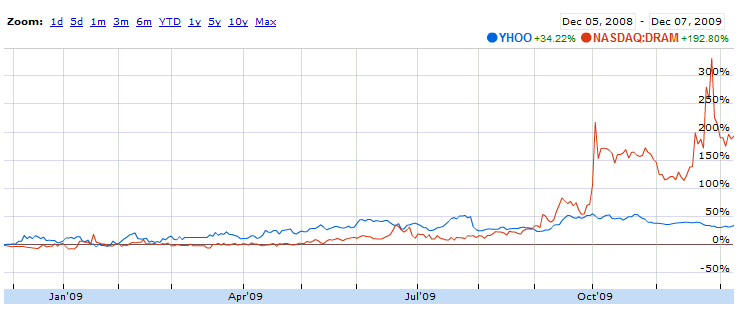
The first 10 rounds were to YHOO, but DRAM landed a crushing blow at the end of the 10th. From there, DRAM pounded away while YHOO got the staggers. At the final bell, YHOO managed a respectable 34.2%, but it wasn’t in DRAM’s league, up an incredible 192.8%.

Post mortem

There’s nothing statistically significant about this little experiment, but, regardless, I think it’s interesting. As I’ve discussed in previous posts, small investors have a huge advantage over larger, professional investors. There is nothing easier to analyse than a Graham net net or liquidation play (here’s my post on Graham’s liquidation value methodology), and, as Professor Henry Oppenheimer demonstrated, the returns to a very simple buy-and-hold-for-a-year-and-repeat strategy will put investment professionals to shame. Graham’s methodology is robust and has withstood the test of time. With a little patience, investing like Graham did provides a tailwind that forgives many investing sins. Here’s to the little guys.

Gonna fly now

Go. Go. Go. Go. Go. Goooooooooo…..
Read Full Post »

Carl Icahn recently gave a guest lecture to Professor Robert Shiller’s Yale Financial Markets class.

In the lecture, Icahn talks about how he started out in finance and evolved into a shareholder activist. He trots out a few of his old saws: the biggest challenge facing corporate America is weak management and today’s CEOs, with exceptions, might not be the most capable of leading global companies. He also discusses the economy and slaps down an undergrad Yalie who has the temerity to have him repeat an answer, which is fun to watch. There are a few gems, including this one:

I was borrowing money and bought all these convertibles and I thought I was a genius and Jack Dreyfus said, you’re going to lose all your money. I had made a few bucks playing poker and that’s how I started with about eight, ten thousand dollars and I made all this money by borrowing at 90%. I would go out and I was making a lot more in two weeks than my father made in two years. My father said, well you know, put the money away. I said, no Dad, I’m really going to make a fortune here. So, I went out–I remember once–and bought a Galaxy convertible. It was a beautiful car. I had a beautiful girlfriend; she was a model–it was just pretty nice.

What happened? The crash came in 1962. I was wiped out in one day; I didn’t even have the poker winnings left. I tell you, I can’t recall if the car left first or the girl left first, but it was pretty close–maybe the same day actually. After that, I learned you have to learn something and I became an expert in options.

Here’s Icahn on his investment strategy:

What I do today still is pretty much the same idea. You buy stocks in a company that is cheap and you look at the asset value of the companies that you buy the stocks in and it becomes a little more complex. Basically, you look for the reason that they’re really cheap and the major reason is often–and usually–very poor management. In a sense, it’s like an arbitrage. You go in; you buy a lot of stock in a company; and you then try to make changes at the company. Today, if you read the newspapers tomorrow, you’ll read–we’re trying to do the same thing at Motorola and if you bother to read The Wall Street Journal tomorrow–or maybe The Times, I don’t know–you’ll see a little bit of what we’re trying to do there. We’re trying to get them to change the structure of the company. We think the board is a very poor board there and we’re trying to change what happens.

And, finally, Icahn responding to a question about activism:

Student: Hi, Mr. Icahn. One major criticism that one CEO against corporate activist that they think activists don’t think long-term interest of the corporation; they just want to get money and get out. How do you answer to that?

Icahn: I would just say that the facts don’t bear that out as far as I’m concerned. I mean, if you–I own quite a few companies. Any company we got control of I put literally hundreds of millions of dollars into them. I mean, I bought a company in 1985–a rail car company–we put hundreds of millions; we still have the fleet. I bought casinos and energy companies and over the years kept them; sold them now, but that’s after ten years. So, any company that we’ve been able to get control of I actually kept. Because getting control is a great thing. If you really believe that management’s not doing well, you can go and clean them up and put a good guy in, So, we–I know they criticize you like that, but that’s part of the propaganda machine; but it’s just not the facts.

Student: A related question is that, what do you do when your activist spirit is not appreciated, as in the case of Motorola when you asked for a seat on the board but just get declined? What’s your next step?

Icahn: Alright, you have patience and now it’s a year later and we’ll see what happens now. Motorola is a good example of what I’m talking about. People don’t like it; they don’t like the cell phone business, but I really think that that business, if you look at Motorola and study it, you’re buying that whole business for nothing. It’s not reflected in the stock price, but they have to do it. As I said publicly, take that business out of Motorola; spin it off and give it to the shareholders. I think, then, you’ve got a real good value. What I’m saying is, nobody likes it now, but hopefully I’m correct on that. I really think by being an activist and putting pressure on that board that has done nothing, really–I think eventually that will happen, hopefully.

Hat tip Mark.

Read Full Post »

November 30, 2009 marked the end of Greenbackd’s fourth quarter and first year, and so it’s time again to report on the performance of the Greenbackd Portfolio and the positions in the portfolio, and outline the future direction of Greenbackd.com.

Fourth quarter 2009 performance of the Greenbackd Portfolio

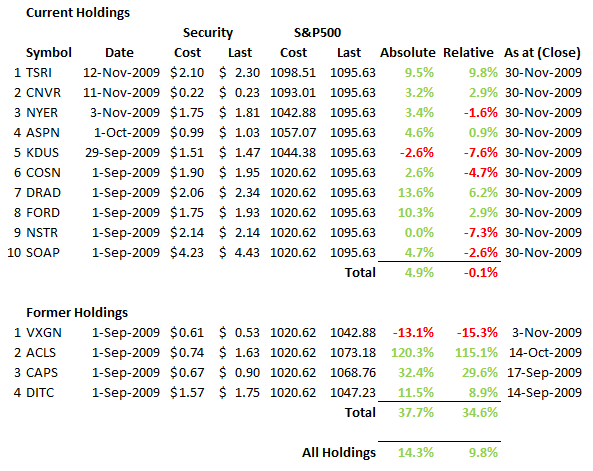
The fourth quarter was another satisfactory quarter for the Greenbackd Portfolioup 14.3% on an absolute basis, which was 9.8% higher than the return on the S&P500 return over the same period. A large positive return for the period is great, but my celebration is tempered once again by the fact that the broader market also had a pretty solid quarter, up 7.4%. The total return for Greenbackd’s first year (assuming equal weighting in all quarters) is 136.8% against a return on the S&P500 of 34.2%, or an outperformance of 102.6% over the return in the S&P500.

It is still too early to determine how well Greenbackd’s strategy of investing in undervalued asset situations with a catalyst is performing, but I believe Greenbackd is heading in the right direction. Set out below is a list of all the stocks in the Greenbackd Portfolio and the absolute and relative performance of each from the close of the last trading day of the third quarter, September 1, 2009, to the close on the last trading day in the fourth quarter, November 30, 2009:

*Note the returns for SOAP and NSTR include special dividends paid. See below for further detail.

You may have noticed something odd about my presentation of performance. The S&P500 index rose by 7.4% in the fourth quarter (from 1020.62 to 1,095.63). Greenbackd’s +14.3% performance might suggest an outperformance over the S&P500 index of 6.9%, while I report outperformance of 9.8%. I calculate Greenbackd’s performance on a slightly different basis, recording the level of the S&P500 Index on the day each stock is added to the portfolio and then comparing the performance of each stock against the index for the same holding period. The Total Relative performance, therefore, is the average performance of each stock against the performance of the S&P500 index for the same periods. As we discussed above, the holding period for Greenbackd’s positions has been too short to provide any meaningful information about the likely performance of the strategy over the long term (2 to 5 years), but I believe that the strategy should outperform the market by a small margin.

Update on the holdings in the Greenbackd Portfolio

There are currently ten stocks in the Greenbackd Portfolio:

  1. TSRI (added November 12, 2009 @ $2.10)
  2. CNVR (added November 11, 2009 @ $0.221)
  3. NYER (added November 3, 2009 @ $1.75)
  4. ASPN (added October 1, 2009 @ $0.985)
  5. KDUS (added September 29, 2009 @ $1.51)
  6. COSN (added August 6, 2009 @ $1.75)
  7. FORD (added July 20, 2009 @ $1.44)
  8. DRAD (added March 9, 2009 @ $0.88)
  9. SOAP (added February 2, 2009 @ $2.50. Initial $3.75 dividend paid July 30)
  10. NSTR (added January 16, 2009 @ $1.91. Initial $2.06 dividend paid July 15)

Greenbackd’s investment philosophy and process

I started Greenbackd in an effort to extend my understanding of asset-based valuation described by Benjamin Graham in the 1934 Edition of Security Analysis. (You can see a summary of Graham’s approach here). Through some great discussion with Greenbackd’s readers, many of who work in the fund management industry as experienced analysts or even managing members of hedge funds, and by incorporating the observations of Marty Whitman (see Marty Whitman’s adjustments to Graham’s net net formula here) and Seth Klarman (the Seth Klarman series starts here), I have refined Greenbackd’s process. I believe that the analyses are now pretty robust and that has manifest itself in satisfactory performance.

Tweedy Browne provides compelling evidence for the asset-based valuation approach. In conjunction with a reader of Greenbackd I have now conducted my own study into the performance of sub-liquidation value stocks over the last 25 years. The paper has been submitted to a practitioner journal and will also appear on Greenbackd in the future.

The future of Greenbackd.com

Greenbackd is a labor of love. I try to create new content every weekday, and to get the stock analyses up just after midnight Eastern Standard Time, so that they’re available before the markets open the following day. Most of the stocks that are currently trading at a premium to the price at which I originally identified them traded for a period at a discount to the price at which I identified them. This means that there are plenty of opportunities to trade on the ideas (not that I suggest you do that without reading the disclosures and doing your own research). If you find the ideas here compelling and you get some value from them, you can support my efforts by making a donation via PayPal.

If you’re looking for net nets in the meantime, here are two good screens:

  1. GuruFocus has a Graham net net screen, with some great functionality ($249 per year)
  2. Graham Investor NCAV screen (Free)

I look forward to bringing you the best undervalued asset situations I can dig up in the next quarter and the next year.

Read Full Post »

Aspen Exploration Corporation (OTC:ASPN) took the unusual step several days ago of making a second announcement regarding the payment of a cash dividend of $0.73 per share to stockholders of record on November 16, 2009. The company initially announced that the dividend would be payable to stockholders of record on November 16, 2009, with the dividend being paid on or about December 2, 2009. The second announcement provides that the Financial Industry Regulatory Authority (FINRA) has advised the company of the operation of Nasdaq Rule 11140(b)(2), which states:

In respect to cash dividends or distributions, stock dividends and/or splits, and the distribution of warrants, which are 25% or greater of the value of the subject security, the ex-dividend date shall be the first business day following the payable date.

This means that the dividend will trade with the stock until December 2, 2009, the payable date. Purchasers on December 3 or later will not be entitled to the dividend.

We’ve been following ASPN (see our ASPN post archive) because it’s trading at a discount to its $1.17 per share liquidation value and there are several potential catalysts in the stock, including a 13D filing from Tymothi O. Tombar, a plan to distribute substantially all of the net, after-tax proceeds from the completion of the Venoco sale to its stockholders ($5.3M), and the possibility that the company will dissolve. The stock is down 1.5% since we initiated the position to close yesterday at $0.983. This values the remaining stub of ASPN at $0.24 ($0.97 less $0.73) against a liquidating value I estimate at $0.44 ($1.17 less $0.73).

Here’s the text of the announcement [via Marketwire]:

DENVER, CO–(Marketwire – November 18, 2009) – Aspen Exploration Corporation (OTCBB: ASPN) viewed what appeared to be unusual market activity yesterday and today in light of its previous announcement of November 3, 2009. That announcement advised the public that a cash dividend of $0.73 per share will be payable to stockholders of record on November 16, 2009, with the dividend being paid on or about December 2, 2009. Notwithstanding the Board’s declaration of a record date, Aspen has been advised by the Financial Industry Regulatory Authority (FINRA) of the application of Nasdaq Rule 11140(b)(2) which states: “In respect to cash dividends or distributions, stock dividends and/or splits, and the distribution of warrants, which are 25% or greater of the value of the subject security, the ex-dividend date shall be the first business day following the payable date.” Persons needing further information or interpretation should consult with their broker-dealer or legal advisors.

[Full Disclosure:  I do not have a holding in ASPN. This is neither a recommendation to buy or sell any securities. All information provided believed to be reliable and presented for information purposes only. Do your own research before investing in any security.]

Read Full Post »

Soapstone Networks Inc (NASDAQ:SOAP) has released its 10Q for the period ended September 30, 2009.

We first looked at SOAP on February 2nd (see Greenbackd’s post archive here) because it was trading well below its net cash value. An activist investor, Mithras Capital, had disclosed an 8.7% holding and called on the company to liquidate. After some urging on Mithras Capital’s part, management acceded to the request and announced a liquidation. SOAP stockholders approved the liquidation of the company on July 28 and received a special dividend of $3.75 per share the next day. Based on our $2.50 purchase price, the $3.75 per share special dividend returned our initial capital plus 50%. At yesterday’s close, the $0.65 stub represents a total return to date of 76%. Management originally estimated the final distribution to be between $0.25 and $0.75 per share, which means the stub is presently trading at a 30% premium to the $0.50 midpoint of the distribution range.

On September 9, in our guest blogger series, Wes Gray and Andy Kern took a look at the SOAP stub as a stand alone investment. Gray and Kern argued that there was plenty of value left in the stub:

e. Total Return Possible

Low Estimate: .39 first distribution (Q2 2010), .06 second distribution (Q4 2010)

=>-4.57%

Expectation: .70 first distribution (Q1 2010), .06 second distribution (Q4 2010)

=>59.01%

High Estimate: .82 first distribution (Q4 2009), .15 second distribution (Q4 2010)

=>102.98%

Expected Return:

P(Low)=.25

P(Estimate)=.50

P(High)=.25

ð .25*-.0457+.50*.5901+.25*1.0298=54.11% expected return by Q4 2010.

At its $0.65 close yesterday, the stub is up 20.4% since that post.

The sale of the company’s non-cash assets including its “principal intellectual property assets,” the value of which we were speculating about on August 11, yielded cash consideration of approximately $2.2M. SOAP does not expect to receive any additional material consideration for the few remaining non-cash assets left in its possession.

The value proposition updated

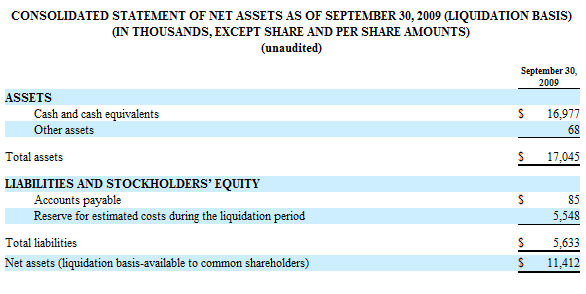
According to the most recent 10Q, which was prepared on a liquidation basis, SOAP has around $11.4M in net assets. This includes total liabilities of around $5.6, of which $5.5M is a reserve for liquidation costs. Here is an extract from the 10Q:

With 15.2M shares on issue, and assuming SOAP spends the full $5.5M reserve for liquidation costs, SOAP looks likely to yield $0.75 per share, the upper end of management’s estimated range and a 15% return from here. If there are any savings in the $5.5M reserve, SOAP could pay out substantially more.

Conclusion

Given that the stock is trading at a 15% discount to what now appears to be the low end of the likely final distribution, I’m going to maintain Greenbackd’s position in SOAP.

[Full Disclosure: I do not have holding in SOAP. This is neither a recommendation to buy or sell any securities. All information provided believed to be reliable and presented for information purposes only. Do your own research before investing in any security.]

Read Full Post »

CoSine Communications Inc (OTC:COSN) has released its 10Q for the quarter ended September 30, 2009.

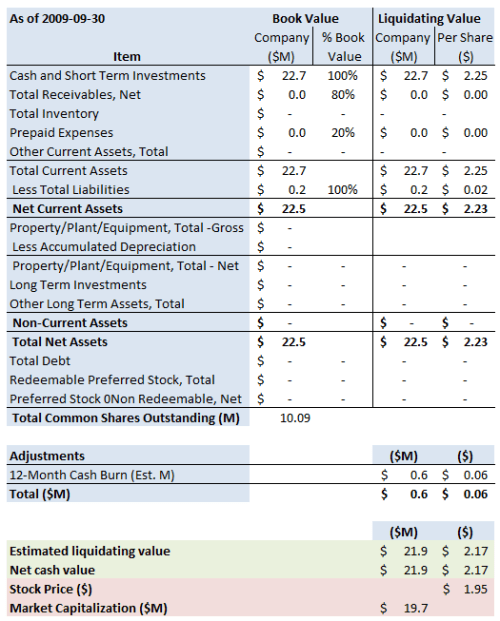
We’ve been following COSN (see Greenbackd’s COSN post archive) because it is a cash box controlled by activist investor Steel Partners. Steel Partners own 47.5% of the stock and sits on the board. The stock is up 11.4% since our initial post to close Friday at $1.95. I initially estimated the net cash value to be around $22.2M or $2.20 per share. After reviewing the 10Q I’ve slightly reduced it in line with the ~$0.3M cash burn for the last two quarters to $21.9M or $2.17 per share. The net cash value has remained relatively stable through 2006, 2007, 2008 and 2009. COSN presents an opportunity to invest alongside Steel Partners at a discount to net cash in a company with substantial NOLs.

The value proposition updated

Little has changed over the last two quarters. The valuation on COSN remains straight-forward: It has around $22.7m in cash and short-term investments, $0.2M in liabilities and 10.1M shares outstanding. I’ve set out the valuation below in the usual manner (the “Book Value” column shows the assets as they are carried in the financial statements, and the “Liquidating Value” column shows our estimate of the value of the assets in a liquidation):

COSN Summary 2009 09 30

Balance sheet adjustments

I’ve made the following adjustments to the balance sheet estimates above:

  • Cash burn: The company used $0.58M in cash in the last three quarters, which we’ve annualized to $0.6M.
  • Off-balance sheet arrangements and contractual obligations: According to COSN’s 10Q, it has no off-balance sheet arrangements.

NOLS

A quick primer on net operating loss carry-forwards (“NOLs”) from the most 2009 10K:

NOLs may be carried forward to offset federal and state taxable income in future years and eliminate income taxes otherwise payable on such taxable income, subject to certain adjustments. Based on current federal corporate income tax rates, our NOLs and other carry-forwards could provide a benefit to us, if fully utilized, of significant future tax savings. However, our ability to use these tax benefits in future years will depend upon the amount of our otherwise taxable income. If we do not have sufficient taxable income in future years to use the tax benefits before they expire, we will lose the benefit of these NOLs permanently. Consequently, our ability to use the tax benefits associated with our substantial NOLs will depend significantly on our success in identifying suitable acquisition candidates, and once identified, successfully consummating an acquisition of these candidates.

Additionally, if we underwent an ownership change, the NOLs would be subject to an annual limit on the amount of the taxable income that may be offset by our NOLs generated prior to the ownership change. If an ownership change were to occur, we may be unable to use a significant portion of our NOLs to offset taxable income. In general, an ownership change occurs when, as of any testing date, the aggregate of the increase in percentage points is more than 50 percentage points of the total amount of a corporation’s stock owned by “5-percent stockholders,” within the meaning of the NOLs limitations, whose percentage ownership of the stock has increased as of such date over the lowest percentage of the stock owned by each such “5-percent stockholder” at any time during the three-year period preceding such date. In general, persons who own 5% or more of a corporation’s stock are “5-percent stockholders,” and all other persons who own less than 5% of a corporation’s stock are treated, together, as a single, public group “5-percent stockholder,” regardless of whether they own an aggregate of 5% of a corporation’s stock.

The amount of NOLs that we have claimed has not been audited or otherwise validated by the U.S. Internal Revenue Service (“IRS”). The IRS could challenge our calculation of the amount of our NOLs or our determinations as to when a prior change in ownership occurred and other provisions of the Internal Revenue Code may limit our ability to carry forward our NOLs to offset taxable income in future years. If the IRS was successful with respect to any such challenge, the potential tax benefit of the NOLs to us could be substantially reduced.

According to the 10K, as of December 31, 2008, COSN had federal NOLs of approximately $353M, which begin to expire in 2018 if not utilized and state NOLs of approximately $213M, which will begin to expire in 2009 if not utilized. The NOLs have a substantial value as a tax shield should COSN acquire a business with taxable earnings, but assessing that value is beyond us.

Catalyst

Steel Partners’ most recent 13D filing sets out its 47.5% holding. Steel Partners’ strategy is to use COSN’s cash to acquire a business with taxable earnings that can be offset by the NOLs. From the 10Q:

Redeployment Strategy and Liquidity

In July 2005, after a comprehensive review of strategic alternatives, our board of directors approved a strategy to redeploy our existing resources to identify and acquire one or more new business operations with existing or prospective taxable earnings that can be offset by use of our NOLs.

Ordinarly, I would prefer a return of cash to the acquisition of a business. This situation is different from the usual case because Steel Partners’ business is investment, and so I think the risk that they might make a bad investment is low. That said, there’s no assurance that they will find a suitable candidate, or if they do, that COSN will be able to use the NOLs.

Conclusion

COSN initially presented an opportunity to invest alongside Steel Partners at a 26% discount to net cash in a company with substantial NOLs. With the increase in the stock price the discount to its net cash position has narrowed to around 11%. I’m maintaining the position in the Greenbackd Portfolio.

[Full Disclosure:  We do not have a holding in COSN. This is neither a recommendation to buy or sell any securities. All information provided believed to be reliable and presented for information purposes only. Do your own research before investing in any security.]

Read Full Post »

Aspen Exploration Corporation (OTC:ASPN) has announced that it will pay a cash dividend of $0.73 per share to stockholders of record on November 16, 2009 from the proceeds of the sale of its California oil and gas assets to Venoco, Inc. $0.73 per share represents $5.3M, which is just over the mid-point of the $5.0M to $5.5M range estimated by the company.

We’ve been following ASPN (see our ASPN post archive) because it’s trading at a discount to its $1.17 per share liquidation value and there are several potential catalysts in the stock, including a 13D filing from Tymothi O. Tombar, a plan to distribute substantially all of the net, after-tax proceeds from the completion of the Venoco sale to its stockholders ($5.3M), and the possibility that the company will dissolve. The stock is down 0.2% since we initiated the position to close yesterday at $0.983. This values the remaining stub of ASPN at $0.253 ($0.983 less $0.73) against a liquidating value I estimate at $0.44 ($1.17 less $0.73). I still think there’s obvious value here, and there might be another interesting play in the stub after the dividend. This is worth watching. It’s should also be noted, as reader bellamyj has pointed out, that, regardless of outcome of the upcoming shareholder vote, ASPN may not liquidate. This is not necessarily a bad thing if the controlling shareholder plans on monetizing the shell and its remaining cash. He owns 20% of the stock, so he’s got some incentive to do so, and he’s paying out a big cash dividend, which is a shareholder-friendly act. That said, it’s not clear whether that dividend was as a result of Timothy O. Tombar’s agitation or a spontaneous effort on behalf of the board. I’ve been wrong about managers before, but hope springs eternal.

Here’s the 8K filing:

On November 2, 2009 Aspen Exploration Corporation (“Aspen”) declared a cash dividend of $0.73 per share. The dividend will be paid to stockholders of record on November 16, 2009, with the dividend being paid on or about December 2, 2009. A copy of the news release describing the dividend is attached hereto as Exhibit 99.1. The distribution follows the final settlement of the sale of Aspen’s California oil and gas assets to Venoco, Inc., at which the parties made a number of immaterial adjustments to the purchase price paid at the June 30, 2009 closing, and made certain other payments that were not determined until after the closing. At the final settlement date Aspen received a net payment from Venoco, but was required to make various payments to third parties which ultimately resulted in a cash outflow from Aspen in an amount not considered to be material.

Aspen expects that after the payment of the dividend, and its anticipated operations through the end of the current calendar year, on December 31, 2009 it will have more than $3 million of working capital remaining. Aspen currently intends to utilize its remaining funds to maintain its corporate status as a reporting issuer under the Securities Exchange Act of 1934 and to explore other business opportunities. Pending developments with respect to any business opportunities Aspen identifies, Aspen may later reevaluate its status and plans and consider alternatives to wind up its affairs. Aspen’s projections and future plans described in this report are “forward-looking statements” (as such term is defined in Section 21E of the Securities Exchange Act of 1934, as amended) which are dependent upon a number of factors. There can be no assurance that Aspen’s projections will prove to be accurate or that Aspen will be able to successfully execute or implement its operations as described herein.

Hat tip Joe G.

[Full Disclosure:  I do not have a holding in ASPN. This is neither a recommendation to buy or sell any securities. All information provided believed to be reliable and presented for information purposes only. Do your own research before investing in any security.]

Read Full Post »

VaxGen Inc (OTC:VXGN) is all over. The latest 10Q has come out and, while not much has changed, it’s irrelevant in light of the pending deal with OXGN. The liquidation value remains around $23.6M or $0.71 per share. Whether that deal is consummated or not, VXGN shareholders will be worse off. The stock price is in no man’s land at the moment. It’s not cheap enough to buy more, and it’s still trading at a big discount to liquidation value. In this instance, it’s probably justified given the malice the board seems to have towards its shareholders. I’m closing Greenbackd’s position out at yesterday’s closing price of $0.53. Greenbackd is up 12.5% on VXGN on an absolute basis, which is off 13.0% relative to the S&P500. It’s a shame because I had plenty of chances to read the writing on the wall and get out at a decent profit. I didn’t, so more fool me. I hung around for too long, hoping that something would happen. Nothing did. The end.

Post mortem

We started following VXGN (see the VXGN post archive here) because it was trading at a substantial discount to its net cash position, had ended its cash-burning product development activities and was “seeking to maximize the value of its remaining assets through a strategic transaction or series of strategic transactions.” VXGN had other potentially valuable assets, including a “state-of-the-art biopharmaceutical manufacturing facility with a 1,000-liter bioreactor that can be used to make cell culture or microbial biologic products” and rights to specified percentages of future net sales relating to its anthrax vaccine product candidate and related technology. I initially estimated the liquidation value to be around $0.84 per share, although that reduced over the holding period to yesterdays $0.71 per share. The authors of a letter sent to the board on July 14 of this year adjudged VXGN’s liquidation value to be significantly higher at $2.12 per share:

Excluding the lease obligations, the net financial assets alone of $37.2 million equate to $1.12 per share. The EBS royalties (assuming a 6% royalty rate and a $500 million contract as contemplated by NIH/HHS and EBS) of $30 million and milestones of $6 million total $36 million of potential additional future value (based clearly on assumptions, none of which are assured), or $1.09 per share. Adding $1.12 and $1.09 equals $2.21 per share.

On the catalyst front, management had said that, if the company was unable to identify and complete an alternate strategic transaction, it proposed to liquidate. One concern of mine was the lawsuit against VXGN by its landlords, in which they sought $22.4M. That lawsuit was dismissed in May, at which point the path for VXGN to liquidate appeared to clear. Unfortunately the board dragged its feet on the liquidation, which, given their relatively high compensation and almost non-existent shareholding, was not difficult to understand.

This state of affairs drew two competing alternate proxy slates seeking nomination to the board of VXGN, Value Investors for Change and the VaxGen Full Value Committee. Value Investors for Change, led by Spencer Capital, filed preliminary proxy documents in August to remove the board. In the proxy documents, Value Investors for Change called out VXGN’s board on its “track record of failure and exorbitant cash compensation”:

VaxGen does not have any operations, other than preparing public reports. The Company has three employees, including the part-time principal executive officer and director, and four non-employee directors. Since the Company’s failed merger with Raven Biotechnologies, Inc. in March 2008, the Board has publicly disclosed that it would either pursue a strategic transaction or a series of strategic transactions or dissolve the Company. The Company has done neither. In the meantime, members of the Board have treated themselves to exorbitant cash compensation. Until July 2009, two non-employee members of the Board were paid over $300,000 per year in compensation. The principal executive officer will likely receive over $400,000 in cash compensation this year.

The VaxGen Full Value Committee, comprising BA Value Investors’ Steven N. Bronson and ROI Capital Management’s Mark T. Boyer and Mitchell J. Soboleski, intended to replace the current board with directors who would focus on the following objectives:

1. Returning capital to [VXGN]’s shareholders, including an immediate distribution of $10,000,000 in cash;

2. Terminating [VXGN]’s lease with its landlord, Oyster Point Tech Center, LLC, and settling with the landlord the obligations of [VXGN] on the remaining lease payments;

3. Exploring ways to monetize [VXGN] as a “public shell,” including the utilization of [VXGN]’s Substantial Net Operating Losses; and

4. Protecting for the benefit of shareholders royalty payments receivable from the sale of [VXGN]’s intellectual property.

BA Value Investors had previously disclosed an activist holding and, in a June 12 letter to the board, called on VXGN to “act promptly to reduce the size of the board to three directors; reduce director compensation; change to a smaller audit firm; terminate the lease of its facilities; otherwise cut costs; make an immediate $10 million distribution to shareholders; make a subsequent distribution of substantially all the remaining cash after settling the lease termination; distribute any royalty income to shareholders; and explore ways to monetize the public company value of the Issuer and use of its net operating losses.”

For a while it looked like a decent outcome was possible, but then VXGN threw a spanner in the works, striking an appalling deal with OXGN at a discount to VXGN’s $0.70 close the prior day. It is also priced at a discount to VXGN’s net cash and liquidation values, and payment is to be made in the watered scrip of OXGN, a speculative biotech play (see our more detailed take on the terms of the VXGN / OXGN deal). BA Value Investors and VaxGen Full Value Committee exited the stock shortly thereafter. Value Investors for Change has also been conspicuously silent, so I think we can assume they’ve thrown in the towel.

Disgruntled shareholders have now initiated several class actions against the board of VXGN over possible breaches of fiduciary duty in the sale to OXGN. The board certainly deserved the suit, but a successful outcome in any litigation will be a Pyrrhic victory for participating VXGN shareholders. As I understand it, VXGN’s board is indemnified out of VXGN’s assets and so as any damages award will return to VXGN plaintiffs VXGN’s assets less legal fees and the break fee.

It’s also possible that the merger will not survive the shareholder vote. As reader bellamyj noted, in November 2007 VXGN announced another disastrous merger with Raven Biotechnologies. Over the next few days VXGN stock fell almost 50% and the merger was terminated the day before the special meeting, apparently due to shareholder opposition. Perhaps that will happen again. If it does, OXGN will still tear out ~$2.5M from VXGN, but it may be a better outcome than the deal on the table. If that happens, we’ll revisit VXGN, but for now, we’re going to say, “Good riddance.” VXGN directors, hang your heads in shame.

Hat tip garp.

[Full Disclosure:  We don’t have a holding in VXGN. This is neither a recommendation to buy or sell any securities. All information provided believed to be reliable and presented for information purposes only. Do your own research before investing in any security.]

Read Full Post »

Following my Simoleon Sense interview with Miguel Barbosa, I’ve had a few requests for a post on Tom Evans. Here it is, hacked together like Frankenstein’s monster from all the public information I could track down:

Thomas Mellon Evans was a one of the first modern corporate raiders, taking Graham’s net current asset analysis and using it to wreak havoc on the gray flannel suits of the 40s and 50s. He’s not particularly well-known today, but he waged numerous takeover battles using tactics that are forerunners of those employed by many of the takeover artists of the 1980s and the activists of the 1990s and 2000s. Proxy battles? Check. Greenmail? Check. Liquidations? Check.

Born September 8, 1920 in Pittsburgh, and orphaned at the age of 11, Evans grew up poor. Despite his famous middle name (his grandmother’s first cousin was Andrew Mellon), he began his financial career at the bottom. After graduating from Yale University in 1931 in the teeth of the Great Depression, he landed a $100-a-month clerk’s job at Gulf Oil.

While his friends headed out in the evening, Evans would stay home reading balance sheets and looking for promising companies: those he could he could buy for less than the assets were worth in liquidation. Evans found such companies by calculating their “net quick assets,” the long forgotten name for “net current assets.” His friends teased him about his obsession and gave him a nickname: “Net Quick” Evans. From the 1944 Time Magazine article, Young Tom Evans:

With only some fatherly advice from Gulf’s Board Chairman, W. L. Mellon, Tom Evans made his way alone. For six years he saved money, like an Alger hero; and played the stockmarket, unlike an Alger hero. Thus he collected $10,000. He wanted to find and buy a family-owned business that had gone to pot. In the down-at-the-heels H. K. Porter Co., in Pittsburgh’s slummy Lawrenceville section, he found it. Once a No. 1 builder of industrial locomotives, Porter Co. was down to 40 workers.

Tom Evans bought up Porter bonds at 10 to 15 cents on the dollar, reorganized the company under 77B, and became president at 28.

From then on, Evan was the chief terror of the sleepy boardrooms of the era, much like Icahn would be 30 years later. As a connoisseur of deep value on the balance sheet, one has to admire his methods (From the New York Times obituary, Thomas Evans, 86, a Takeover Expert, Dies):

‘He was never really an operator; he was a financial guy — a balance sheet buyer,” one of his sons, Robert Sheldon Evans, told Forbes magazine in 1995. ”He would buy something for less than book value and figure the worst that could happen was he would liquidate it and come out O.K. What he didn’t want to do was lose money on the deal. If he knew his downside was covered, then he figured the upside would probably take care of itself.

”It was a very shrewd policy in the 50’s and 60’s, when there were highly inefficient markets: buying undervalued assets, running them for cash and selling off pieces. The 80’s leveraged buyout guys were just taking a lot of his deals to their logical extension.”

The book The White Sharks of Wall Street: Thomas Mellon Evans and the Original Corporate Raiders by Diana B. Henriques is an excellent biography on Evans. More than that, it describes many of the battles for corporate control in the 40s, 50s and 60s. In contradistinction to the takeover battles of the 80s, the dogfights in the 40s, 50s, and 60s were largely proxy fights, and in as much, should be familiar to today’s “activist investors.” James B. Stewart’s Let’s make a deal, his review of Henriques’ book, does it justice:

There are surely few phenomena more remarkable in American business than the periodic ability of cash-poor but swashbuckling newcomers, using little or none of their own money, to seize control of some of the country’s most valuable corporations. In its most recent, frenzied incarnation, dot-com entrepreneurs have exchanged stock in companies with few tangible assets and even fewer profits for control of established, profitable companies. Fifteen years ago, the currency was junk bonds rather than inflated stock. And before that, it was bank loans using a target’s assets as collateral.

Wall Street greets each wave of takeovers as the dawning of a new era. But the proposition that nothing has fundamentally changed is convincingly set forth in ”The White Sharks of Wall Street,” an engaging and thorough history of early corporate takeovers by Diana B. Henriques, a financial reporter for The New York Times. Her central character is Thomas Mellon Evans, who surfaces in what seems like nearly every trendsetting corporate battle from 1945 until his retirement in 1984, and whose tactics remain essential to practitioners of corporate warfare. Junk bonds? Greenmail? Scorched earth? Evans had been there long before investment bankers coined a catchy vocabulary to describe the maneuvers of people like T. Boone Pickens, Carl Icahn and Saul Steinberg.

Though Evans seems to have escaped the widespread public resentment and envy the others generated, and Henriques’s portrait is carefully nonjudgmental, it is difficult for a reader to work up much sympathy for him. He was ruthless, bad-tempered, usually indifferent to workers and communities. He repeatedly displayed what appears to be a criminal disregard for the antitrust laws (though he was never prosecuted). He divorced two wives (the second later committed suicide), and both times a replacement was conspicuously at hand long before any legal proceedings had begun. He betrayed two of his own sons in his quest for corporate dominance and wealth.

Yet as a deal maker Evans displayed a natural audacity and genius. In 1935, 24 years old and lacking any money to speak of, he decided he wanted to gain control of Pittsburgh’s struggling H. K. Porter Company, a manufacturer of steam locomotives. Inspired by a Fortune magazine account of Floyd Odlum, who became rich by using borrowed securities as collateral for loans to buy undervalued stock, Evans borrowed shares from a Mellon mentor, took out a loan and invested in Gulf Oil stock, then a Mellon enterprise. When Gulf’s stock rose handsomely as the nation emerged from the Depression, Evans used his profits to buy Porter bonds, then selling for a small fraction of their face value. When Porter finally had to declare bankruptcy and was reorganized, Evans, as the largest creditor, traded his bonds for equity and became the largest shareholder. Porter, essentially acquired for junk bonds, would be Evans’s vehicle for most of his life.

I highly recommend The White Sharks of Wall Street: Thomas Mellon Evans and the Original Corporate Raiders by Diana B. Henriques for fans of deep value and activist investment.

Read Full Post »

We’ve just completed an interview with Miguel Barbosa of the wonderful Simoleon Sense. Go there now, and get trapped in an endless loop as you are recirculated back here and so on.

Read Full Post »

« Newer Posts - Older Posts »