Mario Cibelli’s recent 13D amendment for Dover Motorsports Inc (NYSE:DVD) is interesting reading. Cibelli controls around 17.5% of DVD through Marathon Partners and Cibelli Capital Management. His most recent 13D amendment filed Wednesday annexes a letter setting out a (huge) case study of DVD “partly as a contribution to public education but also to obtain a clearly objective review of the Dover Motorsports situation for our own investment purposes:”
Via Fed-Ex
April 26, 2010
Trustees of RMT Trust
Michele M. Rollins
R. Randall Rollins
Henry B. Tippie
Board of Directors, Dover Motorsports, Inc.
Henry B. Tippie, Chairman
Denis McGlynn, Chief Executive Officer
Patrick J. Bagley
Kenneth K. Chalmers
Jeffrey W. Rollins
John W. Rollins, Jr.
R. Randall Rollins
Eugene W. Weaver
Dover Motorsports, Inc.
1311 N. DuPont Highway
Dover, Delaware 19903
RE: Dover Motorsports, Inc. Case Study
Dear Trustees of RMT Trust and Board Members:
Please find enclosed a study that we sponsored, partly as a contribution to public education but also to obtain a clearly objective review of the Dover Motorsports situation for our own investment purposes.
We believe this objective and thorough review confirms our position that Mr. Tippie has not been performing his duties satisfactorily, and cannot be relied upon to do so in the future. We recognize that Mr. Tippie’s past accomplishments are significant and worthy of admiration, but whatever tribute is due cannot be imposed on the company’s long-suffering shareholders. Under these circumstances, it is the fiduciary responsibility of the company’s directors as well as of the trustees of its controlling shareholder to act in the interest of those who rely upon them to assure the competent management of Dover Motorsports.
If you are reluctant to take the necessary actions yourselves, you should at least allow me to do so. As you know from our reports, I have made sound preparations to assume this responsibility.
Sincerely,
Mario D. Cibelli
Managing Member
Enclosure
Cibelli’s DVD case study:
Isaac C. Flanagan
April 26, 2010
Dancing on the Deck of the Titanic:
Henry B. Tippie and Dover Motorsports, Inc.
As the first decade of the 21st century rapidly drew to a close, the motorsports industry in the United States faced shifting internal dynamics, and was buffeted by the macroeconomic environment. The third-largest public player in a sector whose decades-long cycle of consolidation was largely complete, Dover Motorsports, Inc. (NYSE: DVD) (“Dover Motorsports,” “Dover” or the “Company”) was not immune.
By the time Henry B. Tippie was elected Chairman of Dover’s Board of Directors in 2000 following the death of Company founder and Chairman John W. Rollins, he had distinguished himself through nearly fifty years of service to the Rollins family and their group of companies. In his career, Mr. Tippie had developed a reputation for consistently organizing and growing companies in a diverse group of industries, frequently taking them public. Mr. Tippie was known not only as a successful manager and a nimble rescuer of companies, but also as a leader with unimpeachable integrity. The University of Iowa described Henry Tippie in the following manner on the biographical web page entitled Who is Henry Tippie?:
“Integrity. Innovation. Impact.
Those words not only apply to the Tippie College and its offerings, they also apply to its benefactor, Henry B. Tippie. A native of Belle Plaine, Iowa, Henry Tippie is a man of integrity, who has built his personal and professional life on the principles of hard work and doing the right thing. He is a living and breathing illustration of the word ‘integrity.'”1
1 http://tippie.uiowa.edu/about/henry.cfm
It is in this context that the circumstances surrounding Dover Motorsports could have been confusing to those familiar with the situation starting in 2007. The management decisions made over a long period of time at Dover seemed contradictory to the legacy of both Mr. Tippie and the Rollins group of companies and left Dover at a major crossroads in 2009.
Company Description
Dover Motorsports, Inc., headquartered in Dover, Delaware, marketed and promoted motorsports entertainment in the United States via the following four raceways:
1. Dover International Speedway in Dover, Delaware
2. Gateway International Raceway near St. Louis, Missouri
3. Memphis Motorsports Park in Memphis, Tennessee
4. Nashville Superspeedway in Lebanon, Tennessee
The Sprint Cup Series was NASCAR’s premier racing series, with 36 races scheduled in 2009 and 36 more scheduled in 2010. Dover International Speedway hosted two Sprint Cup Series race weekends each year, and was the only one of the Company’s four tracks to host a Sprint Cup Series event. All four facilities hosted NASCAR Nationwide Series and Camping World Truck Series events, although these events drew much smaller crowds and generated significantly lower sponsorship, event-related, and broadcast television revenues compared to Sprint Cup events.
Dover Motorsports was one of three publicly traded racetrack operators, along with International Speedway Corporation (NASDAQ: ISCA) (“ISCA”) and Speedway Motorsports, Inc. (NYSE: TRK) (“SMI”). ISCA was controlled by members of the France family and SMI was controlled by O. Bruton Smith.
Motorsports Industry Overview
NASCAR
Founded by Bill France, Sr. in 1948, the National Association for Stock Car Auto Racing, Inc. (NASCAR) was the premier motorsports sanctioning body. NASCAR consisted of three national series (the NASCAR Sprint Cup Series, NASCAR Nationwide Series, and NASCAR Camping World Truck Series), a road racing series, and a variety of regional, local, and international racing series. The France family controlled the sanctioning body, and Brian Z. France served as CEO and Chairman of the Board of NASCAR.
By the fall of 2009, racetrack operations in the United States had begun to display many of the classic signs of sector maturity. Most significantly, nearly all of the country’s major media markets and population centers boasted an established NASCAR-affiliated track by this point, with the notable exception of New York City. Given the lack of de novo growth prospects and NASCAR’s outspoken reluctance to expand the current race schedule, profit-expansion opportunities were largely driven by more efficient marketing and management of tracks, offering enhanced experiences to race attendees, and successful acquisition and integration of competitors.

Pocono Raceway was owned by the Mattioli family with the asset held in a generation- skipping trust2, and the historic Indianapolis Motor Speedway, known for its open-wheeled racing, was owned by the George/Hulman family.
2 Speed Channel (6/13/04), reported by http://www.jayski.com
Corporate History
The Company was founded in 1969 as racetrack operator Dover Downs, and launched with a NASCAR Sprint Cup Series race won by Richard Petty. Dover Downs Entertainment, Inc., which included both the motorsports and gaming businesses, went public on the New York Stock Exchange in 1996 under the ticker symbol DVD. In 2002, the gaming portion of the Company’s operation was separated and went public on the New York Stock Exchange as Dover Downs Gaming & Entertainment, Inc. under the ticker symbol DDE. The Company’s motorsports operations were renamed Dover Motorsports, Inc. following the divestiture and retained the DVD ticker symbol. Despite the separation into two distinct businesses, the management teams of each company remained nearly identical.
Share Classes and Voting Structure
Dover Motorsports maintained a dual class share structure, which included common stock and Class A common stock. The Class A shares, owned by a small group of Rollins family members and management, carried ten votes per share. Common shares carried a single vote per share. Dividends on Class A shares could not exceed those of common shares, but under certain circumstances common dividends could exceed those of the Class A shares. In addition, the common and Class A common shares were part of a shareholder rights plan, also known as a “poison pill.” In the event that an outside investor accumulated over 10 percent of the company’s total shares, or tendered a takeover offer without prior approval, existing shareholders had the right to purchase additional shares in order to prevent a takeover.
RMT Trust
Following the death of John W. Rollins, Senior on April 4, 2000, Henry Tippie (at the time, Vice Chairman of Dover) was named executor of Mr. Rollins’ vast estate, and thereafter, Mr. Tippie possessed more than 50% voting control of the Company. The Last Will and Testament of John W. Rollins, Senior, established the RMT Trust as the primary vehicle to transfer assets to his wife, Michele M. Rollins. Among many of its stakes in property and operating assets, the RMT Trust held 8 million shares of Class A Common Stock in 2009, which represented approximately 39.4% of the voting control of Dover Motorsports. The Last Will and Testament stipulated that the RMT Trust would be administered by three trustees, presently Michele M. Rollins, R. Randall Rollins, and Henry B. Tippie. Through an agreement which renews annually, Michele Rollins and Randall Rollins yielded sole discretion over the voting power of shares held by RMT Trust to Henry Tippie. Therefore, at the behest of the Rollins, Henry Tippie maintained the dual role of Chairman of the Company and voting trustee of RMT Trust and was able to single-handedly determine the outcome of any and all shareholder votes. As the Company disclosed in its Annual Report:
“We are a controlled corporation because a single person…controls in excess of fifty percent of our voting power. This means he has the ability to determine the outcome of the election of directors at our annual meetings and to determine the outcome of many significant corporate transactions….Such a concentration of voting power could have the affect of delaying or preventing a third party from acquiring us at a premium.”
Business Overview
Key Executives
Henry B. Tippie, Chairman of the Board
Henry Tippie serves as Chairman of the Board of Dover Motorsports, as well as controlling Trustee of RMT Trust (Dover’s largest shareholder), and in these capacities exercises control over 54.4% of the combined voting power of the two classes of the Company’s common stock.
A Belle Plaine, Iowa farm boy, Henry B. Tippie enlisted in the United States Army Air Force at the age of 17, and enrolled at the University of Iowa upon completion of his military service. After earning his degree in Accounting in two years in 1949, Mr. Tippie pursued work as an accountant in Des Moines and Omaha, eventually earning his CPA in 1951. Shortly thereafter, he was hired by Delaware-based John W. Rollins, Associates as a controller. In his decades with the Rollins family and the diverse group of companies they control, Mr. Tippie has been instrumental in the growth and management of a number of firms across many unrelated industries.
For his many achievements in business, Mr. Tippie has been recognized with induction into the Horatio Alger Association of Distinguished Americans and has been the recipient of several distinguished alumni awards from the University of Iowa. In 1999, the University of Iowa renamed its College of Business Administration the Henry B. Tippie College of Business. The Henry B. Tippie College of Business was the first academic division of the University of Iowa to be named after an alumnus.
Mr. Tippie also serves as Chairman of the Board of Dover Downs Gaming & Entertainment and is a Director of three other public companies controlled by the Rollins family.
R. Randall Rollins, Director
In addition to his role as Trustee of RMT Trust and Director of Dover Motorsports and Dover Downs Gaming & Entertainment, Mr. Rollins was the Chairman of the Board of Rollins, Inc. (NYSE: ROL), Marine Products Corp. (NYSE: MPX), and RPC, Inc. (NYSE: RES) and maintained shared voting control of each of these public companies with his younger brother, Gary Rollins. As the eldest son of the late O. Wayne Rollins (brother of John W. Rollins, Senior) and as the sole Rollins family member involved with each of the five public companies controlled by the Rollins family, Mr. Rollins appeared to be the de-facto patriarch of the Rollins family.
Denis McGlynn, President, CEO and Director
Jeffrey W. Rollins, Director, son of John W. Rollins, Sr.
Kenneth K. Chalmers, Director
Patrick J. Bagley, Former CFO; Director
John W. Rollins, Jr., Director, son of John W. Rollins, Sr.
Eugene W. Weaver, Former SVP, Administration; Director
With the exception of Eugene Weaver, seven of the eight Directors of Dover Motorsports also served on the board of Dover Downs Entertainment. Mr. Tippie and Mr. McGlynn, maintained their respective directorships and/or management positions at Dover Downs Gaming & Entertainment as well, and received separate compensation from that entity.
DVD Directors – Overlap with Companies Controlled by the Rollins Family

Shareholder Concerns
Scale
Driving the consolidation wave of the late 1990’s through late 2000’s was Dover Motorsports’ largest competitor, International Speedway Corporation, or ISCA. Owning 13 active tracks, ISCA hosted 19 of the 36 NASCAR Sprint Cup Series races by 2009. By comparison, competitor Speedway Motorsports occupied a distant second place with eight racetracks, while Dover rounded out the third position with its four tracks and two Sprint Cup races. Consolidating a sizable portfolio of tracks and race dates under a single umbrella provided the leading players with sustainable competitive advantages in the form of superior ability to negotiate with NASCAR, lobby municipal and state governments and regulators, maintain pricing power for sponsorships and ticketing, and spread marketing and corporate expenses across a broader revenue base.
While the benefits of scale accrued to each of the top three market participants to some extent, International Speedway’s position as the industry leader had become increasingly difficult to challenge.
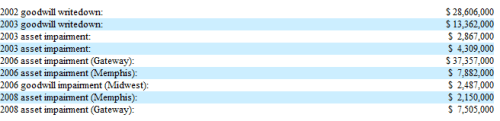
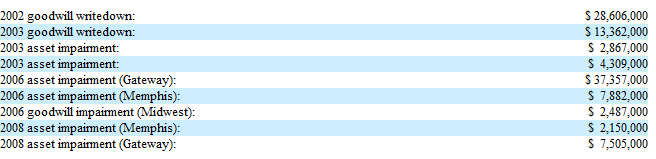
Dover Motorsports’ efforts to increase its size and competitive position, via both acquisitions and de novo expansion, were met with significant challenges. The 1998 acquisition of the Grand Prix Association of Long Beach for a pro-forma price of approximately $91 million included the Grand Prix of Long Beach, Gateway International Raceway and Memphis Motorsports Park. The Company later acquired the Grand Prix of Denver and Grand Prix of St. Petersburg and folded them into this business unit. These acquisitions resulted in a steady stream of asset impairments and goodwill writedowns of over $106 million between 2002 and mid-2009, and by 2005, only the Gateway and Memphis tracks remained part of Dover Motorsports.
In April 2001, Dover Motorsports inaugurated the Nashville Superspeedway, a 1.33 mile racetrack with a permanent seating capacity of 50,000, built at a cost of approximately $100 million (net of subsidies from the state of Tennessee). The facility was built for the purpose of attracting a NASCAR Sprint Cup Series race, which had yet to occur. In the 2009 NASCAR racing season, the Nashville Superspeedway played host to two NASCAR Nationwide Series races, the Pepsi 300 and Nationwide Auto Parts 300, and bore the unique distinction of being the only track to host two NASCAR Nationwide Series events without also hosting a Sprint Cup Series race.
By 2006, it was evident that Nashville would not attract a Sprint Cup series race, which resulted in nearly $20 million of asset impairments between 2006 and 2008.
In addition to the multitude of goodwill writedowns and asset impairments which occurred over the decade, it was believed that the Gateway, Memphis, and Nashville tracks collectively operated at a $5-$6 million annual loss and had never been profitable. An exact figure has never been available given the Company had never publicly provided any track level operating data or classified the Midwest assets as a separate operating unit.
Chairman Tippie’s business philosophy on cutting losses was highlighted in a 1999 interview from the Tippie School of Management at the University of Iowa.
“Being detail-oriented has always been important to me. I believe in getting all the facts, looking at different points of view, from different angles. It makes me a 24-hour “sleep on it” type of a decision-maker. I think it out, then go forward. If it doesn’t work, fine. I’m not one to stay with it if it doesn’t work– I cut my losses and try something else. I don’t let decisions keep me awake at night.”
“I’m probably at my best when things are toughest. When things get tough, I feel the need to organize and straighten things out. I’m strong on planning wherever I’m going. I’m also known as an ‘attack dog.’ I’m for attacking a problem, not running from it.”3
Declining Fundamentals
NASCAR experienced tremendous growth in popularity over a 15 year period, peaking at an estimated 75 million NASCAR fans in 2005. In the 2006 racing season, however, NASCAR began to experience declines in both television ratings and race attendance. Television ratings declined in 32 of 36 races, with declines of more than 10% for 16 of those races. In addition, NASCAR reports estimated that attendance decreased at a third of Sprint Cup races. At that time, it was estimated that fewer than half of the Sprint Cup races were sold out.45
The macro-economic fallout arising from the bursting of the United States’ housing bubble in 2007 continued to plague the consumer discretionary sector well into 2009. As a result, ticket demand for race events, corporate spending and sponsorship budgets, concession sales and other revenue streams generally remained soft across the motorsports industry, and Dover was no exception. Revenue and operating profit declines, which began in Fiscal 2006, had yet to reverse course. While the broad economic malaise affected Dover’s competitors as well, the Company’s lack of scale, its unprofitable tracks, and its reliance on a single facility (Dover) for its operating profit left the Company more vulnerable to undesirable economic conditions and underperformance. The reliance on a single track for its profits also subjected the Company to variability in results due to potential adverse weather conditions on its two Sprint Cup weekends per year.
Ticket sales presented a unique barometer for changing market conditions in the motorsports industry. Attendance at Dover International Speedway, never again sold out its 140,000 seated capacity, yet management continued to resist cutting ticket prices in 2009, opting instead to focus on package deals combining race admission, food and lodging.6 With 53% of NASCAR fans earning less than $50,000 annually, and 32% earning less than $30,000, many operators began to pay attention to what was becoming an increasingly elastic demand base.7 Competing racetracks aggressively cut prices in an attempt to revive volumes, with noteworthy examples such as Daytona International Speedway cutting grandstand prices to $40, the lowest level since 1996.8
The first wave of sponsorship terminations by corporate advertisers began in late summer and early fall 2008 with the abrupt exit of long-time supporters such as Chevron, General Motors and Chrysler. By July 2009, all four automobile manufacturers affiliated with the sport had reduced their support or announced plans to do so. Many of the sponsors who continued their involvement with NASCAR cut their commitments, forcing teams and track operators to seek multiple parties to split sponsorship deals.
While the early wave of sponsorship cancellations was weighted heavily towards the most beleaguered industries and marginal teams, by May 2009, speculation had begun that even brand-name players such as Jeff Gordon might be affected. Media sources were reporting that even DuPont chemical may not renew its NASCAR deal upon expiration, following other advertisers such as GM Goodwrench, Tide, Kodak, Jack Daniel’s and Jim Beam, among others.
Beyond the challenges faced by the prestigious Sprint Cup Series, the lower-tier events, such as the NASCAR Nationwide Series and Camping World Truck Series were hit even harder. With widespread sponsor exits and a number of teams sitting idle, industry observers are not convinced these lower tier series will survive in their current form over the intermediate term.
3 Business at Iowa, Henry Tippie Interview, Spring 1999
4 http://www.jayski.com/pages/tvratings2006.htm
5 USA Today, “NASCAR’s Growth Slows After 15 Years in the Fast Lane
6 Delaware News Journal, January 16, 2009
7 USA Today, “Tracks Go Extra Mile to Keep Fans Coming Back,” April 28, 2008
8 Revenues From Sports Venues, “Prices Drop for NASCAR Tickets in Daytona,” July 9, 2009
The slashing of corporate budget allocations to NASCAR, its raceways, races and teams led to multiplicative effects. As sponsor budgets fell, race teams were forced to cut their number of cars, number of races entered, merge with competitors, or cease operations altogether.
Many NASCAR track, event and team sponsors were in hard-hit sectors of the economy, such as automotive and construction. While some sponsorships were replaced by upstarts such as GoDaddy.com and Cash4Gold, serious questions remained about the ability of the industry to permanently replace lost revenue.
Transparency or Lack Thereof
The Company reported its financial results under a single operating segment, and did not disclose track-level information to any finer degree of granularity, making third-party analysis of the relative performance of various tracks a daunting task. The Company did not host an analyst day nor did its management participate in investor conferences. Dover Motorsports eliminated the Q&A portion of its quarterly earnings conference calls after the Q2 2008 event, eliminating the only public forum for shareholders to communicate with management. With no earnings guidance provided by the Company and minimal coverage provided by the equity research community, shareholders were seriously challenged to forecast future performance.
Failed Shift in Strategy
On January 28, 2009, Dover publicly announced it had entered into an agreement to sell Memphis Motorsports Park to Gulf Coast Entertainment, L.L.C. (“Gulf Coast”) for $10 million in cash, subject to financing conditions, with an expected closing date of April 30, 2009. Gulf Coast had announced its intention in September 2006 to build a major motorsports and entertainment facility in southern Alabama, with an initial expected completion date of fall 2009. By spring 2009, however, it became apparent that the financing for the Memphis acquisition might be at risk when Dover announced on April 24, 2009 that their agreement with Gulf Coast had been amended to provide for a closing on or before June 29, 2009. On July 8, 2009, Dover announced that Gulf Coast did not finalize its project financing in time for the scheduled June 29, 2009 closing date and further extended the closing date until September 29, 2009.
On September 30, 2009, the Company announced that its agreement to sell Memphis Motorsports Park to Gulf Coast had been terminated due to Gulf Coast’s inability to secure financing.
Public Market Valuation
From October 1, 2008 to October 1, 2009, Dover experienced a precipitous share price decline, falling nearly 72 percent, from $5.20 to $1.48 per share. This was more than double the percentage decline in the share prices of its two nearest competitors, International Speedway and Speedway Motorsports, whose share prices lost 30 percent and 26 percent, respectively.
While the $340 million price SMI paid for the New Hampshire International Speedway (a close comparable to Dover International Speedway) in 2008 may not be easily replicated in the environment of late 2009, even a fraction thereof would have eclipsed Dover’s total enterprise value, at that time, of roughly $91 million.
Investor Sentiment
By 2007, Dover’s outside shareholders had become increasingly concerned with the Company’s performance and strategy, voicing concerns about the Company’s prospects as a stand-alone entity. One of the most vocal shareholders was Marathon Partners, L.P., a New York City-based investment partnership founded by Mario Cibelli, the largest outside shareholder of the Company. In a series of letters addressed to Dover’s board of directors beginning in May 2007, Marathon articulated the concerns of Dover’s shareholders: namely, the Company’s weakened financial and operating position relative to its competitors and the resulting need to divest assets up to and potentially including the Company as a whole.
Marathon sent several letters to Dover’s board of directors during the period from 2007 to 2009. When Dover ultimately responded via letter on September 9, 2009, the Company’s General Counsel indicated that Dover had participated in merger talks with a consortium consisting of Speedway Motorsports and International Speedway, Dover’s primary competitors, on May 2, 2007. According to Dover Motorsports, the consortium offered to acquire Dover Motorsports for a five-cent per share premium to market value. Based on the May 1, 2007 adjusted closing price of $5.57, the stock went on to lose approximately seventy percent of its market value by late October 2009.
Voting Results of 2009 Annual Meeting
At the Company’s annual meeting which took place on April 29, 2009, shareholders voted on the re-election of three directors (including Mr. Tippie) and a stockholder proposal submitted by Marathon Partners to eliminate the Company’s poison pill.
Regarding Mr. Tippie’s re-election, 95.7 percent of the voting shares were cast in favor of Mr. Tippie’s re-election, with 4.3 percent of the votes being withheld. However, adjusting for the voting impact of the Class A shares, a very different result was apparent. Assuming all insiders had voted for the re-election of Mr. Tippie, the remaining non-insider votes would have totaled 65.2 percent withheld against Mr. Tippie’s re-election.
 The number of “Withheld” votes related to the re-election of Chairman Tippie to the Board of Directors over his past three re-elections seemed to reflect a deterioration of support by outside shareholders.

Regarding the Stockholder Proposal, Marathon Partners argued in its supporting statement that the Rights Agreement served no other purpose than to arbitrarily limit the number of shares a current or prospective shareholder could own at 10% of the combined classes of stock. Similar to the results of Mr. Tippie’s re-election, the vote of the non-insiders was drastically different than those of the insiders, with 90.7% of outside shareholders in favor of eliminating the poison pill.

Increasing Level of Shareholder Concern
Exchange Listing Warnings
On February 20, 2009, Dover Motorsports received a notice from the New York Stock Exchange indicating that it failed to meet the NYSE’s $75 million minimum market capitalization requirement and was in danger of being de-listed. On June 2, 2009, Dover received notice that it had regained compliance due to a reduction in minimum thresholds to $50 million. In early October of 2009, with a market capitalization of roughly $54 million, a mere 7.5 percent decline in the share price would once again put the Company in danger of being de-listed by the NYSE.
Suspension of Dividend
On July 29, 2009, Dover Motorsports announced that its Board of Directors voted to suspend the Company’s quarterly dividend on all classes of its common stock. As a result, Dover became the second Rollins-controlled public company in 2009 to suspend its regular dividend. The suspension of the dividend triggered the following salient provision in the Last Will and Testament of John W. Rollins, Senior.
“My wife shall have the power at any time and from time to time to require Trustee to convert any non income-producing property held at any time by the RMT to income producing property by delivering to Trustee a written direction to that effect.”9
Therefore, despite the Voting Agreement in force, the suspension of dividend enabled Ms. Rollins to compel Mr. Tippie to convert RMT Trust’s Dover shares from ‘non-income producing’ to ‘income producing’ at any time if so desired.
Debt Covenants
On August 21, 2009 the Company amended its revolving credit agreement with PNC Bank in order to avoid violating covenants attached to the revolver. As of the Company’s June 30, 2009 financial statements, $34.8 million was outstanding. The revised agreement increased interest rates on this facility to roughly LIBOR + 350 basis points, depending on certain external factors such as the current prime rate. In addition, the revised agreement granted the lender a lien on the Company’s assets and prohibited it from resuming its dividend.
Management Reticence to Discuss Sale
Setting itself apart from many companies which have wrestled with failed acquisitions and divestitures, concerns over debt repayment and de-listing notifications, Dover chose not to entertain any formal, public discussion of a potential sale process, nor did it publicly discuss the possibility of retaining an outside advisor to evaluate its options with respect to maximizing shareholder value. With the exception of CEO Denis McGlynn’s passing comment that “the Board has to look at [every potential offer]” during the Company’s July 24, 2008 earnings call (the Company’s final Q&A session), management had yet to publicly address the notion of a sale.
Management Non-Compete & Change in Control Provisions
As of the close of Fiscal Year 2008, the Company had $7.6 million to $9.2 million in contingent liabilities related to non-compete and change in control provisions relating to Dover’s senior management. Given the struggles endured by the Company, and subsequent evaporation of shareholder value, these agreements had appeared to become increasingly questionable. Independent observers may have wondered if a truly arms-length board would have continued to approve such agreements in the face of the Company’s ongoing challenges.
9 Last Will and Testament of John W. Rollins, Sr., paragraph 10(A)(1)
Strategic Alternatives
By October 2009, Dover Motorsports was at a crossroads with three simple options: it could maintain the status quo, continuing its present course of action and attempting to pay down debt out of cash flow; it could attempt to become a scale player through an acquisition or acquisitions, or it could retain a financial advisor and conduct a sales process.
Status Quo
Returning to profit growth via a “stay the course” strategy would first and foremost depend on a favorable macroeconomic environment. In the fall of 2009, industry observers expected headwinds to persist at least through 2010. Furthermore, the Company would need to sell its loss-generating business units in order to make more rapid progress on debt reduction and an eventual resumption of dividend payment. The failed sale of Memphis Motorsports Park to Gulf Coast Entertainment after nearly one year of public, and as much as three years of behind-the-scenes effort by the Company cast doubts on Dover’s ability to raise funds by selling any tracks except for its marquee asset, Dover International Speedway. With a strong likelihood of a continuing weak economic environment, incremental revenue and profitability expansion resulting from uplift in attendance, increased ticket prices and/or more favorable corporate sponsorship deals were becoming increasingly unlikely. In the event that NASCAR decided to reduce the number of races in future years, Dover Motorsports would potentially find itself at a disadvantage in its efforts to retain onto its Sprint Cup Series race weekends given its status as a small, independent operator.
During fiscal 2009, the Company was faced with a de-listing warning from the New York Stock Exchange which was only overcome due to a favorable change in requirements, and was forced to renegotiate its revolving credit agreement at less favorable terms when it appeared the Company would likely violate its debt covenants. Between these ongoing pain points, consolidation trends in the industry, and the Company’s position of weakness relative to its competitors, it was difficult to envision a scenario in which Dover Motorsports was capable of thriving as a stand-alone entity. By failing to articulate a forward-looking plan for a stand-alone Dover, management had done nothing to shed light on the viability of maintaining the status quo.
Acquisitions
Dover Motorsports had an extremely limited ability to pursue acquisitions due to a minimal cash position and diminished ability to fund acquisitions using debt. The Company’s experience with the Grand Prix Association of Long Beach cast doubts about its ability to successfully integrate an acquisition regardless of financing considerations.
Sale of Company
As the third largest public racetrack operator in the US, Dover Motorsports’ most credible potential acquirers were International Speedway Corporation and Speedway Motorsports. Each company had the financial and organizational capabilities to acquire and successfully integrate Dover Motorsports into a larger platform.
Potential Acquirers
International Speedway Corporation (“ISC”):
International Speedway Corporation was far and away the dominant racetrack operator in the US from the late-1990’s onward. In addition to its 13 racetracks, ISC was unique among track owners in the fact that its controlling shareholder, the France family, also owns the NASCAR organization. International Speedway had been a key partner of NASCAR in its attempt to expand and modernize the sport of automobile racing, and the two organizations have worked in tandem for over a decade to increase the number of high profile races and penetrate new media markets. NASCAR’s France family controlled more than two-thirds of the voting stock of International Speedway, and the two companies shared many of the same individuals among their executive ranks. While some of ISC’s competitors have alleged that this situation violated antitrust statutes, the courts had thus far shown little willingness to sever the relationship between these companies.
In early 2007, ISC acquired the remaining 62.5 percent of Raceway Associates it did not already own, giving it 100 percent of the Chicagoland Speedway and its Sprint Cup race weekend, for approximately $102 million. By acquiring nine tracks from 1999 to 2009, International Speedway demonstrated its competence at successfully valuing, purchasing, integrating and operating a nationwide portfolio of racetracks.
Speedway Motorsports Incorporated (“SMI”):
Speedway Motorsports Incorporated became the first publicly traded racetrack operator in the United States following its Initial Public Offering on the New York Stock Exchange in 1995. After pursuing a multi-year strategy of growth through the acquisition and closure of tracks in order to obtain NASCAR race dates, SMI operated eight racetracks by the fall of 2009. Speedway Motorsports boasts one of the largest permanent seat totals in the motorsports industry, and the highest average number of seats per raceway. In addition to its primary business of selling tickets to racing events, sponsorship and advertising placement and concessions sales, Speedway was also involved in the marketing and distribution of licensed and unlicensed souvenir and apparel merchandise and also operated a racing broadcast network through its Performance Racing Network subsidiary.
In January 2008, Speedway Motorsports closed on the $340 million acquisition of New Hampshire International Speedway, a racetrack with striking similarities to Dover International Speedway. Both facilities were home to two Sprint Cup race weekends, although New Hampshire International Speedway seats roughly 40,000 fewer attendees. Furthermore, New Hampshire International Speedway occupied a lower tier of TV revenue participation than the Dover racetrack for one of its two Sprint Cup races.
In December 2008, SMI closed on its acquisition of Kentucky Speedway for $78 million. Although it was designed with Sprint Cup Series events in similar fashion to Dover’s Nashville track, the facility did not host a Sprint Cup race weekend at the time it was purchased. Given Speedway’s objective of hosting one or two Sprint Cup race weekends at each of its qualified facilities, this transaction gave SMI a powerful incentive to obtain additional Sprint Cup races through an acquisition.
Transaction Rationale
A buyout offer could potentially arrive in the form of an all-stock offer at a premium to the Company’s current trading price, with a potential share repurchase designed to neutralize the dilutive effects of an all-stock transaction. Given recent retrenchments in the share prices of Dover’s two publicly-traded competitors, shareholders would derive additional upside in a subsequent recovery. Given the events of the first decade of the 21st century, it would be hard for any observer to conceive of a scenario in which Dover shareholders would be more successful as a standalone entity. Swapping Dover’s shares for those of a competitor who possessed a lower likelihood of underperforming the overall motorsports industry would mitigate any potential argument questioning the wisdom of what could be viewed as “selling at the bottom.”
Potential Obstacles
External obstacles to a transaction would be minimal. NASCAR demonstrated a willingness to endorse these roll-up acquisitions by transferring the race event sanction agreements to the acquirer. Both International Speedway and Speedway Motorsports have made no secret of their desire to acquire additional racetracks which host Sprint Cup Series events.
Internal obstacles to a transaction would be more formidable. The poison pill and non-compete agreements would need to be overcome before any possible transaction. Ultimately, the one and only relevant barrier to a Company-saving transaction appeared to be Mr. Tippie. His acquiescence would facilitate the board’s clear-headed assessment of the Company’s situation and realistic future progress, potentially forming an independent special committee and retaining an advisor.
Which Way Forward?
By all measures, the trajectory of Dover Motorsports under Mr. Tippie’s control left much to be desired. The remaining question for board members in 2009 was “What now?” Would the Company be best served by putting its future in the hands of a larger, stronger competitor, or by hoping to prevail in a battle of David versus two Goliaths?
If a board member felt a merger was the best course of action, how would he or she go about convincing Mr. Tippie that the history of Dover Motorsports and the jobs of its employees would be best secured through a merger, and that this transaction would be a fitting coda to an illustrious career spanning over six decades?
If, on the other hand, you elected to stay the course, how would you respond to concerns that you had neglected the concerns of the shareholders?
Given R. Randal Rollins role as a Director of Dover, a Trustee of RMT Trust (the largest shareholder), and apparent patriarch of the Rollins family, how might non-family board members attempt to convince Mr. Rollins to effect change at Dover?
How might Mr. Rollins best alter the current path of Dover given the long-standing relationship between Mr. Tippie and the Rollins family?
Subsequent Events
On October 30, 2009, the Company announced that it was ceasing all operations at Memphis Motorsports Park and that it would not promote any events in Memphis in 2010. Concurrently with the announcement, the Company announced it secured approval from NASCAR to realign the Memphis Nationwide Series race to Gateway International Raceway and the Camping World Truck Series race to Nashville Superspeedway.
On November 2, 2009, the Company reported its quarterly earnings for the period ended September 30, 2009. At that time, the Company disclosed that it made a further asset impairment charge of $7.5 million related to Memphis Motorsports Park.
On November 9, 2009, Marathon Partners sent a letter to the Trustees of RMT Trust, offering to acquire RMT Trust’s 8,000,000 shares of Class A common stock for $2.35 per share, a 35% premium to the day’s closing price of $1.75. While a sale of RMT Trust shares would not have resulted in Marathon Partners controlling the Company, it would have resulted in a shift of control from Mr. Tippie to other Rollins family members and management.
On November 17th, 2009, Mr. Tippie responded via letter to Marathon Partners indicating that the three Trustees of RMT Trust had no interest in pursuing Marathon Partners’ offer.
On November 25, 2009, Marathon Partners submitted a shareholder proposal to Dover Motorsports, seeking to amend the Bylaws of Dover to eliminate the transferability restrictions of Dover’s Class A Common Stock.
On December 1, 2009 Kansas Entertainment, LLC, a 50/50 joint venture between International Speedway and Penn National Gaming, was selected by the Kansas Lottery Gaming Facility Review Board to develop and operate a Hollywood-themed entertainment destination overlooking Turn 2 at ISCA’s Kansas Speedway, with a planned opening of 2012. Included within the joint venture’s winning proposal was ISCA’s commitment to add a second Sprint Cup race to Kansas Speedway in 2011.
On December 11, 2009, the United States Court of Appeals for the Sixth Circuit affirmed the lower court’s ruling in which it dismissed, in its entirety, the civil antitrust action brought by Kentucky Speedway, LLC against ISC and NASCAR. Jerry Carroll announced on behalf of the plaintiffs that the founding track ownership group will not exercise remaining legal options in the case of Kentucky Speedway, which largely cleared the way for SMI to move a Sprint Cup date to Kentucky Speedway as early as 2011.
Mr. Tippie was awarded an honorary doctorate from the University of Iowa at their December 19, 2009 commencement ceremonies. In the official University of Iowa press release dated December 3, 2009, Dean Curt Hunter describes Mr. Tippie as follows:
“Henry Tippie is a man of humble demeanor but extraordinary achievement, and he is a role model for University of Iowa students,” said Hunter. “He has built his businesses the right away [sic], with hard work and ethical considerations always foremost. His generosity with the University ensures that he will continue to inspire our students for generations to come.”10
10 http://tippie.uiowa.edu/news/story.cfm?id=2248
Although the information contained in this case study has been obtained from public sources that the author believes to be reliable, the author cannot guarantee its accuracy. The case study is for academic purposes only, and does not constitute an offer or solicitation to buy or sell any securities discussed herein. Marathon Partners, LP supported the costs of completing this study and had an investment interest in Dover Motorsports, Inc. as of the time of this writing.
Read Full Post »








 Greenbackd