Feeds:
Posts
Comments

Archive for the ‘Activist Investors’ Category

Soapstone Networks Inc (NASDAQ:SOAP) has announced that it is reducing its headcount by approximately 40% “to reduce expenses and conserve cash in the current economic environment without diminishing the overall value of the Company.”

We been following SOAP (see our post archive here) because it is trading well below its net cash value with an activist investor, Mithras Capital, disclosing an 8.7% holding in October last year. The stock is up 40.0% from $2.50 when we initiated our position to close yesterday at $3.50, giving SOAP a market capitalization of $52.0M. We estimate the company’s net cash value to be $86.1M or $5.59 per share. We continue to believe that SOAP is a very good opportunity. The company’s ongoing business is small in comparison to its net cash position, so it shouldn’t dissipate its cash any time soon. It has no off-balance sheet arrangements, little in the way of ongoing contractual obligations and no material litigation, so the cash position seems reasonably certain. The company’s engagement of an investment bank to explore strategic alternatives is a promising step in the right direction. Of concern is the continued issuance of stock and options at a huge discount to liquidation value. The sooner Mithras Capital gets control of this situation the better.

The press release from SOAP is as follows:

Billerica, MA, April 14, 2009 – Soapstone Networks Inc. (NASDAQ: SOAP) today announced that it has undertaken an initiative to further reduce its total headcount by approximately 40%, in order to reduce expenses and conserve cash in the current economic environment without diminishing the overall value of the Company.

The Company expects to incur charges for severance and related costs of approximately $0.5 million in the second quarter of fiscal 2009 in connection with this action and anticipates overall incremental cost savings of approximately $3.0 million during 2009 as a result of these reductions, in addition to the $5.0 million in cost savings anticipated to result from the reduction in force previously announced February 12, 2009.

“We have taken these additional steps as we continue to aggressively explore strategic alternatives with the help of our financial advisor, Morgan Stanley & Co. Incorporated,” said Bill Leighton, Soapstone’s CEO. “We believe that this is a level at which we can continue with our PNC development and sales effort into the Carrier Ethernet market, while conserving a significant amount of cash.”

Hat tip to Double F.

[Full Disclosure:  We have a holding in SOAP. This is neither a recommendation to buy or sell any securities. All information provided believed to be reliable and presented for information purposes only. Do your own research before investing in any security.]
Read Full Post »

The Official Activist Investing Blog has published its list of activist investments for March (links are to the relevant post archive for our open positions):

Ticker Company Investor
ACTL Actel Corp Ramius Capital
AGYS Agilysys Inc Ramius Capital
AMLN Amylin Pharmaceuticals Eastbourne Capital
ASPM Aspect Medical Systems First Manhattan Co
ASPM Aspect Medical Systems Coghill Capital
AVCA Advocat Inc. Bristol Investment Fund
AVGN Avigen Inc Biotechnology Value Fund
BARI Bancorp Rhode Island Financial Edge Fund
BASI Bioanalytical Systems Thomas Harenburg
BBI Blockbuster Inc. Mark Wattles
BBW Build-A-Bear Workshop Crescendo Capital
BNV Beverly National Corp Lawrence Seidman
CAMD California Micro Devices Corp Dialectic Capital Management
CEE Central Europe & Russia Fund City of London Investment Group
CHIC Charlotte Russe Holding Inc KarpReilly Capital Management
CITZ CFS Bancorp Inc Financial Edge Fund
CLCT Collectors Universe Shamrock Activist Value Fund
CLHI.PK CLST Holdings Red Oak Partners
CRGN Curagen Corp DellaCamera Capital
CTO Consolidated Tomoka Land Co Wintergreen Advisers
CYBI Cybex International Discovery Partners
DSCM Drugstore.com Discovery Partners
DVD Dover Motorsports, Inc. Gamco Investors
FACE Physicians Formula Holdings, Inc Mill Road Capital
FMMH.OB Fremont Michigan Insurance Corp Harry Long
FSCI Fisher Communications Gamco Investors
GET Gaylord Entertainment GAMCO
GET Gaylord Entertainment TRT Holdings
GMXR GMX Resources Centennial Energy Partners
HWK Hawk Corp Gamco Investors
IPAS iPass Inc Foxhill Opportunity Master Fund
JAX J. Alexanders Corp Mill Road Capital
KFS Kingsway Financial Services Oakmont Capital
KONA Kona Grill Mill Road Capital
LCAV LCA Vision Inc Stephen Joffe
LGF Lions Gate Entertainment Carl Icahn
LNBB LNB Bancorp Richard Osborne
LSR Life Sciences Research Andrew Baker
MCGC MCG Capital Springbok Capital
MCRL Micrel Inc Obrem Capital
MDS Midas Inc. Silverstone Capital
MHGC Morgans Hotel Group Co Edward Scheetz
MIM MI Developments Hotchkis & Wiley Capital
MXF The Mexico Fund Inc. City of London Investment Group
MYE Myers Industries GAMCO Investors
NLCI Nobel Learning Communities Blesbok Inc
NOX Neuberger Berman Income Opportunity Fund Western Investment
NTN NTN Buzztime Trinad Capital
NUF Nuveen Florida Quality Income Municipal Fund Western Investment
PHH PHH Corp Pennant Capital
PNNW Pennichuck Corp Gamco Investors
PPCO Penwest Pharmaceuticals Tang Capital; Perceptive Life Sciences
PXD Pioneer Natural Resources Southeastern Asset Management
RDC Rowan Companies Steel Partners
RHDC.PK RH Donnelley Dodsville Investments
RPT Ramco-Gershenson Properties Trust Equity One
RUBO Rubios Restaurant Alex Meruelo
SCLN SciClone Pharmaceuticals Sigma Tau Financial
SLRY Salary.com Raging Capital Management
SRLS Seracare Life Sciences Ltova Holdings
SSE Southern Connecticut Bancorp Inc Lawrence Seidman
SUAI Specialty Underwriters Alliance Hallmark Financial Services
SUG Southern Union Co Sandell Asset Management
TDS Telephone & Data Systems Inc. Gamco Investors
TGT Target Corp Pershing Square Capital
TMI TM Entertainment & Media Bulldog Investors
TRID Trident Microsystems Inc. Spencer Capital
TRMA Trico Marine Kistefos AS
VSNT Versant Corp Discovery Capital
WBSN Websense Inc Shamrock Actvivist Value fund
WOC Wilshire Enterprises Pennsylvania Avenue Funds
WOC Wilshire Enterprises Bulldog Investors

Read Full Post »

Hedge Fund Solutions, which produces The Official Activist Investing Blog, recently announced the launch of a new investment research product, Catalyst Investment Research, which is “dedicated to uncovering undervalued publicly traded companies that could have the potential to generate outsized returns due to an activist investor’s involvement.”

Catalyst Investment Research is a collaboration between Damien J. Park of Hedge Fund Solutions and The Official Activist Investing Blog, and Jonathan Heller, CFA, who writes Cheap Stocks, which was one of the inspirations for this site.

Download a complimentary copy (.pdf) of the recently published Catalyst Investment Research analysis for Consolidated-Tomoka Land Co (AMEX:CTO).

Read Full Post »

Tang Capital Partners has filed a preliminary proxy statement for the Vanda Pharmaceuticals Inc. (NASDAQ:VNDA) 2009 Annual Meeting of Stockholders urging stockholders to support Tang Capital Partners’ slate of two director nominees, Kevin C. Tang and Andrew D. Levin, M.D., Ph.D.

We’ve been following VNDA (see our post archive here) because it’s trading below its net cash value and Tang Capital Partners (TCP), has called for the company to “cease operations immediately, liquidate [VNDA]’s assets and distribute all remaining capital to the Stockholders.” The stock is up 16.7% since we initiated the position from $0.78 to close yesterday at $0.91, which gives the company a market capitalization of $24.3M. We estimate the net cash value to be around 75% higher at $42.6M or $1.60 per share. The company is hemorrhaging cash, so the investment turns on TCP’s ability to get control and staunch the bleeding. If TCP cannot get onto the board quickly or at all, the company will continue to burn cash and the investment will be a dud. VNDA has a staggered board, so this will make TCP’s task difficult.

The Background and reasons for the solicitation in the preliminary proxy statement is set out below:

Tang Capital has engaged in discussions with the Company and the Board with regards to the strategic direction of the Company. We believe that in order to maximize value for all stockholders, the Company must cease operations immediately, liquidate the Company’s assets and distribute all remaining capital to the Company’s stockholders.

Since the Company continues to operate as of the date of this Proxy Statement and has not publicly announced any plan of liquidation and dissolution, we believe the Board has rejected our proposal to immediately cease all operations, liquidate the Company’s assets and distribute all remaining capital to the Company’s stockholders. In light of the foregoing, and in order to preserve and maximize the diminishing value of the Company’s assets for the benefit of all stockholders, Tang Capital has nominated Kevin C. Tang and Andrew D. Levin, M.D., Ph.D. for election to the Board at the Annual Meeting and proposed a stockholder resolution to be voted on at the Annual Meeting whereby the stockholders will request that the Company cease operations immediately, liquidate the Company’s assets and distribute all remaining capital to the Company’s stockholders.

On February 13, 2009, Tang Capital delivered a letter (the “Letter”) to the Nominating and Governance Committee of the Company recommending Mr. Tang and Dr. Levin as nominees for election to the Board at the Annual Meeting. On the same date, Tang Capital also delivered a notice (the “Notice”) to the Company of its intention to, among other things, nominate Mr. Tang and Dr. Levin for election to the Board and propose the stockholder resolution described herein.

Since delivery of the Letter and Notice, the Board has failed to engage with Tang Capital in a dialogue on the merits of its recommendations. Tang Capital therefore decided to embark on this solicitation of proxies to elect the Nominees and approve the resolution described herein. See the information under the heading “Proposal 1 – Election of Directors” beginning on page • for additional information about the Nominees. Further, Tang Capital believes that the proposed resolution is the best way for the stockholders to let the Board know what the stockholders consider to be the best direction for the future of the Company in a manner that is quantitative, clear and indisputable.

[Full Disclosure:  We do not have a holding in VNDA. This is neither a recommendation to buy or sell any securities. All information provided believed to be reliable and presented for information purposes only. Do your own research before investing in any security.]

Read Full Post »

In an article on his Breakout Performance blog, Activist Investors Sidelined by Brutal Market, Dr. Eric Jackson gives some advice to the next generation of activist investors. Jackson is the founder of Ironfire Capital, an activist fund manager that uses “Internet-based social networking tools to gather information and amplify the impact of current focus campaigns,” and is perhaps best known for his campaign against Yahoo! Inc (NASDAQ:YHOO). Jackson believes that, to be successful, the next generation of activists must do the following:

  1. Hedge, in order to preserve partner capital in the event of terrible years like 2008. The days of long-only are over.
  2. Build a reputation for always doing right for shareholders (especially long-term holders). Some of the “quick fix” activists of the last five years never won the trust of large mutual funds and pension funds, who tend to be the biggest holders of stock of the large-cap companies. As a result, proxy contests failed to win over the support of this important constituency, for fear of how these activists would represent their interests properly.
  3. Focus more on strategy and operations, less on single events. There will always be a place for activist investors to go after a company, advocating they sell a single division, or do a quick dividend to shareholders. However, these situations tend to be more prevalent in small-cap companies. Large-cap companies, by definition, have more complex problems and require more complex solutions. The next generation of top activists will understand this and have deep expertise in their firms on strategy and operations.
  4. Use the tools of the Internet and social networking. In 2007, when I ran a successful activist campaign against Yahoo!, which resulted in unseating Terry Semel as CEO after a large “no” vote at the annual meeting, I owned 96 shares of Yahoo! However, I was able to get my message out to large and small shareholders via my blog, YouTube, wikis, Facebook and Twitter. More than calling attention to my ideas, these social networking tools allowed fellow shareholders to pledge support to my group and encouraged them to suggest additional ideas for how Yahoo! could improve. I was most surprised and pleased with how many existing Yahoo! employees participated. Yet, their interests were perfectly aligned with our groups: We were all stockholders of Yahoo! and wanted to see the stock price go up through needed changes, which the current board and management were not making. The next generation of large activist investors will be masters at using the Internet to conduct their campaigns.
  5. Be more collaborative, less combative with target companies. It will always be necessary to run successful — sometimes nasty — proxy contests against entrenched boards and management. In my opinion, the Yahoo! board, for example, will never respond to a “nice guy” activist approach. It is so entrenched and disconnected from the opinions of shareholders that it would be impossible to reason with them. There’s a time to knock heads. However, some activists only knock heads. They only know how to hit one key on the piano. The next generation of activist investors will be able to play hard ball but tend to be much more collaborative with the board and the CEO — at least at the beginning, until reasonable dialog leads nowhere. Such an approach is also far less expensive than an “all-negative, all-the-time” approach.

Jackson makes an interesting point. A full blown proxy battle is prohibitively expensive for all but the very biggest stockholders (and even then it is an unappetizing prospect if it will materially reduce returns). If regulatory reform makes nominating directors a simpler and cheaper process – which the SEC’s proposed “proxy access” rules do – then the “tools of Internet and social networking” become potent weapons that act to level the playing field for the smaller investor. Such a change could create a new generation of web-savvy micro activists, who control only a handful of shares but understand how to use social networking media to influence boards, much like Jackson does with Ironfire Capital and his blog. But with a small capital base, how does Jackson make the campaign worth his while? In other words, how does he get paid?

Read Full Post »

ARC Wireless Solutions (NASDAQ:ARCW) has filed its 10K for the year ended December 31, 2008. In a disappointing development, ARCW has entered into a “financial advisory engagement” with a Brean Murray Carret and Mr. Hassan Nemazee for “financial advisory and business consulting services, including restructuring services,” pursuant to which ARCW pays fees for services. Over the life of the agreement to 2013, ARCW will pay no less than $1.5M. The agreement means that Brean Murray Carret will earn more than other shareholders by running the business and has no incentive to create a catalytic event in ARCW. That means our investment thesis is gone and we’re exiting on that basis. We opened the ARCW position at $2.86 and it closed yesterday at $2.75, which means we’re down 3.85% on an absolute basis. The S&P500 Index was at 845.71 when we opened the position and closed yesterday at 843.88, which means we’re down 3.63% on a relative basis.

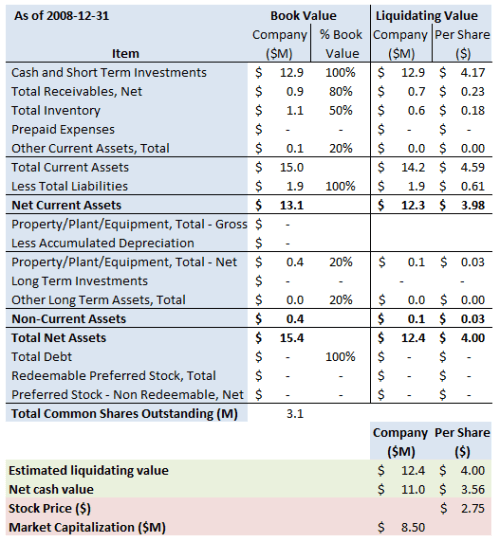
We started following ARCW on January 28, 2009 (see our post archive here) because it was a net cash stock with an activist investor, Brean Murray Carret, disclosing a 13.9% position on November 3 last year. ARCW closed yesterday at $2.75, giving it a market capitalization of just $8.5M. We initially estimated its liquidation value to be around $13.9M or $4.49 per share. After reviewing the 10K, we’ve now reduced our estimate of the liquidation value to $12.4M or $4.00 per share. The decrease is mostly attributable to cash used to fund operating losses in 2008. Brean Murray Carret’s original 13D filing disclosed its intention to tip out ARCW’s board and “nominate an alternative slate of directors for election to [ARCW’s]’s Board of Directors at the earliest possible opportunity.” Its subsequent 13D filing indicated that this occurred quickly, and Brean Murray Carret’s nominees were elected by the board of ARCW on November 12, 2008. Unfortunately for us, it seems Brean Murray Carret will run the business rather than realize the assets.

The value proposition updated

ARCW is a loss-making, generally cash-consuming company. The company’s balance sheet has, however, retained some value (the “Book Value” column shows the assets as they are carried in the financial statements, and the “Liquidating Value” column shows our estimate of the value of the assets in a liquidation):

arcw-summary-2008-12-31

Off-balance sheet arrangements and contractual obligations

According to the 10K, ARCW has no off-balance sheet arrangements and its contractual obligations are $0.9M in total.

The value remaining on ARCW’s balance sheet is as a result of its sale in 2006 of its wholly owned subsidiary Winncom for $17M. The company has since burned through some of that cash, but it does still have a net cash value of $11.0M or $3.56 per share.

The catalyst

We missed this in our initial analysis, but fortunately commenter Chad was awake. One disappointing development in ARCW since Brean Murray Carret got control of the board has been the company’s entry into a “financial advisory engagement” with Quadrant Management, Inc., which is under common control with Brean Murray Carret and Mr. Hassan Nemazee. Between them, they beneficially own 27.5% of ARCW. Pursuant to the “financial advisory engagement,” Quadrant provides to ARCW “financial advisory and business consulting services, including restructuring services.” ARCW pays the following: 1) an initial cash fee of $250,000; 2) an annual fee of the greater of (i) $250,000, or (ii) 20% of any increase in reported earnings before interest, taxes, depreciation and amortization after adjusting for one-time and non-recurring items for the current financial year over preceding year, or (iii) 20% of reported EBITDA for the current financial year, and; 3) all reasonable out-of-pocket expenses incurred by Quadrant in performing services under the engagement.

[Full Disclosure:  We do not have a holding in ARCW. This is neither a recommendation to buy or sell any securities. All information provided believed to be reliable and presented for information purposes only. Do your own research before investing in any security.]

Read Full Post »

Steven M. Davidoff, The Deal Professor, has an analysis of the proxy fight between William. A. Ackman’s Pershing Square Capital and Target Corporation (NYSE:TGT) in his NYTimes.com DealBook column, Target’s Challenge.  Pershing Square has fund dedicated to its investment in TGT, which Davidoff says controls 7.9% of the company through stock and call options. TGT has a staggered board with twelve directors, four of whom are up for reelection for this year’s meeting, which is scheduled for May 28. Pershing Square, claiming that TGT’s board really comprises thirteen members, has submitted a slate comprising five nominees.

Davidoff writes that Pershing Square’s claim of an extra member relates to Robert J. Ulrich’s resignation from the board in January this year:

Pershing contends that, under Target’s articles of incorporation, the board does not automatically shrink as a result of a resignation; rather, a vacancy is created – in this case, a vacancy for a 13th director to be elected this year.

Pershing bases its claim on Article VI of Target’s articles of incorporation. The article states that:

The business and affairs of the corporation shall be managed by or under the direction of a Board of Directors consisting of not less than five nor more than twenty-one persons, who need not be shareholders. The number of directors may be increased by the shareholders or Board of Directors or decreased by the shareholders from the number of directors on the Board of Directors immediately prior to the effective date of this Article VI; provided, however, that any change in the number of directors on the Board of Directors (including, without limitation, changes at annual meetings of shareholders) shall be approved by the affirmative vote of not less than seventy-five percent (75%) of the votes entitled to be cast by the holders of all then outstanding shares of Voting Stock (as defined in Article IV), voting together as a single class, unless such change shall have been approved by a majority of the entire Board of Directors.”

(emphasis added)

Pershing bases its argument on the italicized language, which states that only a 75 percent vote of the shareholders can reduce the size of the board. Target has disputed this claim, presumably relying instead upon the clause after the italicized language, which provides the power to the board to approve the change.

Target is claiming that the clause modifies the entire requirement for shareholder approval. In contrast, I presume that Pershing is claiming that this language modifies only the part about a 75 percent vote requirement, and otherwise a shareholder vote is mandatory. The ambiguity is certainly there, and given the penchant of courts to interpret articles and bylaws against the drafting companies and in favor of the shareholder franchise, Pershing has a viable claim. It would be more certain if Target were incorporated in Delaware, but it is actually incorporated in Minnesota.

Last week, Pershing offered to arbitrate the issue. Instead, Target has simply and rather cleverly put the matter to its shareholders in its proxy filed Monday. Target has ceded the issue to its shareholders, and asserted that because the change has been approved by a majority of the board of directors, it now only needs the affirmative vote of the majority of the outstanding shares of Target common stock voting at a meeting where the quorum requirement is met. Thus, Target has avoided an initial litigation skirmish that it had a real chance of losing, while appearing shareholder-friendly at the same time. A nice trick.

A nice trick indeed. It seems to us that the net effect of TGT’s fancy footwork is to reduce the threshold for the resolution to shrink the board from 75% of the votes entitled to be cast to a simple majority, which could have been their intention all along. As we’ve discussed recently in the context of the Biotechnology Value Fund (BVF) proxy fight for the board of Avigen Inc (NASDAQ:AVGN) (see our post archive here), achieving a supermajority is nigh on impossible. In BVF’s case it was two-thirds, rather than three-quarters, of the votes entitled to be cast. BVF was unable to get over the line, even at that slightly lower threshold, though they held around 30% of AVGN’s stock and therefore only needed the support of a little over half of the other stockholders. We believe that BVF was ultimately unsuccessful because 30% of AVGN’s stockholders neglected to vote at all, and those votes not cast counted for the incumbents. TGT is clearly concerned it might find itself in a similar position. Even though TGT has the distinct advantage of being the incumbent, they clearly recognize that the 75% threshold is improbably high. At such a high threshold, votes not cast can be fatal to the resolution, so they’ve taken measures to reduce the threshold to a simple majority. We think this will still prove too high for the incumbents, but it’s a nice card to play if you have it in your hand to do so. Davidoff notes that only Pershing Square has nominated a fifth director to take office. This means that if the resolution does not pass and TGT’s board remains at thirteen members, one of Pershing Square’s nominees is automatically elected. We’ll watch the outcome with interest.

Read Full Post »

MathStar Inc (OTC:MATH) has filed its 10K for the year ended December 31, 2008.

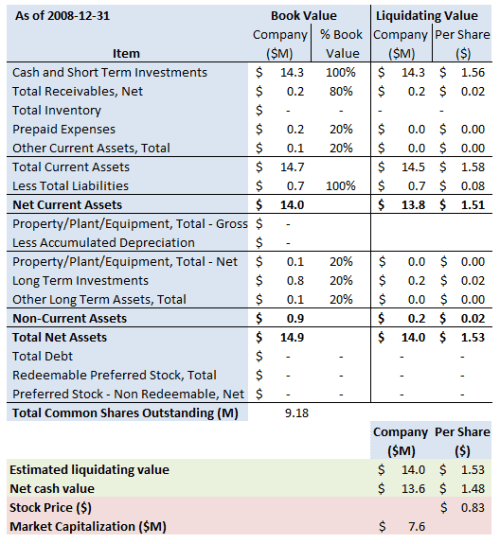
We’ve been following MATH since December last year (see our post archive here) when it was trading at $0.68. We initiated the position because MATH is a net cash stock with two substantial stockholders lobbying management to liquidate. The stock is up 21.3% to $0.825 yesterday, giving it a market capitalization of $7.6M. We initially estimated MATH’s liquidation value to be $14.4M or $1.57 per share. The balance sheet had around $14M or $1.52 per share in value at December 31. Adjusting for contractual obligations and another quarter of cash burn at say $0.6M per quarter, we now estimate MATH’s liquidation value to be around $12.0M or $1.31 per share. That value is predominantly cash and short term investments and doesn’t take into account any further value that the sale of the FPOA technology and intellectual property may yield. The two activist investors, Mr. Zachary McAdoo of The Zanett Group and Mr. Salvatore Muoio of S. Muoio & Co., have been urging MATH’s board to consider liquidation rather than a merger. MATH’s board seems to agree, twice rejecting unsolicited merger proposals, suspending the company’s operations and exploring “strategic alternatives, which could include merger, acquisition, increasing operations in another structure or liquidation.” From the 10K:

During the three months ended June 30, 2008, we announced a curtailment of operations as our Board evaluated strategic alternatives. Strategic alternatives that are being evaluated by our Board of Directors and management include, but are not limited to, restarting the company; merging with or acquiring another company, including or excluding our intellectual property (IP); increasing operations in another structure; or liquidation. The primary criteria for determining the strategic alternative is to maximize shareholder value, which may or may not include the use of the accumulated net operating losses (NOL). Although we have curtailed operations, we have met all financial obligations with vendors, key suppliers, and strategic partners. We have engaged a third party investment banking firm to explore the sale of intellectual property and patents and potential merger and acquisition alternatives.

The value proposition updated

MATH has rapidly burned cash throughout the year, mainly on research and development. The company has now put a stop to its R&D activities, which has reduced the cash burn significantly from $1.6M in the September quarter to $0.4M in the December quarter. The company’s value rests on its vestigial holding of cash and equivalents (the “Book Value” column shows the assets as they are carried in the financial statements, and the “Liquidating Value” column shows our estimate of the value of the assets in a liquidation):

math-summary-2008-12-31

Off-balance sheet arrangements and contractual obligations

According to MATH’s 10K, it has no off-balance sheet arrangements, but has around $1.4M in non-cancellable commitments for design licenses and operating leases.

Adjusting for the $1.4M in non-cancellable commitments for design licenses and operating leases and another quarter of cash burn at around $0.6M, we estimate the liquidation value to be around $12.0M or $1.31 per share.

Conclusion

At its $0.835 close yesterday, MATH has a market capitalization of just $7.6M. Our updated liquidation valuation is still some 60% higher at $12.0M or $1.31 per share, so we believe that MATH still represents good value. With other potentially valuable assets and Messrs. McAdoo and Muoio pushing the board to liquidate the company, we’re going to maintain our position in MATH.

[Full Disclosure:  We do not have a holding in MATH. This is neither a recommendation to buy or sell any securities. All information provided believed to be reliable and presented for information purposes only. Do your own research before investing in any security.]

Read Full Post »

Neurobiological Technologies Inc (NASDAQ:NTII) has engaged a financial adviser to explore a sale of the company or its major assets to determine “if there is a transaction more beneficial to our shareholders than a liquidation,” according to its CEO, William Fletcher.

We’ve been following NTII (see our post archive here) because it’s trading at a substantial discount to our estimate of its liquidating value and stockholders representing at least 45% of its stock (one stockholder estimates 65%) have called for its liquidation. NTII is up 25% from $0.53 when we started following it to close yesterday at $0.66. At yesterday’s close, NTII has a market capitalization of just $17.8M, which is around 80% of our estimate of its $21.9M or $0.81 per share liquidation value. There exists the possibility that its liquidation value is significantly higher again if NTII receives a portion of the net proceeds paid to Celtic Pharmaceuticals upon a sale of XERECEPT. The company’s decision to explore a sale or liquidation is welcome news. With Biotechnology Value Fund, Millennium Technology Value Partners and Highland Capital Management, holding approximately 45% of NTII’s outstanding stock and calling for its liquidation, we feel the company will be under some pressure to accede and that should lead to a reasonably quick resolution.

Reuters has the article:

March 26 (Reuters) – Neurobiological Technologies Inc (NTII.O) said it was evaluating a potential sale of the company or its major assets and had hired a financial adviser to help with the process.

“We have retained RBC Capital Markets to assist us in efficiently determining if there is a transaction more beneficial to our shareholders than a liquidation,” acting Chief Executive William Fletcher said.

In January, the company had suspended further development of Viprinex, its drug for acute ischemic stroke, and cut about 75 percent of its workforce.

Thanks JM.

[Full Disclosure:  We do not have a holding in NTII. This is neither a recommendation to buy or sell any securities. All information provided believed to be reliable and presented for information purposes only. Do your own research before investing in any security.]

Read Full Post »

In an opinion piece for the New York Times titled, We’re Not the Boss of A.I.G., Carl Icahn argues that the legal “devices” that disenfranchise shareholders “can be found at the root of today’s financial crisis:”

The legal landscape is filled with devices designed by state legislators and courts to prevent shareholders from influencing how companies are run and so allow management free rein. Legal mechanisms known as poison pills, permitted under the laws of most states, effectively prohibit shareholders from accumulating a large position in a company or working with other large shareholders to influence the company.

Furthermore, public corporations may legally adopt a staggered board, whereby board members are grouped into classes, with each one representing about a third of the total number of directors, so that only one class comes up for election in a year.

This means that seriously shaking up a board would require at least two very expensive proxy contests over two years. And current state laws permit incumbent board members access to the corporate treasury, allowing them to spend millions of dollars, to hire lawyers and public relations firms, run ads and mail materials to prevent shareholders from adding their designees to the board of directors.

One problem identified by Icahn is complex “advance notice” requirements that enable companies to derail efforts to elect shareholder-nominated board members:

Although a majority shareholder like the government may be able to get its nominees onto the A.I.G. board without a fight, typically even a large shareholder must conduct an expensive proxy contest to elect its nominees – that is, he needs to solicit enough votes from other shareholders. This is accomplished by mailing a statement describing the shareholder’s positions, and a card on which to vote. At a large public company, mailing, printing and other costs can run into the millions of dollars.

Icahm has a typically straight-forward solution to the problem:

Those costs could be reduced, and the election process could be made more open, if the Securities and Exchange Commission would allow “proxy access.”

Proxy access would permit shareholders to solicit votes for the election of their nominees by including the names and other relevant information about those nominees in their company’s annual proxy statement, and thus save the cost of sending additional documents. But so far the S.E.C. has said no to proxy access for the election of directors nominated by shareholders, though its new chairwoman, Mary Schapiro, said on Thursday that the commission will take up the issue in the coming months.

Echoing his thoughts in an earlier essay published in the Wall Street Journal, Icahn also argues that allowing shareholders to vote by simple majority to migrate a company from its state of incorporation to more shareholder-friendly states would stop many of the abuses:

With some exceptions, our public corporations are increasingly unable to compete globally, they pay excessive compensation to top brass and they are generally unaccountable to shareholders. The best hope to change this situation is to allow shareholders the power to move the state of incorporation of public companies from one state to another. For example, North Dakota passed a law in 2007 that, among other things, provides for proxy access and for the reimbursement of expenses to a shareholder who runs a successful proxy fight. A move to North Dakota would greatly advance shareholder rights for any company.

But under current state law shareholders can elect to move their company to another jurisdiction only if the existing board of directors approves such a move — and those incumbent boards will want to stay in the management-friendly states they already inhabit.

Federal legislation could correct this absurdity and permit shareholders to move the corporations they own to another state by a simple majority vote. Such legislation would override the restrictions of state laws that prevent such a change of jurisdiction unless approved by the board of directors. Most important, it would encourage the states, which profit from the tax revenues that flow from corporations, to compete with one another by reorienting their laws on corporate governance to benefit shareholders.

According to Icahn, a possible silver lining to the A.I.G. mess is that it will “alert Washington to the lamentable state of corporate governance in America:”

Our legislators will find – as I have as a shareholder who has waged many battles to get on corporate boards – that the rights of the shareholders are quite circumscribed.

It is time to remove the many devices that managements use to entrench their power, and give shareholders real power. The “ownership” rights that the government, as a shareholder, is now talking about are the same ones that activist shareholders have been demanding for years.

Read Full Post »

« Newer Posts - Older Posts »