Feeds:
Posts
Comments

Archive for the ‘Activist Investors’ Category

Autobytel Inc’s (NASDAQ:ABTL) board has responded to Trilogy, Inc’s $0.35 per share tender offer, calling it “grossly inadequate” and “unequivocally” recommending that stockholders reject it.

We started following ABTL (see our post archive here) because it was trading at a substantial discount to its liquidation and net cash values and Trilogy had filed a 13D notice disclosing a 7.4% holding. Trilogy has now launched a tender offer for ABTL at $0.35 per share, which is at our estimate of ABTL’s $15.4M or $0.34 per share net cash value, but at a substantial discount to our estimate of ABTL’s $24.3M or $0.54 per share liquidation value. When Trilogy launched its offer, we wrote that we believed that $0.35 per share was only the opening salvo and a higher price was possible if the board terminated the rights plan poison pill. The stock closed yesterday at $0.515, which is a huge 47% premium to Trilogy’s offer price and suggests the market is also anticipating a higher offer. The stock is up 19.8% since we started following it in December.

Here’s the letter from ABTL:

April 27, 2009

Dear Stockholder:

On Monday, April 20, 2009, I received a letter from Trilogy Enterprises, Inc. (“Trilogy”) indicating that Trilogy had launched a tender offer for all of Autobytel Inc.’s (our “Company”) outstanding shares of common stock at $0.35 per share.

Our Board of Directors (our “Board”), in consultation with its legal and financial advisors, has evaluated Trilogy’s offer and has found Trilogy’s $0.35 offer price to be grossly inadequate and unequivocally recommends to stockholders that they reject Trilogy’s offer and not tender their shares to Trilogy.

Our Board also believes that the combination of actions taken by our Company as described below will result in our stockholders achieving significantly more value than the offer made by Trilogy. In reaching its decision to recommend that stockholders reject the Trilogy offer and not tender their shares to Trilogy, our Board considered many factors, including:

• Our Company’s strong balance sheet and current cash and receivables position, noting, in particular, that our Company’s cash position alone is substantially in excess of Trilogy’s offer.

• The initial reaction of the securities trading markets to Trilogy’s offer appears to support our Board’s decision that the offer price is inadequate.

• The recent thorough evaluation of strategic alternatives conducted by our Board, including the possible sale of our Company, which concluded that selling our Company in today’s environment was not in the best interest of maximizing value.

• The indications of interest received and offers from potential buyers for our Company as a result of the sale process.

• Inquiries made to our Company’s financial advisor by other interested parties in response to Trilogy’s offer.

• The reasons for the Board’s decision to terminate the sale process, including:

• The value of our Company’s websites; and

• The value of our Company’s intellectual property, particularly its patents, which resulted in a $20 million settlement with the Dealix Corporation in 2006 and most recently settlements with Edmunds.com, Internet Brands, InsWeb and Lead Point that will provide our Company with valuable content, images, shopping and interactive tools and data for our websites.

• Other strategic alternatives being evaluated by our Board and management team.

• The belief that Trilogy is being opportunist in exploiting a recent extreme price decline in our common stock and use of confidential information about our Company obtained by Trilogy under a non-disclosure agreement.

Based upon the above, our Board recommends that you reject Trilogy’s offer and not tender your shares of common stock for purchase by Trilogy.

In addition, we encourage you to read the enclosed Schedule 14D-9, which provides further details with regard to our Board’s recommendation and discusses the factors that our Board carefully considered and evaluated in making its decision to reject Trilogy’s offer.

If you have any questions, please do not hesitate to contact our information agent, MacKenzie Partners, Inc., at the following numbers: Toll-Free 1-800-322-2885 or at 1-212-929-5500 (collect) or by email at autobytel@mackenziepartners.com.

On Behalf of the Board of Directors,

Jeffrey H. Coats
President and Chief Executive Officer

At $0.515, ABTL has a market capitalization of $23.3M, which is approaching our estimate of its $0.54 per share liquidation value. We’re planning to maintain the position as we believe a higher bid is on the cards and Trilogy will know that it is unlikely to get sufficient acceptances at a discount to ABTL’s liquidation value.

[Full Disclosure:  We do not have a holding in ABTL. This is neither a recommendation to buy or sell any securities. All information provided believed to be reliable and presented for information purposes only. Do your own research before investing in any security.]

Read Full Post »

Portfolio has a profile on Bill Ackman by

On starting Gotham Partners:

Ackman entertained the notion that he and Berkowitz might be able to raise tens of millions of dollars for Gotham’s launch-and he managed to talk his way into meeting with many of the wealthy and powerful moguls that he’d set his sights on. He pitched real estate scion Tom Durst and proposed three investment ideas to demonstrate Gotham’s research capacity. Durst declined to invest with the firm but then, according to Ackman, put his own money to work in the companies that Ackman and Berkowitz had recommended. After each had big gains in a matter of months, Durst came back to them and agreed to put money into their fund.

Gotham didn’t come up with anything close to Ackman’s hoped-for sum, mustering only $3.1 million. But in 1993, he and Berkowitz went ahead and launched the fund anyway. In time, Gotham gathered in millions. The Ziff family came in early; legendary investors such as Jack Nash, Leon Levy, Michael Steinhardt, and Seth Klarman also put money in.

In 1994, Gotham bought shares in a real estate investment trust poised to take control of Rockefeller Center, effectively becoming the largest holder of the real estate complex. At the time, the New York commercial real estate market was in a devastating slump. Thrusting himself into a highly publicized takeover battle, Ackman scored huge returns on his investment when the REIT was bought. He was on the map.

On his Farmer Mac investment:

Over the next three years, his fund averaged returns of 40 percent annually after fees. Gotham hardly ever shorted or bet against companies. But one day in early 2002, Whitney Tilson, a friend of Ackman’s since their days at Harvard College, called him at home to recommend that he buy a stake in a company called Farmer Mac, the Fannie Mae of farm mortgages. Ackman printed the annual report and started reading it around 9 that night. Riveted, he continued past midnight. He called Tilson first thing the next morning, excited. Farmer Mac was indeed an opportunity, but Tilson had it wrong. Ackman didn’t want to buy the stock; he wanted to short it.

Gotham placed its bearish bets. Then Ackman confronted a problem-how to get his negative message out. He began by talking to a reporter at the New York Times but didn’t think the resulting story made the case strongly enough, so he set up a website for the express purpose of displaying a report he wrote, with disclosures that his fund was short Farmer Mac’s stock. Going public on a short is an invitation to be attacked by companies and investors.

Ackman relished the frenzy that ensued. He’s still proud of the report’s title, “Buying the Farm.” And he profited spectacularly from the results: By fall, Farmer Mac’s stock had collapsed.

The first confrontation with MBIA:

Fresh from the Farmer Mac success, Ackman launched an audacious assault on MBIA, a company at the center of both Wall Street and state and local finance across the country. This move would prove remarkably insightful once the financial crisis hit, but vindication would be years in coming. First, Ackman was forced to undergo a remarkable battle with the company and its regulators.

MBIA dominated a sleepy, safe, and wonderful business: insuring municipal bonds from default. Since muni bonds almost never defaulted, MBIA almost never had to pay off the insurance. But when Ackman surveyed the company’s filings, he realized that MBIA had, to a degree utterly unrecognized by Wall Street, shifted into the business of insuring a vast array of much more dangerous paper: collateralized-debt obligations, or CDOs, which were constructed by the big banks to combine the bonds of multiple companies.

Expecting MBIA to default, Gotham began buying credit-default swaps, a form of short-selling in the unregulated derivatives market. If other investors became worried that MBIA would default, Ackman could sell the credit-default swaps for a gain; if MBIA actually did default, he would make a king’s ransom.

MBIA got wind of Ackman’s research and asked to meet with him. On November 21, 2002, Gotham representatives sat down with top MBIA executives. As people who were there recall the meeting, Jay Brown, the CEO of MBIA, began by saying how long he had been in the insurance business. “No one has ever questioned my reputation or my company’s,” he said. “You are using an unregulated market to manipulate a regulated market,” referring to MBIA’s insurance business. “You’re a young guy. It’s early in your career. You want to think very hard before you release that report,” Brown said, pointing out that MBIA was the largest guarantor of municipal bonds in New York State and the country.

“Is there anything you disagree with or that’s factually inaccurate?” Ackman asked.

“This is not about the facts,” Brown replied. “Let’s put it this way: We have friends in high places.” (An MBIA spokesperson says that the purpose of the meeting was to learn Ackman’s intentions and to request an early copy of his report to be able to point out any inaccuracies.)

The tense encounter lasted less than a half-hour. As they walked out, Ackman’s analyst shook Brown’s hand. Ackman then held his hand out to the CEO. Brown looked at it, lifted his arm up, and said, “I don’t think so.”

The article is worth a look. See it quick before Portfolio goes the way of the Dodo.

Read Full Post »

Empirical Finance Research Blog has a review of a new paper, Hedge Fund Activism, Corporate Governance, and Firm Performance, which finds that the “market reacts favorably to hedge fund activism, as the abnormal return upon announcement of potential activism is in the range of seven percent, with no return reversal during the subsequent year.” Further, the paper “provides important new evidence on the mechanisms and effects of informed shareholder monitoring.”

The authors seek to address the questions posed by “critics and regulators” about the benefits of hedge fund activism to shareholders and the claim that hedge fund activists “destroy value by distracting managers from long-term projects.” Specifically, the paper seeks to answer the following questions:

  • Which firms do activists target and how do those targets respond?
  • How does the market react to the announcement of activism?
  • Do activists succeed in implementing their objectives?
  • Are activists short-term in focus?

We’ve set out below brief answers to the questions posed in the paper:

Which firms do activists target and how do those targets respond?

Hedge fund activists tend to target companies that are typically “value” firms, with low market value relative to book value, although they are profitable with sound operating cash flows and return on assets. Payout at these companies before intervention is lower than that of a matched sample. Target companies also have more takeover defenses and pay their CEOs more than comparable companies. Relatively few targeted companies are large-cap firms, which is not surprising given the relatively high cost of amassing a meaningful stake in such a target. Targets exhibit significantly higher institutional ownership and trading liquidity. These characteristics make it easier for activists to acquire a significant stake quickly.

How does the market react to the announcement of activism?

We find that the market reacts favorably to activism, consistent with the view that it creates value. The filing of a Schedule 13D revealing an activist fund’s investment in a target firm results in large positive average abnormal returns, in the range of 7 to 8 percent, during the (-20,+20) announcement window. The increase in both price and abnormal trading volume of target shares begins one to ten days prior to filing. We find that the positive returns at announcement are not reversed over time, as there is no evidence of a negative abnormal drift during the one-year period subsequent to the announcement. We also document that the positive abnormal returns are only marginally lower for hedge funds that disclosed substantial ownership positions (through quarterly Form 13F filings) before they file a Schedule 13D, which is consistent with the view that the abnormal returns are due to new information about activism, not merely that about stock picking. Moreover, target prices decline upon the exit of a hedge fund only after it has been unsuccessful, which indicates that the information reflected in the positive announcement returns conveys the market’s expectation for the success of activism.

Activism that targets the sale of the company or changes in business strategy, such as refocusing and spinning-off non-core assets, is associated with the largest positive abnormal partial effects of 8.54 percent and 5.95 percent, respectively (the latter figure is lower than the overall sample average because most events target multiple issues). This evidence suggests that hedge funds are able to create value when they see large allocative inefficiencies. In contrast, we find that the market response to capital-structure related activism – including debt restructuring, recapitalization, dividends, and share repurchases – is positive, yet insignificant. We find a similar lack of statistically meaningful reaction for governance-related activism-including attempts to rescind take-over defenses, to oust CEOs, to enhance board independence, and to curtail CEO compensation. Hedge funds with a track record of successful activism generate higher returns, as do hedge funds that initiate activism with hostile tactics.

Do activists succeed in implementing their objectives?

The positive market reaction is also consistent with ex-post evidence of overall improved performance at target firms. On average, from the year before announcement to the year after, total payout increases by 0.3-0.5 percentage points (as a percentage of the market value of equity, relative to an all-sample mean of 2.2 percentage points), and book value leverage increases by 1.3-1.4 percentage points (relative to an all-sample mean of 33.5 percentage points). Both changes are consistent with a reduction of agency problems associated with free cash flow and subject managers to increased market discipline.

We also find improvement in return on assets and operating profit margins, but this takes longer to happen. The post-event year sees little change compared to the year prior to intervention. However, EBITDA/Assets (EBITDA/Sales) at target firms increase by 0.9-1.5 (4.7-5.8) percentage points by two years after intervention. Analyst expectations also suggest improved prospects at target firms after hedge fund intervention. During the months before Schedule 13D filings, analysts downgrade (future) targets more than they upgrade them whereas after intervention is announced analysts maintain neutral ratings. Given that successful activism often leads to attrition through sale of the target company, ex post performance analysis based on surviving firms may underestimate the positive effect of activism.

Are activists short-term in focus?

Hedge fund activists are not short-term in focus, as some critics have claimed. The median holding period for completed deals is about one year, calculated as running from the date a hedge fund files a Schedule 13D to the date when the fund no longer holds a significant stake in a target company. The calculation substantially understates the actual median holding period, because it necessarily excludes events where no exit information is available by March 2007. Analysis of portfolio turnover rates of the funds in our sample suggests holding periods of closer to twenty months.

Empirical Finance Research has some tips for implementing the “hedge fund activist alpha strategy” based on their experience watching real-world activists work their magic:

1. Focus on small companies

2. Watch for activists who are entering companies at the same time mutual funds are dumping (watch for 13-G’s filed concurrently with 13Ds). This way you can buy at cheap prices while the mutual funds are putting pressure on the stock. Eventually, the selling pressure is gone AND you have an activist there to make sure the ship is sailing straight ahead.

3. Call the company in question and assess how ‘open’ they are. Sometimes even the best activist campaign can’t beat an overly entrenched and crooked management.

4. Call the activist and get a feel for what they want to do with the company. In my experience, activist investors are usually class-act capitalists and may give you hints as to the direction they want to take a company.

5. Do your own due diligence and determine where the ‘hidden’ value is located. If you have an assessment of exactly what the activist is after, you may be able to determine how successful they will be in their attempts to unlock this value. Here is a quick example. If you determine the activist wants to unlock value when there is a discrepancy between the value of an asset on the books and the value of an asset in the real-world (i.e. a real estate holding), but you determine that selling the asset would be a nightmare (maybe you live down the street from the property) and/or involves abusive tax treatment that not many people understand, you may shy away from following the activist.

Read Full Post »

In Ackman and Target Tangle in Ballot Brawl, The New York Times’ Dealbook has coverage of the “universal ballot” spat between William A. Ackman’s Pershing Square Capital and Target Corporation (NYSE:TGT).  A candidate on Pershing Square’s ticket, Ronald J. Gilson, who is a law professor at Stanford University and an expert in corporate governance, has proposed that TGT place all the nominees running for election to the board on a single ballot, the so-called “universal ballot.” Presently, shareholders in most proxy fights receive two proxy cards and can vote only for one slate of candidates. Gilson’s proposal would give TGT’s shareholders the chance to pick candidates from both management and Pershing Square’s proxies.

Dealbook reports that the shareholder advisory firm RickMetrics Group support the universal ballot proposal:

“Pershing appears to be astutely exploiting the current pro-(shareholder)-choice zeitgeist, and puts Target on its back foot,” RiskMetrics said in a research note issued Tuesday. “It will be challenging for Target, absent some sort of unwaivable legal impediment, to argue against Pershing’s proposal without coming across as anti-shareholder.”

Here is Gilson’s letter to the board:

RONALD J. GILSON

Charles J. Meyers Professor
of Law and Business

April 21, 2009

Mr. Gregg Steinhafel
Chairman of the Board
Chief Executive Officer and President
Mr. Timothy R. Baer
Executive Vice President
Corporate Secretary and General Counsel
Target Corporation
1000 Nicollet Mall
Minneapolis, Minnesota 55403

Re: Proposal to Use a Universal Proxy at the2009 Annual Meeting of Shareholders

Dear Messrs. Steinhafel and Baer:

On March 17, 2009, Pershing Square Capital Management, L.P. publicly announced that its affiliates had delivered a Notice of Nomination to you proposing to nominate five individuals for election as directors of Target at the company’s 2009 Annual Meeting of Shareholders. I am one of those nominees.

Both Target and Pershing Square have a unique opportunity to make this election historic from a corporate governance perspective. As you may know, the press has reported that SEC chair Mary Schapiro has directed the Commission’s staff to draft proposals for rules governing shareholder proxy access by mid-May 2009. I expect those proposed rules will provide the opportunity for the use of a universal proxy card whereby shareholders can choose – on one proxy card – from among the candidates nominated both by the company and by shareholders. The benefit to shareholders, who may want to choose members from both slates, would be substantial.

I first wrote about the need to remove the barriers to non-control proxy contests some 19 years ago.1 The occasion then was to recommend a change in the bona fide nominee rule to allow a shareholder running a short slate to include the names of the company’s nominees on the shareholder’s proxy card. That recommendation was accepted by the SEC, as I recall at the urging of Mary Schapiro, who was then a Commissioner.

Target and Pershing Square now have the opportunity to proactively provide good corporate governance to the Target shareholders by making it convenient for them to make a choice in what, in the end, is their election. This is not a control contest. The qualifications of the candidates will be fully vetted by the time of the May 28th election, and Target shareholders are entirely capable of assessing the candidates and making a choice. There is simply no excuse to deny shareholders the benefit of the use of a universal proxy card. The alternative will make it procedurally more difficult for Target shareholders to exercise their franchise. This is a problem that we, together, have the power to solve.

I have received assurance from Pershing Square that they would support a universal proxy card for Target’s upcoming Annual Meeting. I now seek the same from you. In the alterative, I ask that you consider allowing the company’s nominees to be named on the Pershing Square Gold proxy card. In either instance, shareholders would have the benefit of being able to choose the best nominees for the job. Target now has the opportunity to hold an election that will be a credit to the company’s corporate governance. I urge you to carefully consider this proposal and do the right thing for Target shareholders.

Very truly yours,

/s/ Ronald J. Gilson

1 Ronald J. Gilson, Lilli A. Gordon & John Pound, How the Proxy Rules Discourage Constructive Engagement: Regulatory Barriers to Electing a Minority of Directors, 17 Journal of Corporate Law 29 (with L. Gordon & J. Pound) (1992).

Here is TGT’s response:

TARGET CORPORATION COMMENTS ON LETTER FROM PERSHING SQUARE NOMINEE RONALD GILSON

MINNEAPOLIS, April 21, 2009 – Target Corporation (NYSE:TGT) today commented on the letter from Pershing Square nominee, Professor Ronald J. Gilson, that Pershing Square filed with the Securities and Exchange Commission (“SEC”). In the letter, Professor Gilson references possible future SEC changes to the federal proxy rules and proposes the use of a universal proxy card by Target and Pershing Square. Pershing Square has initiated a proxy contest to elect its own nominees, including Professor Gilson, to Target’s Board of Directors.

The company said, “We believe Professor Gilson’s proposal, coming at this stage of the proxy contest, would cause delay and confusion. Shareholders have a clear choice between our independent nominees on our WHITE proxy card and Bill Ackman’s slate on Pershing Square’s gold proxy card. We note, as does Professor Gilson, that the SEC may be considering a proxy access proposal. Any such proposal should be allowed to proceed on an appropriate timetable allowing for careful review and consideration by the SEC of a number of issues, including whether proxy access should be available to an entity, like Pershing Square, which has initiated its own proxy contest. In the meantime, the current proxy rules provide a framework for the conduct of the proxy voting process that is perfectly adequate for resolving the issues that Pershing Square is raising.

“With Target’s Annual Meeting only five weeks away, we believe our shareholders clearly understand the choice between our independent directors and the Pershing Square slate. We will be mailing our proxy materials shortly and encourage our shareholders to use our WHITE proxy card to support the reelection of the directors nominated by our Board.”

Shareholders who have questions about voting or the matters to be voted upon at the Annual Meeting are encouraged to call MacKenzie Partners, Inc. at 800-322-2885 Toll-Free or Georgeson at 866-295-8105 Toll-Free. The company will hold the 2009 Annual Meeting of Shareholders on Thursday, May 28, 2009. Target will be distributing proxy materials to shareholders of record as of March 30, 2009.

And Pershing Square’s response:

Pershing Square Comments on
Target’s Objection to Universal Ballot Proposal

New York – Pershing Square Capital Management, L.P., and Professor Ronald J. Gilson, who has been nominated by Pershing Square to serve as an independent director of Target Corporation (NYSE: TGT), expressed disappointment with Target’s response to Professor Gilson’s letter seeking the use of a universal proxy card, naming both Target’s and Pershing Square’s nominees, for use in connection with Target’s upcoming Annual Meeting of Shareholders.

“Rather than causing confusion, the proposal would eliminate confusion by giving shareholders something they would otherwise lack – the simple chance to choose the best among all of the candidates, rather than between two slates of candidates.” commented Professor Gilson. Pershing Square believes that the adoption by both Target and Pershing Square of a universal proxy card would reflect best-in-class corporate governance, and would result in the most qualified directors being elected, regardless of which proxy card a shareholder returned.

On the universal proxy card proposal, Bill Ackman of Pershing Square said, “it’s important for shareholders to have a choice so that they can vote for whichever candidates they prefer, regardless of which proxy card they submit. Pershing Square wants to provide shareholders with that freedom of choice. We are hoping Target will as well.”

Because proxy cards have not yet been mailed, and because new proxy cards are easy to print from the company’s or Pershing Square’s website, Pershing Square does not believe that adopting a universal proxy card would add any material expense to the proxy contest. Pershing Square also noted that it would be willing to bear the additional printing costs of the universal proxy cards.

Furthermore, Target’s public explanation for its refusal to use a universal proxy card does not address why Target would not permit its nominees to be named on Pershing Square’s Gold proxy card. Indeed, based on the timing of Target’s public response, Pershing Square questions how the matter could have been raised with its Board of Directors and whether Target’s nominees were given the opportunity to consent to being named on a universal proxy card or Pershing Square’s Gold proxy card.

Pershing Square requests Target’s nominees for permission to be included on the Gold proxy card in the event that the company will not consent to a universal proxy card.

[Full Disclosure:  We do not have a holding in TGT. This is neither a recommendation to buy or sell any securities. All information provided believed to be reliable and presented for information purposes only. Do your own research before investing in any security.]

Read Full Post »

Autobytel Inc (NASDAQ:ABTL) has received a tender offer from Trilogy, Inc. at $0.35 per share. ABTL’s board is reviewing the offer and will advise its acceptence or rejection of the offer “on or before April 24, 2009.”

We started following ABTL (see our post archive here) because it was trading at a discount to its liquidation and net cash value and Trilogy, Inc. had been creeping up the register. Trilogy held 7.4% of ABTL’s outstanding stock prior to launching the tender offer. ABTL closed yesterday at $0.39, which is an 11% premium to Trilogy’s offer price, but still at a substantial discount to our estimate of ABTL’s liquidation value. We estimate that value to be around 38% higher still at $24.3M or $0.54 per share and ABTL’s net cash value to be around $15.4M or $0.34 per share.

Here’s Trilogy’s press release:

TRILOGY ENTERPRISES ANNOUNCES CASH TENDER OFFER FOR AUTOBYTEL AT $0.35 NET PER SHARE

AUSTIN, Texas, April 20, 2009 – Trilogy Enterprises, Inc. (“Trilogy”), a provider of technology powered business services to the automotive industry, today announced that its wholly-owned subsidiary, Infield Acquisition, Inc., has commenced a tender offer to acquire all of the outstanding shares of common stock of Autobytel Inc. (Nasdaq: ABTL) for $0.35 net per share in cash.

The offer represents a 32% premium over the trailing 30-day average closing price of Autobytel’s common stock.

“We are pleased to offer a significant premium to Autobytel’s shareholders, ” stated Sean Fallon, Senior Vice President of Trilogy. “The automotive industry is experiencing an unprecedented decline and we believe that Autobytel must take steps now to ensure its shareholders receive the highest value. Given the significant risks of this business and the Company’s history of operating losses, we believe the premium offered is very attractive.”

“As Autobytel’s second largest stockholder and the beneficial owner of approximately 7.4% of Autobytel’s outstanding common stock, we have studied this business carefully. We have concluded that Autobytel’s ability to execute a turnaround and realize significant value for its stockholders is subject to significant and unacceptable risk. We believe that a high-premium, all-cash tender offer is the most effective way to maximize value for all stockholders. As a result, we have determined it is necessary to take the offer directly to our fellow stockholders in order to deliver significant value to them as expeditiously as possible,” added Mr. Fallon.

“We are confident our fellow stockholders will find that this compelling offer reflects a superior value for their shares, both in light of Autobytel’s current and recent trading history, as well as any realistic near or long term assessment of Autobytel’s prospects. We are committed to completing this offer and remain willing to work cooperatively with Autobytel,” concluded Mr. Fallon.

The tender offer is scheduled to expire at 12:01 A.M., New York City time, on Tuesday, May 19, 2009, unless extended. The tender offer documents, including the Offer to Purchase and related Letter of Transmittal, will be filed today with the Securities and Exchange Commission (“SEC”). Autobytel’s stockholders may obtain copies of the tender offer documents when they become available at http://www.sec.gov. Free copies of such documents can also be obtained when they become available by calling Morrow & Co., LLC, toll-free at (800) 662-5200.

The tender offer was detailed in a letter dated April 20, 2009 from Trilogy to ABTL’s President and Chief Executive Officer, Jeffrey H. Coats, and ABTL’s Board of Directors. The full text of the letter is set forth below:

April 20, 2009
Autobytel Inc.
18872 MacArthur Boulevard, Suite 200
Irvine, California 92612-1400
Attention: Mr. Jeffrey H. Coats, President and Chief Executive Officer

Ladies and Gentlemen:

Trilogy Enterprises, Inc. (“Trilogy”), through its affiliates, owns approximately 7.4% of Autobytel Inc.’s (“Autobytel” or the “Company”) stock and is Autobytel’s second largest stockholder. We have successfully created and delivered innovative solutions to the automotive industry for more than a decade.

We believe Autobytel is facing a crucial period in its corporate existence. The automotive market is undergoing a crisis so severe that it is difficult to adequately describe. Strong companies may find a way forward. Weak companies will undoubtedly fail.

Unfortunately, Autobytel has historically struggled to create an independently viable business. For example:

• In 2006, Autobytel incurred operating losses of $40MM on $85MM in revenue;

• In 2007, Autobytel incurred operating losses of $35MM (not including litigation settlement costs) on $84MM in revenue; and

• In 2008, Autobytel incurred operating losses of $36MM (before impairment charges and litigation settlement costs) on $71MM in revenue, which declined by 15% from the prior year.

Autobytel has itself acknowledged that the market is “extremely challenging” and it expects the U.S. automotive industry to decline more than 20% in 2009. Given the market outlook, what should stockholders reasonably expect from a company that has not proven itself viable historically?

We recognize that Autobytel has taken steps to address this crisis. However, we do not believe the steps taken are adequate to address the severity of the situation. Autobytel facing another corporate reorganization during potentially the worst market in history seems highly unlikely to prevail. The current plan appears akin to “let’s give this one last shot”. Unfortunately, shareholder cash and value is at stake.

Given Autobytel’s business prospects and the significant historical and recent operating losses, the Board should take steps now to preserve as much shareholder value as possible. We believe the only means to accomplish this is the immediate sale of the business.

We are aware that Autobytel had engaged a financial advisor to evaluate the possible sale of the Company. Autobytel announced that its advisor conducted an extensive process which resulted in Autobytel concluding that shareholder value could not be maximized in the current environment. We assume this means no buyer desired to pay a price required by the Board.

Today, our wholly-owned subsidiary has commenced a tender offer that provides stockholders with an opportunity to sell shares at $0.35 per share in cash. We believe this price is likely lower than the share price the Board aspired to obtain during the recent sale process. However, we believe it is a full and fair value for the Company and offers both an attractive premium for stockholders, as well as immediate liquidity for a stock that is thinly traded.

We hereby request that the Board support the proposed tender offer, and in doing so, consider the following:

• The offer represents a 32% premium on the stock’s trailing 30 day closing price;

• The offer provides immediate liquidity for all stockholders;

• The trading volume reported for April is less than 65,000 shares per day, on over 45 million shares outstanding;

• The Company is a sub-scale public company and may not be able to continue to bear the costs and obligations of a public company;

• The Company cannot withstand another shift in strategy during what may be the worst market in history;

• The Company may not be able to continue to bear the costs of its management team, including the lucrative packages offered to its recent hires;

• The Company recently issued executive stock options at $0.35 per share, which the Company must believe is fair value;

• The Company had $32MM in cash in September and only $27MM in December;

• The Company continues to burn cash and is likely to do so for the foreseeable future. It is reasonable to believe that the Company may run out of cash by the end of 2010;

• Without at least breakeven results, stockholder value will only continue to deteriorate until no stockholder value remains;

• Any acquiror must take on the Company’s cash burn and fund the Company in a highly uncertain environment; and

• Any acquirer may have to invest significant additional funds into the Company to make it operationally efficient and competitive.

It is time to stop the erosion in stockholder value. Looking at where Autobytel’s stock price traded a year ago is not indicative of the true value of the Company, but it should serve as a reminder of the value that was destroyed. Autobytel’s management should realistically evaluate the prospects for its business. A candid assessment of that situation should lead management to conclude that an all cash offer at a significant premium to all Company stockholders is in the best interests of the stockholders.

We are pleased to make this proposal to our fellow stockholders. We believe they will find it to be attractive in light of both the Company’s trading history, and a realistic assessment of the Company’s prospects. We are committed to completing this offer and hopeful that we will be able to work cooperatively with the Company in doing so.
We look forward to your timely response.

Sincerely,
Trilogy Enterprises, Inc.

Trilogy’s offer is a little disappointing given that it is pitched at ABTL’s net cash value and at a large discount to its liquidation value. The discount is a direct result of the poison pill adopted by ABTL in 2004. From the most recent 10K:

Preferred Shares Purchase Rights Plan

In July 2004, the Board of Directors approved the adoption of a stockholder rights plan under which all stockholders of record as of August 10, 2004 received rights to purchase shares of Series A Junior Participating Preferred Stock. The rights were distributed as a non-taxable dividend and will expire July 30, 2014.

The rights will be exercisable only if a person or group acquires 15% or more of the common stock of the Company or announces a tender offer for 15% or more of the common stock. If a person or group acquires 15% or more of the common stock, all rightholders, except the acquirer, will be entitled to acquire at the then exercise price of a right that number of shares of the Company’s common stock which at the time will have a market value of two times the exercise price of the right. Under certain circumstances, all rightholders, other than the acquirer, will be entitled to receive at the then exercise price of a right that number of shares of common stock of the acquiring company which at the time will have a market value of two times the exercise price of the right. The initial exercise price of a right is $65.00.

The Board of Directors may terminate the rights plan at any time or redeem the rights prior to the time a person or group acquires more than 15% of the Company’s common stock.

In January 2009, the stockholder rights plan was amended to allow Coghill Capital Management LLC and certain of its affiliates (collectively “Coghill”) to hold up to 8,118,410 shares without becoming an acquiring person under the stockholders rights, subject to various conditions set forth in the amendment, including Coghill’s execution of and compliance with a standstill agreement.

We believe this is the opening salvo in Trilogy’s tender offer, and a higher price is possible if the board terminates the rights plan. We’ll watch the developments with interest.

[Full Disclosure:  We do not have a holding in ABTL. This is neither a recommendation to buy or sell any securities. All information provided believed to be reliable and presented for information purposes only. Do your own research before investing in any security.]

Read Full Post »

Facet Biotech Corporation (NASDAQ:FACT) is a new category of investment for us: special situations. It’s an activist play with a catalyst in the form of Dr. Roderick Wong’s nomination for the annual meeting of an alternative slate of directors, including well-known activist investor Robert. L. Chapman. The dissident slate has called for a cash dividend of up to $15 per share and demanded the sale of the other non-cash assets, estimating they may be worth an additional $8 to $16 per share, which represents a substantial upside at FACT’s $9.13 closing price yesterday. The company currently has a market capitalization of $216.8M. We estimate the liquidation value to be anywhere from nil to $259M or ~$10.85 per share and the net cash value from nil to $228M or $10.54 per share. The company is burning through its cash at a rapid rate, so the main risk to the investment is that the status quo is maintained. Although Wong et al hold only 0.5% of FACT’s outstanding stock, we think the presence of Bob Chapman and other noted activist and deep value investors on the register (Baupost Group holds ~18%) indicates a good chance of success for the dissidents. It’s not one for the Greenbackd Portfolio, but it’s an interesting play, so we’re creating a new Special Situations portfolio and adding FACT as our first holding.

About FACT

FACT is a biotechnology company spun out of PDL Biopharma, Inc. (PDL) in December last year. It operates what previously had been PDL’s biotechnology business. In the spin-off, PDL contributed to FACT certain intellectual property associated with the biotechnology business, $405 million in cash, an assignment of future payments from Biogen Idec Inc. and Bristol-Myers Squibb Company (BMS) and royalty and milestone revenues from certain other agreements. FACT is now engaged in “identifying and developing oncology therapeutics.” It has four antibodies in the clinic for “oncology and immunologic disease indications,” of which two are in phase II and two in phase I. The company has several “investigational compounds in various stages of development” for the treatment of cancer and immunologic diseases, three of which it is developing with Biogen Idec and one with BMS. The company’s investor relations website is here.

The value proposition

The company’s hard asset value (which excludes the PDL biotechnology business intellectual property) rests mainly on its holding of cash and equivalents contributed by PDL (the “Book Value” column shows the assets as they are carried in the financial statements, and the “Liquidating Value” column shows our estimate of the value of the assets in a liquidation):

fact-summary1

Balance sheet adjustments

We need to make the following adjustments to the balance sheet estimates above:

  • Cash burn: We’ve assumed cash burn to the annual meeting on May 26 of $40M (management estimates $90M for the year).
  • Off-balance sheet arrangements and contractual obligations: According to FACT’s 10K, it has no off-balance sheet arrangements, but its contractual obligations are extensive, including $220M in lease payments and related obligations, $10M in contract manufacturing obligations and $2M in equipment operating leases for a grand total of $234M.
  • Termination payments: If Wong’s nominees are elected to the board at the annual meeting, five officers will receive around $10M in termination payments. Not bad for a few quarters work. Those payments are pretty obscene, so we’ve set them out below:fact-termination1

If the company sustains another twelve months of cash burn and must pay out all its contractual obligations, it has next to no value in liquidation aside from the intellectual property associated with PDL’s biotechnology business, the value of which we can’t estimate. On that view, we estimate the liquidation to be nil. If the dissidents get control quickly, stop the cash burn and can sublease or assign the leases or otherwise negotiate the contractual obligations away, then we estimate liquidation value of around $259M or ~$10.85 per share and net cash value of $228M or $10.54 per share plus whatever PDL’s biotechnology IP is worth (the dissidents estimate between $8 and $16 per share). Of course, the dissidents have a different plan in mind, calling for an immediate cash dividend of up to $15 plus the sale of the company to crystalize the value of the non-cash assets.

The catalyst

The FACT situation kicked off with the dissident slate’s March 30 press release:

Facet Alternate Director Slate Proposed

Cash Dividend, Sale of Company Demanded

NEW YORK, March 30 /PRNewswire/ —

* Alternate Slate Delivered to Facet: On March 26, 2009, a proposed alternate slate of directors (the “Alternate Slate”) was delivered to Facet Biotech Corporation (“Facet,” or the “Company”; http://www.facetbiotech.com) CEO and President Faheem Hasnain (“Mr. Hasnain”), and to the Facet Board of Directors (the “Incumbent Board”), with a stated platform of maximizing shareholder value via a substantial cash dividend followed by a sale of the Company. Facet apparently has determined not to make immediate public disclosure to its owners that such an alternative to the Incumbent Board now is available.
* Alternate Slate Concern Heightened Following Dialog with Facet Management: Following receipt of notice of the Alternate Slate, Mr. Hasnain and CFO Andrew Guggenhime held a conference call with three members of the Alternate Slate, including nominating shareholder Dr. Roderick Wong. On the call, Dr. Wong expressed extreme dissatisfaction with the rapid cash-depleting business plan of the Company, expected to approach $100 million in 2009 alone. Moreover, the Alternate Slate made clear its view that a substantial cash dividend, followed by a sale of the Company, is favored by a preponderance of Facet’s owners. Based on the unsatisfactory response from Facet management to these presented views, the Alternate Slate determined it prudent to make public disclosure of its formation and of its conference call with the Company.
* Immediate And Substantial Cash Dividend Of Up To $15 Per Share Demanded: Subject to a review of the Facet 2008 Form 10-K, which should be released by the Company on March 31, 2009, the Alternate Slate is seeking the immediate distribution of a substantial portion – up to $15 per share – of the approximately $17 per share on the Company’s balance sheet as of December 31, 2008, followed by a sale of Facet.
* Non-Cash Assets May Be Worth An Additional $8 – $16 Per Share: Subject to further review, the Alternate Slate currently estimates that the Company’s non-cash assets, including the antibody technology platform and the drug candidates, could yield an additional $8 – $16 per share via a sale of the Company.
* Liquidation Demand From Alternate Slate Follows Similar Action At Other Companies: The Alternate Slate notes that similar demands were made of management at Northstar Neuroscience, Inc. and, most recently, at Avigen, Inc. As with Facet, investors in these two companies insisted upon and, appropriately, were rewarded with corporate liquidations.

As demonstrated by the Company’s public valuation near the low end of the range within the biotech sector, as measured by a variety of metrics, the Alternate Slate believes the preponderance of Facet shareholders have little confidence in the strategic plans supported by management and the Incumbent Board. Moreover, given that the top five (by percentage ownership per Securities and Exchange Commission public filings) Facet owners appear to represent over 45% of the outstanding shares, the Alternate Slate believes that the Company’s management and Incumbent Board may, with only modest effort, conclude that the majority of Facet investors agree with the cash dividend and sale platform endorsed by the Alternate Slate.

According to S.E.C. filings, these top-five holders are:

1. Baupost Group, LLC 16.68%
2. Iridian Asset Management, LLC 12.39%
3. Goldman Sachs Group, Inc. 6.20%
4. AXA 5.29%
5. Barclays Global Investors 4.82%

Dr. Roderick Wong then nominated an alternative slate of directors, including Philip R. Broenniman, Robert L. Chapman, Jr., David Gale, Bradd Gold and Roderick Wong. While we don’t know much about Wong, we’ve written about Bob Chapman before (see our earlier post, Where in the world is Chapman Capital). In response to Wong’s nomination, FACT sent the following letter to Wong on April 6:

Dear Dr. Wong:

We are in receipt of your letter dated March 26, 2009 and the accompanying notice of your intent to nominate directors at our 2009 Annual Meeting of Stockholders. We welcome the input of our stockholders, and our Board has considered the suggestions articulated in your letter and March 30, 2009 press release.

Our Board and management remain firmly committed to increasing the value of the Company to our stockholders. To this end, our Board has regularly evaluated the Company’s business plan as well as strategic alternatives to create value for our stockholders since the Company’s spin-off less than four months ago. In this regard, we note the following:

· Facet has undergone a rigorous analysis of its strategy, both in connection with our recent spin-off and subsequently.

· Our goal has been to focus on therapeutic areas that we believe hold the greatest opportunity for us to create meaningful value for our stockholders. As a result of our continued review and analysis, we are focusing our efforts on oncology.

· We believe our development programs and technology capabilities represent substantial potential value for our stockholders. Indeed, our collaborations with Bristol-Myers Squibb and Biogen Idec on certain of our development programs validate the value of these programs. We firmly believe that by continuing to advance these and other programs, as well as our proprietary protein engineering technology platform, we can enhance value for our stockholders.

· Furthermore, in an effort to maintain strict financial discipline, we have aggressively lowered our cost structure. In particular, as we recently announced, we have reduced our headcount and our overall anticipated cash utilization in 2009, thereby extending the time period for which we have funding.

We believe that our current Board, comprised of four independent directors and Faheem Hasnain, our President and Chief Executive Officer, and the management of the Company have a record of working to advance the interests of all stockholders, consistent with their fiduciary duty.

Based on our strategic review and ongoing analyses, the Board believes that our current strategic plan is the right plan to build value for our stockholders. Since we are committed to considering all

alternatives to creating value, we have reviewed your proposal for the liquidation of the Company. We have, however, unanimously concluded that the interests of our stockholders are best served by continuing to focus on executing our current strategy. Moreover, the Board believes that the assumptions stated in your March 30 press release with regard to the Company’s ability to distribute a significant cash dividend do not properly take into account, among other things, the Company’s significant lease and other obligations, which are detailed in the Company’s 2008 Annual Report on Form 10-K. Further, we believe that in this current economic environment, your proposals would significantly impair the Company’s ability to realize appropriate value for its existing assets.

Accordingly, we do not believe that your suggestions are in the best interests of our stockholders. We intend to maintain an open and active dialogue with our stockholders as we continue to work to enhance stockholder value.

Sincerely,

Brad Goodwin

Chairperson of the Board

Seth Klarman’s Baupost Group filed its 13D notice on April 8, disclosing a 17.8% holding in FACT. We’ve written extensively about Klarman’s liquidation value investment process (see our Klarman post archive here). Klarman is a noted deep value investor. While the Baupost Group’s position was built at a lower price than persists today, we feel reasonably comfortable following Klarman into a position.

Conclusion

FACT is a special situation: an activist play with an upside of $15 per share in a special cash dividend and an additional $8 to $16 per share upon the sale of the other non-cash assets. The downside is potentially unlimited. The dissidents appear to be led by Dr. Roderick Wong, and include noted activist investor Robert. L. Chapman. Seth Klarman’s Baupost Group, holds 17.8% according to its most recent 13D notice. The dissidents’ initial press release seems to imply that they have the support of stockholders representing 45% of the outstanding stock, although this is not independently verifiable. At its $9.13 closing price yesterday, the company has a market capitalization of $216.8M. We estimate the liquidation value to be anywhere from nil to $259M or ~$10.85 per share and the net cash value from nil to $228M or $10.54 per share. The company is burning through its cash at a rapid rate, so the main risk to the investment is that the status quo is maintained. We think the presence of Bob Chapman on the slate and Klarman’s Baupost Group on the register bodes well for the dissidents, so we’re adding FACT to our new Special Situations portfolio.

FACT closed yesterday at $9.13.

The S&P500 Index closed yesterday at 850.08.

Hat tip to John Allen.

[Full Disclosure:  We do not have a holding in FACT. This is neither a recommendation to buy or sell any securities. All information provided believed to be reliable and presented for information purposes only. Do your own research before investing in any security.]

Read Full Post »
Business Week has an article, Fighting takeovers by playing the debt card, describing Amylin Pharmaceuticals Inc.’s (NASDAQ:AMLN) attempts to fend off Carl Icahn through the use of a “Poison Put.” A poison put is a change-of-control debt covenant the effect of which is to require the borrower to pay back an outstanding loan if investors buy a sufficiently large stake in the company or elect a slate of directors. In this case, AMLN says it would be forced to pay back a $125M loan if Icahn’s slate gets control of its board, which could in turn cause it to default on up to $900M in debt. That makes AMLN an unpalatable activist target.

Business Week says the covenant is the “choice du jour” for an increasing number of companies seeking to avoid the attention of activists and raiders:

Many companies have such change of control covenants in their bond or loan agreements, among them J.C. Penney (JCP), Kroger (KR), Ingersoll-Rand (IR), and Dell (DELL). That’s not to say they would use them to ward off an Icahn. Nor is it clear how many companies are using these covenants to do so. But shareholder activists have little doubt that they have become a takeover defense. “[These change of control provisions] are designed to deter a proxy fight,” says Chris Young, director of mergers and acquisitions research for the shareholder advisory firm RiskMetrics Group (RMG).

Change in control provisions are nothing new. In fact they are a standard condition in most loan agreements:

Change of control provisions first began appearing in 1980 when corporate raiders started taking over companies and loading them up with debt. Concerned that these companies would be unable to pay back their loans, lenders insisted on covenants requiring them to repay their original lenders. These provisions became fashionable again during the private equity boom of recent years. Now, with credit tight, they have become a potent deterrent to corporate raiders leery of being forced to repay a company’s debt and then refinance the loans at higher rates.

What is new, however, is companies actively seeking the inclusion of such a covenant as a device to fend off a suitor, as Lions Gate Entertainment Corp. (USA) (NYSE:LGF) and Exelon Corporation (NYSE:EXC) seemed to do recently:

When JPMorgan Chase (JPM) extended Lions Gate’s revolving line of credit last year, the terms included a provision that triggers instant repayment if an investor buys more than 20% of the company’s stock. Since then Icahn has acquired 14% of Lions Gate. In late March, Lions Gate “strongly urged” investors-while taking no formal position-to scrutinize an offer by Icahn to buy $316 million in debt. (He could convert it into stock and boost his ownership stake.) In the same letter, Lions Gate, without mentioning Icahn, said it could be forced to repay both its bank debt and notes.

In another case, the giant electric utility Exelon (EXC) wants to buy rival NRG Energy (NRG) for $5 billion and is waging a proxy battle to elect nine members to NRG’s board. In a letter to shareholders, NRG warned that such an outcome would trigger “an acceleration” of its $8 billion of debt. Exelon General Counsel William A. Von Hoene Jr. counters that NRG is “using the debt issue as a threat” to scare off NRG’s shareholders from considering its bid.

AMLN shareholders aren’t taking it lying down. The San Antonio Fire & Police Pension Fund, an AMLN investor, has sued the company for agreeing to the poison put about the time takeover speculation began in 2007. For its part, AMLN says it has since tried unsuccessfully to get bondholders to waive a provision blocking outsiders from taking over the board and has asked its bankers for a similar waiver. Steven M. Davidoff, The Deal Professor, has a superb analysis of the issues in his NYTimes.com DealBook column, Icahn, Amylin and the New Nuances of Activist Investing. Says Davidoff:

The pension fund’s claim is mainly that these poison put provisions are void. In support of this claim, the plaintiff appears to be arguing that the provision violates the Unocal standard in Delaware, which requires that director action in response to a threat to the corporation not be coercive vis-à-vis stockholders.

In addition, the plaintiff claims that the poison put provisions violate Section 141(a) of the Delaware General Corporation Law which requires that the business and affairs of a Delaware corporation be run by the board. Here, the plaintiff claims that the poison put provisions hinder the board’s exercise of its fiduciary duties to ensure a free and fair election, since the directors cannot approve all nominees for election.

The more problematic issue is with the language in the credit agreement for the term loan. … [If] in a two-year period the board changes control due to a proxy contest, the provision is triggered. The actions of Mr. Icahn and Eastbourne, if successful, would do the trick.

So, we are left with the issue of whether this provision violates Unocal. The answer is likely no. Delaware has broadly interpreted the doctrine, and here there is an opening for a change of control to occur – it will just take two years. This conceivably could be only two proxy contests, and therefore I suspect will likely not be found coercive. After all if Delaware tolerates staggered boards, why wouldn’t it tolerate a provision which has a similar effect?

Shareholder activist Nell Minow says companies shouldn’t use the poison put if their object is to disenfranchise stockholders:

These are shareholder rights that can’t be negotiated away by someone else.

We agree. Unfortunately, as Davidoff points out, lenders do have legitimate reasons for asking for such a provisions: they want to know who they are dealing with. This means that lenders will keep proposing poison puts and boards will “avoid resisting” them because they deter shareholder activism.

Read Full Post »

Chromcraft Revington (AMEX:CRC) has filed its 10K for the period ended December 31, 2008.

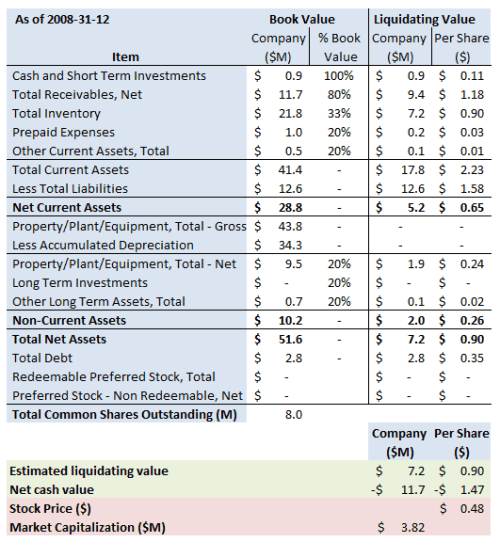
We initiated the position in CRC in December last year (see the post archive here) because it was trading at a substantial discount to its liquidation value and a substantial stockholder had called for its sale or orderly liquidation. Aldebaran Capital, LLC, a 7.7% stockholder, sent a letter to the company on October 29 last year arguing that if CRC is unable to “promptly stabilize its business and rationalize its cost structure” it should be sold or liquidated. Neither of those two events has occurred and the company now appears to be trading at a premium to its value in liquidation. We initially estimated the company’s liquidation value at around $15M. We’ve now reduced our valuation to $2.8M or $0.35 per share. The problem we identified when we opened the position persists: The company is in a liquidity crisis and risks entering bankruptcy. For these reasons, we’re exiting.

We opened the CRC position at $0.46 and it closed yesterday at $0.48, which means we’re up 4.8% on an absolute basis. The S&P500 Index was at 909.7 when we opened the position and closed yesterday at 832.39, which means we’re up 12.8% on a relative basis.

The value proposition updated

The company appears to have some value on its balance sheet, but much of that value is illusory for the reasons we’ll outline below (the “Book Value” column shows the assets as they are carried in the financial statements, and the “Liquidating Value” column shows our estimate of the value of the assets in a liquidation):

crc-summary-2008-12-31The $7.2M in liquidation value above doesn’t take into account CRC’s non-cancelable operating leases for office space, showroom facilities and transportation and other equipment. The future minimum lease payments under these leases for the years ending December 31, 2009, 2010, 2011, 2012 and 2013 are $1.9M, $1.1M, $0.8M, $0.6M, and $0, respectively, or $4.4M in total. Deducting the $4.4M from the $7.2M in balance sheet value leaves just $2.8M or $0.35 per share.

A slightly disappointing outcome, but we’re happy to take a small gain given the reduction in value.

[Full Disclosure:  We do not have a holding in CRC. This is neither a recommendation to buy or sell any securities. All information provided believed to be reliable and presented for information purposes only. Do your own research before investing in any security.]

Read Full Post »

In Icahn Takes On Kerkorian in Big Las Vegas Showdown (subscription required), The Wall Street Journal reports that Carl Icahn has built a large position in the bonds of MGM MIRAGE (NYSE:MGM) and is pushing it to restructure in bankruptcy court. MGM is struggling to service approximately $14B in debt and fund payments on its $8.6B City Center project in Las Vegas. MGM is controlled by billionaire Kirk Kerkorian, who holds about 53% of MGM valued at approximately $900M (down from ~$15B in late 2007). Kerkorian’s stake would be wiped out in a bankruptcy filing, which gives secured debtholders priority over stockholders in relation to assets.

It’s an interesting play for Icahn. The WSJ reports that he and Oaktree Capital Management hold a “little less than $500M” face value of MGM bonds out of approximately $7B of the non-bank debt. According to the WSJ, Icahn has little leverage now, but that could change as the bonds fall due:

When MGM Mirage bonds come due in July and October, the bondholders could force a filing if the company is unable to make those payments. Or, if MGM Mirage were to try to tender an offer to repurchase its bonds to lighten its debt load, they could also block that move. “Right now, it is just, sit back and wait,” said a person familiar with the matter. “The company is in a jam.”

The WSJ reports that the company has some unusual debt:

Its $7 billion in bank debt isn’t secured by the kind of assets typically used as collateral, meaning banks can’t foreclose on any of it (sic) properties. Those properties are still generating cash and stand to see strong profits if the economy improves.

MGM’s bank lenders have two reasons to help it avoid bankruptcy: 1. A bankruptcy filing would put the banks “on par with bondholders, leaving the two groups to battle over the assets,” and 2. MGM can still offer its properties as collateral to the banks and so improve their position relative to the bondholders.

The WSJ says that Icahn and Oaktree aren’t working together and their strategies aren’t yet clear:

They could be angling for equity in the company inside or outside bankruptcy. They could also be after some of MGM Mirage’s storied casino assets or simply want to ride out a bankruptcy with the bet that the bonds will recover far more than it cost to purchase them.

If MGM Mirage tried to buy up those bonds, then Mr. Icahn and Oaktree could block such steps.

But the move could blow up on Mr. Icahn and Oaktree if the company is able to avoid bankruptcy or it cuts deals with bank lenders and provides them liens on MGM Mirage’s assets, which could depress the recovery rates for MGM Mirage bonds.

It’s an interesting situation, and one we’re going to watch closely. Hunter over at Distressed Debt Investing says “MGM bondholders are licking their chops about a possible debt for equity exchange” and is looking to build a MGM bond valuation model. We’ll let you know how he goes.

Read Full Post »

In his blog, The Icahn Report, Carl Icahn argues in a new post, It’s Up to the Shareholders, Not the Government, to Demand Change at a Company, that “shareholders have been complicit in allowing management excesses and incompetence by not taking a stand.” Nell Minnow, editor and co-founder of the Corporate Library, agrees:

Shareholders have reelected these directors, have approved these pay plans and have been enablers for the addictive behavior of the corporate community.

Icahn asks, “Why should investors tolerate poor performance? Why should taxpayers?”

I have shaken up boards and managements at many companies in which I have invested, including Blockbuster, ImClone, Stratosphere, Philips Services, Federal-Mogul and many others. Generally, but not always, the net result has been very positive for the company and the shareholders. It is important to get new blood, new strategies and new ideas into underperforming companies.

Icahn laments the fact that it took a “force the size of the U.S. government” to change the board and management at General Motors Corporation (NYSE:GM):

In effect, the government has become the world’s biggest activist investor, making the same kinds of demands that any activist or creditor should rightfully make in return for its investment.

He concludes that he hopes that the “global economic meltdown” results in shareholders demanding more of their companies and not leaving it to the government.

Read Full Post »

« Newer Posts - Older Posts »