Feeds:
Posts
Comments

Archive for the ‘Value Investment’ Category

Price-to-book value is demonstrably useful as a predictor of future investment returns. As we discussed yesterday in Testing the performance of price-to-book value, various studies, including Roger Ibbotson’s Decile Portfolios of the New York Stock Exchange, 1967 – 1984 (1986), Werner F.M. DeBondt and Richard H. Thaler’s Further Evidence on Investor Overreaction and Stock Market Seasonality (1987), Josef Lakonishok, Andrei Shleifer, and Robert Vishny Contrarian Investment, Extrapolation and Risk (1994) and The Brandes Institute’s Value vs Glamour: A Global Phenomenon (2008) all conclude that lower price-to-book value stocks tend to outperform higher price-to-book value stocks, and at lower risk. Understanding this to be the case, the obvious question for me becomes, “Within the low price-to-book value universe, is there any way of further distinguishing likely stars from likely laggards and thereby further increasing returns?” The answer can be found in two studies: Joseph D. Piotroski’s seminal paper Value Investing: The Use of Historical Financial Statement Information to Separate Winners from Losers (.pdf) and Lakonishok, Shleifer, and Vishny’s original Contrarian Investment, Extrapolation and Risk (1994).

I’ll be discussing both of these studies in some detail over the next two days, starting with LSV’s Two-Dimensional Classifications tomorrow.

Read Full Post »

This site is dedicated to undervalued asset situations, but I haven’t yet spent much time on undervalued asset situations other than liquidations and Graham net current asset value stocks. Two areas worthy of further study are low price-to-book value stocks and low price-to-tangible book value stocks. I’ve found that it is difficult to impossible to find any research examining the performance of stocks selected on the basis of price-to-tangible book value. That may be because book value alone can explain most of the performance and removing goodwill and intangibles from the calculation adds very little. Tangible book value is of interest to me because I assume it more closely describes the likely value of a company in liquidation than book value does. That assumption may be wrong. Some intangibles have value in liquidation, although it’s always difficult to collect on the goodwill. If anyone knows of any study explicitly examining the performance of stocks selected on the basis of price-to-tangible book value, please shoot me an email at greenbackd at gmail or leave a comment in this post.

Book value has received plenty of attention from researchers in academia and industry, starting with Roger Ibbotson’s Decile Portfolios of the New York Stock Exchange, 1967 – 1984 (1986) and  Werner F.M. DeBondt and Richard H. Thaler’s Further Evidence on Investor Overreaction and Stock Market Seasonality (1987). In Value vs Glamour: A Global Phenomenon, The Brandes Institute updated the landmark 1994 study by Josef Lakonishok, Andrei Shleifer, and Robert Vishny Contrarian Investment, Extrapolation and Risk. All of these studies looked at the performance of stocks selected on the basis of price-to-book value (among other value metrics). The findings are uniform: lower price-to-book value stocks tend to outperform higher price-to-book value stocks, and at lower risk. On the strength of the findings in these various studies I’ve decided to run a handful of real-time tests to see how a portfolio constructed of the cheapest stocks determined on a price-to-book value basis performs against the market.

Constructing a 30-stock portfolio

The Ibbotson, LSV and Brandes Institute studies created decile portfolios and Thaler and DeBont created quintile portfolios. I propose to informally test the P/B method at the extreme, taking the cheapest 30 stocks in the Google Finance screener (I use the Google Finance screener because it’s publicly available and easily replicable) and creating an equally weighted portfolio. Here is the list of stocks generated as at the November 20, 2009 close:

Symbol Market cap Price to book Last price P/E ratio Book value/share
TOPS 33.97M 0.11 1.15 0.92 9.77
CEP 76.78M 0.15 3.38 4.76 23.23
SVLF 28.99M 0.17 0.76 2.48 5.09
BXG 77.47M 0.23 2.38 33.81 12.24
SGMA 13.46M 0.29 3.52 14.12 11.88
KRG 190.16M 0.3 3.02 28.97 10.3
BDR 5.88M 0.31 0.95 9.99 3.14
FREE 34.30M 0.31 1.62 1.61 5.71
IOT 22.51M 0.32 5.4 3.75 16.98
WPCS 20.69M 0.35 2.98 16.61 8.53
SSY 8.71M 0.35 1.83 14 5.19
CUO 19.18M 0.36 12 7.81 32.93
ONAV 73.53M 0.37 3.84 6.83 10.87
SBLK 202.11M 0.37 3.46 1.93 9.59
CHMP 17.68M 0.38 1.77 6.64 5.19
XFN 17.64M 0.39 0.96 5.22 2.34
HTX 966.12M 0.39 3.01 29.92 7.68
KV.A 178.31M 0.4 3.57 2.18 9.27
ULTR 144.94M 0.4 4.91 4.75 12.6
MDTH 145.35M 0.42 7.4 30.63 18.86
HAST 42.70M 0.43 4.42 23.92 10.45
TBSI 255.08M 0.44 8.53 4.67 20.01
GASS 129.40M 0.44 5.8 6.51 14.25
CONN 145.52M 0.44 6.48 6.88 14.89
BBEP 596.46M 0.44 11.3 3.39 25.7
CBR 230.18M 0.45 3.31 11.57 7.53
PRGN 222.19M 0.48 5.15 2.29 11.37
EROC 352.29M 0.48 4.59 1.25 9.76
JTX 119.45M 0.5 4.15 6.55 8.47
INOC 23.93M 0.5 1.94 5.68 3.77

For the sake of comparison the S&P500 closed Friday at 1,091.38.

Perhaps one of the most striking findings in the various studies discussed above was made by DeBondt and Thaler. They examined the earnings pattern of the cheapest companies (ranked on the basis of price-to-book) to the most expensive companies. They found that the earnings of the cheaper companies grew faster than the earnings of the more expensive companies over the period of the study. DeBondt and Thaler attribute the earnings outperformanceof the cheaper companies to the phenomenon of “mean reversion,” which Tweedy Browne describe as the observation that “significant declines in earnings are followed by significant earnings increases, and that significant earnings increases are followed by slower rates of increase or declines.” I’m interested to see whether this phenomenon will be observable in the 30 company portfolio listed above.

It seems counterintuitive that a portfolio constructed using a single, simple metric (in this case, price-to-book) should outperform the market. The fact that the various studies discussed above have reached uniform conclusions leads me to believe that this phenomenon is real. The companies listed above are a diverse group in terms of market capitalization, earnings, debt loads and businesses/industries. The only factor uniting the stocks in the list above is that they are the cheapest 30 stocks in the Google Finance screener on the basis of price-to-book value. I look forward to seeing how they perform against the market, represented by the S&P500 index.

Update

Here’s the Tickerspy portfolio tracker for the Greenbackd Contrarian Value Portfolio.

[Full Disclosure:  No positions. This is neither a recommendation to buy or sell any securities. All information provided believed to be reliable and presented for information purposes only. Do your own research before investing in any security.]

Read Full Post »

The superb Abnormal Returns has a post “Investing by the seat of their pants,” which, among other things, discusses William Bernstein’s conjecture that “only a tiny fraction, 1 in 1000, investors have the skills to become truly competent investors.”  In the preface of his new book, Bernstein suggests four abilities successful investors must enjoy (via Information Processing):

First, they must possess an interest in the process. It is no different from carpentry, gardening, or parenting. If money management is not enjoyable, then a lousy job inevitably results, and, unfortunately, most people enjoy finance about as much as they do root canal work.

Second, investors need more than a bit of math horsepower, far beyond simple arithmetic and algebra, or even the ability to manipulate a spreadsheet. Mastering the basics of investment theory requires an understanding of the laws of probability and a working knowledge of statistics. Sadly, as one financial columnist explained to me more than a decade ago, fractions are a stretch for 90 percent of the population.

Third, investors need a firm grasp of financial history, from the South Sea Bubble to the Great Depression. Alas, as we shall soon see, this is something that even professionals have real trouble with.

Even if investors possess all three of these abilities, it will all be for naught if they do not have a fourth one: the emotional discipline to execute their planned strategy faithfully, come hell, high water, or the apparent end of capitalism as we know it. “ Stay the course ” : It sounds so easy when uttered at high tide. Unfortunately, when the water recedes, it is not. I expect no more than 10 percent of the population passes muster on each of the above counts. This suggests that as few as one person in ten thousand (10 percent to the fourth power) has the full skill set. Perhaps I am being overly pessimistic. After all, these four abilities may not be entirely independent: if someone is smart enough, it is also more likely he or she will be interested in finance and be driven to delve into financial history.

But even the most optimistic assumptions — increase the odds at any of the four steps to 30 percent and link them — suggests that no more than a few percent of the population is qualified to manage their own money. And even with the requisite skill set, more than a little moxie is involved. This last requirement — the ability to deploy what legendary investor Charley Ellis calls “ the emotional game ” — is completely independent of the other three; Wall Street is littered with the bones of those who knew just what to do, but could not bring themselves to do it.

Bernstein’s is an interesting thought experiment. Steve Hsu at Information Processing, after considering the abilities identified by Bernstein, categorizes them as follows:

…the right interests (history, finance theory, markets — relatively easily acquired, as these subjects are fascinating), personality factors (discipline, controlled risk taking, decisiveness — not so easily acquired, but can be improved over time) and intelligence (not easily acquired, but perhaps the threshold isn’t that high at 90th percentile).

Bernstein’s list and Hsu’s categorization of it feels right. Whether it winnows the universe of competent investors down to 1 in 10,000 is open to debate, but I think few would have a genuine quibble with the content of the list. The only other element that I would suggest – and it is possible that it’s already captured within Bernstein’s list as “emotional discipline” – is the ability to think and act counterintuitively.

There are many examples of strategies that are counterintuitive and produce above-market returns. Value is a counterintuitive strategy. Glamour feels like a better bet than value, but studies have shown over and over again that value outperforms glamour or momentum. Tangible asset value – liquidation value investing or low price-to-book value investing – is counterintuitive even to practitioners within the value school, who predominantly seek Buffett-style earnings and growth. The counterintuitive element is that companies within the lowest price-to-book quintile – not, by any means, earnings machines – tend to grow earnings faster than companies in the highest price-to-book quintile, a phenomenon that value investors recognize as “mean reversion”.  Even with the liquidation value investment world itself, the counterintuitive strategy – buying loss-making net nets – outperforms the intuitive one – buying net nets with positive earnings.

This suggests to me that the ability to understand a concept from an intellectual standpoint is a necessary but insufficient condition for competent investing. One must also be able to suspend instinct or intuition or disbelief and follow intellect through to action. That seems to me to be a rare trait, but one that I believe can be developed. Is it possible that, if one follows a counterintuitive strategy for long enough and succeeds with it, it becomes intuitive? I think so, but I’d like to see what you think too.

Update

I knew I was asking for it when I wrote the panglossian, “I think few would have a genuine quibble with the content of the list.” An astute reader has a quibble, and I’m embarrassed to say that I think he’s right:

I flatly deny Bernstein’s assertion that “investors need more than a bit of math horsepower.” I cite the highest authority:

1. Ben Graham explicitly warned against “calculations made about common stock values, or related investment policies, that went beyond simple arithmetic or the most elementary algebra.” Indeed, “whenever [calculus] is brought in, or higher algebra, you could take it as a warning signal that the operator is trying to substitute theory for experience, and usually also to give speculation the deceptive guise of investment.”

2. “If calculus were required,” Buffett has said, “I’d have to go back to delivering papers. I’ve never seen any need for algebra … It’s true that you have to divide by the number of shares outstanding, so division is required. If you were going out to buy a farm or an apartment house or a dry cleaning establishment, I really don’t think you’d have to take someone along to do calculus.”

3. Elsewhere, Buffett has said “read Ben Graham and Phil Fisher, read annual reports, but don’t do equations with Greek letters in them.”

4. In one of his books, Peter Lynch recounts at length that the mathematical stuff he learnt in MBA-School were hindrances rather than helps, and that “the arts/philosophy side” (or words to that effect) of his education have stood him in much better stead. Indeed, I recall Lynch saying something like “all the maths you need to invest competently you learnt in primary school.”

5. The “Ben Graham, Meet Ludwig von Mises” paper you cited a while back discusses the Austrian conception of value, markets and entrepreneurial discovery. None of these things rely upon maths, probability or stats. But they do, I think, hinge upon the ability to think unpopular or contrarian thoughts — like adherence to the Austrian School!

Mind you, I’ve never liked Bernstein and indeed have long thought that he does far more harm than good. This assertion is but one in a long list of silly things he’s said over the years. In short, not only is mathematics NOT a necessary condition of successful investment; it may be a sufficient condition of investment failure.

Read Full Post »

The FT Alphaville blog has a post, The US stock market is overvalued by 40%, based on a recent research report, The US Stock Market: Value and Nonsense About It, from Andrew Smithers of London-based research house Smithers & Co.

According to the FT Alphaville blog, Smithers says there are only two ‘valid’ ways to value the market. One is by using a cyclically adjusted PE ratio and the other by using the Q ratio, which compares the market capitalisation of companies with their net worth, adjusted to current prices. Both techniques yield the same answer: the stockmarket is overvalued by around 40%.

Smithers explains:

As the valid measures of the US market show that it is currently around 40% overvalued, some ingenuity is needed to claim otherwise. The EPS for the past 12 months on the S&P 500 is $7.51 so, with the index at 1071, it is selling at a trailing PE of 142. This is far higher than it has ever been before, as the previous end month record is a PE of 47. But current multiples are no guide to value; when depressed, or elevated, they need to be adjusted to their cyclical norm.

This is how the cyclically adjusted PE (”CAPE”) is calculated and when its current value is compared with long-term average, using the geometric means of EPS and cyclically adjusted PEs,6 it shows that the market is 37.7% overpriced using 10 years of earnings’ data and 45% if 20 years are used. This method is therefore of no use to those who sell shares, or have made faulty claims about value in the past. The following are among the most common approaches to circumventing the problem this presents. Some produce relatively small distortions, but these can amount to a substantial degree of misinformation when combined.

Go to the The FT Alphaville blog post, The US stock market is overvalued by 40%.

Read Full Post »

In a new paper Value vs Glamour: A Global Phenomenon (via SSRN)  The Brandes Institute updates the landmark 1994 study by Josef Lakonishok, Andrei Shleifer, and Robert Vishny investigating the performance of value stocks relative to that of glamour securities in the United States over a 26-year period. Lakonishok, Shleifer, and Vishny found that value stocks tended to outperform glamour stocks by wide margins, but their earlier research did not include the glamour-driven markets of the late 1990s and early 2000s. The paper asks, “What effect might this period have on their conclusions?” To answer that question, The Brandes Institute updated the research through to June 2008, examining the comparative performance of value and glamour over a 40-year period, and extending the scope of the initial study to include non-U.S. markets, to determine whether the value premium is evident worldwide.

The research focuses on our favorite indicator, price-to-book value, but also includes price-to-cash flow, price-to-earnings, sales growth over the preceding five years and combinations of the foregoing. Here is The Brandes Institute’s discussion on price-to-book:

Lakonishok, Shleifer, and Vishny on price-to-book

The Brandes Institute  hewed closely to Lakonishok, Shleifer, and Vishny’s methods, described on page 3 of the paper:

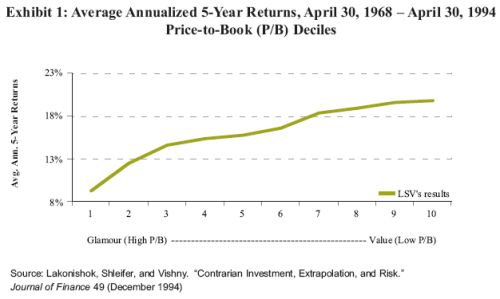
First, the sample of companies as of April 30, 1968 was divided into deciles based on one of the criteria above. Second, the aggregate performance of each decile was tracked for each of the next five years on each April 30. Finally, the first and second steps were repeated for each April 30 from 1969 to 1989.

We start with the price-to-book criterion as an example. First, all stocks traded on the NYSE and AMEX as of April 30, 1968 were sorted into deciles based on their price-to-book ratios on that date. Stocks with the highers P/B ratios were grouped in decile 1. For each consecutive decile, P/B ratios decreased; this cuilminated in stocks with the lowest P/B values forming decile 10.

In essence, this process created 10 separate portfolios, each with an inception date of April 30, 1968. The lower deciles, which consisted of higher-P/B stocks, represented glamour portfolios. In contrast, the higher deciles – those filled with lower-P/B stocks – represented value portfolios.

From there, annual performance of deciles 1 through 10 was tracked over the subsequent five years. Additionally, new 10-decile sets were constructed based on the combined NYSE/AMEX sample as of April 30, 1969, and every subsequent April 30 through 1989. For each of these new sets, decile-by-decile performance was recorded for the five yeras after the inception date. After completing this process, the researchers had created 22 sets of P/B deciles, and tracked five years of decile-by-decile performance for each one. Next, [Lakonishok, Shleifer, and Vishny] averaged the performance data across these 22 decile-sets to compare value and glamour.

As the chart below indicates, [Lakonishok, Shleifer, and Vishny] found that performance for glamour stocks was outpaced by performance for their value counterparts. For instance, 5-year returns for decile 1 – those stocks with the highest P/B ratios – averaged an annualized 9.3%, while returns for the low-P/B decile 10 averaged 19.8%. These annualized figures are equivalent to cumulative rates of return of 56.0% and 146.2%, respectively.

Value Glamour 1

[Lakonishok, Shleifer, and Vishny] repeated this analysis for deciles based on price-to-cash flow, price-to-earnings, and sales growth. The trio found that, for each of these value/glamour criteria, value stocks outperformed glamour stocks by wide margins. Additionally, value bested glamour in experiments with groups sorted by select pairings of P/B, P/CF, P/E, and sales growth.

The Brandes Institute update

The Brandes Institute sought to extend and update Lakonishok, Shleifer, and Vishny’s findings. They replicated the results of the Lakonishok, Shleifer, and Vishny study to validate their methodology. When they were satisfied that there was sufficient parity between their results and Lakonishok, Shleifer, and Vishny’s findings “to validate our methodology as a functional approximation of the [Lakonishok, Shleifer, and Vishny] framework,” they adjusted the sample in three ways: First, they included stocks listed on the NASDAQ domiciled in the US. Second, they excluded the smalles 50% of all companies in the sample. Finally, they divided the remaining companies into small capitalization (70% of the group by number) and large capitalization (30% of the group by number):

To expand upon [Lakonishok, Shleifer, and Vishny’s] findings we begin with our adjusted sample, which now includes data through 2008. Specifically, we added decile-sets formed on April 30, 1990 through April 30, 2003 and incorporated their performance into our analysis. This increased our sample size from 22 sets of deciles to 36. In addition, the end of the period covered by our performance calculations extended from April 30, 1994 to April 30, 2008.

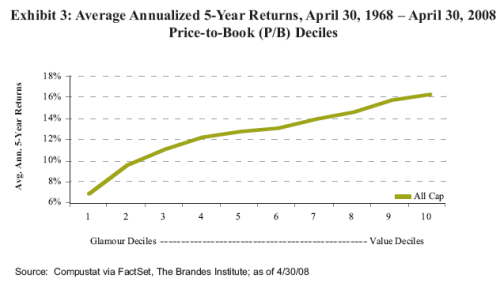
Exhibit 3 compares average annualized performance for U.S. stocks from the 1968 to 2008 period for deciles based on price-to-book. Returns for deciles across the spectrum changed only slightly in the extended time frame from our replicated [Lakonishok, Shleifer, and Vishny’s] results. Most notably, the overall pattern of substantial value stock outperformance persisted. During the 1968 to 2008 period, performance for decile 1 glamour stocks averaged an annualized 6.9% vs. an average of 16.2% for the value stocks in decile 10. Respective cumulative performance equaled 39.6% and 111.9%.

Value Glamour 2

Set out below is the comparison of large cap and small cap performance:

Value Glamour 3The paper concludes that the value premium persists for the world’s developed markets in aggregate, and on an individual coutry basis. We believe it is more compelling evidence for value based investment, and, in particular, asset based value investment.

Read Full Post »

The old Wall Street saw, variously attributed to Warren Buffett or Humphrey B. Neill, author of the Art of Contrary Thinking, goes, “Never confuse genius with a bull market.” With that in mind, we present to you the performance of the Wilshire 5000 Equal Weight Index, which is one of the broadest measures of the stock market.

For the month of September the Wilshire 5000 Equal Weight Index was up 15.8% and for the last quarter to September 30 it was up 36.0%.  You can see for yourself at the Wilshire Index Calculator (it’s a little clunky – you’ll need to select “Wilshire 5000 Equal Weight” in the “Broad/Style” box and set the date to September 30 2009). Year to date the index is up a whopping 83.02%. From March through September, the average stock is up 113.1%. If we take the Wilshire 4500 Equal Weight Index, which excludes the top 500 stocks by market capitalization of the 5000 Equal Weight Index, the return is +120% from March to September 2009. Sobering.

Hat tip Bo.

Read Full Post »

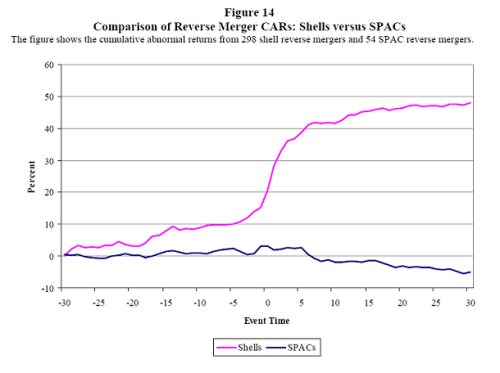
In Shell Games: On the Stock Price Performance of Shell Companies, Ioannis V. Floros and Travis R. Sapp examine the stock price performance of shell companies over the period 2006 to 2008. Floros and Sapp’s findings are quite amazing:

When a takeover agreement is consummated, shell company three-month abnormal returns are 48.1%.

What’s a shell?

The SEC defines any company with “no or nominal operations, and with no or nominal assets or assets consisting solely of cash and cash equivalents” as a shell company. All companies reporting to the SEC must indicate whether they declare themselves a shell company according to Rule 12b-2. Shell firms are traded either on the OTC Bulletin Board (OTCBB) or through Pink Sheets. According to the authors, “[most] shells come into existence either with the sole intent of merging with unidentified single or multiple companies (these are called virgin shells), after being created with a business plan that fails to materialize (these are called development stage shells), or after selling their operations and assets following bankruptcy (these are called natural shells).” The sole purpose of most shells is to “find a suitor for a reverse merger agreement.”

Why a reverse merger rather than an IPO?

The paper sets out five primary advantages to a reverse merger (RM) over an IPO:

First, by engaging in a RM with an existing reporting shell company, a firm can avoid having to go through the lengthy SEC review process. This can save the firm anywhere from 2-12 months. Second, less legal groundwork is needed, and therefore less legal expense. A RM typically costs $200,000 – 300,000 less than an IPO, and this does not include indirect IPO costs such as underpricing. Third, the firm does not need to time the market since a limited percentage of the total stock is typically traded in the immediate post-RM period. Many IPOs are withdrawn at the last minute due to a perceived lack of interest among investors. Fourth, the private firm’s managers don’t have to spend lots of time doing road shows. And finally, the current owners generally own a large majority of the resulting public company.

How big is the opportunity?

RMs have grown in popularity from only three in 1990 to 236 in 2008, and shell companies are providing fuel for much of this growth. Only 26 of the RMs in 2008 were between two operating companies; the other 210 were shell RMs. There are currently over 1,400 reporting shell companies in existence.

What’s a shell worth?

This is where the rubber hits the road for we deep value folk:

Shells that are already trading in the market typically sell for around $1,000,000 and virgin shells, which do not trade, sell for around $100,000 (Feldman (2006)).

Why invest in shells?

The authors found that the stock price of most shell firms “tends to decay rapidly over time. The half-life of shell share prices is 172 trading days, or about eight months.” This leads them to ask why investors continue to hold shell shares and why the number of shell firms growing:

We find that approximately half of all trading shell companies consummate a RM in a given year. Since these firms have no operations, investors must be solely attracted by an expectation of a future RM agreement.

Is that a rational expectation? You bet:

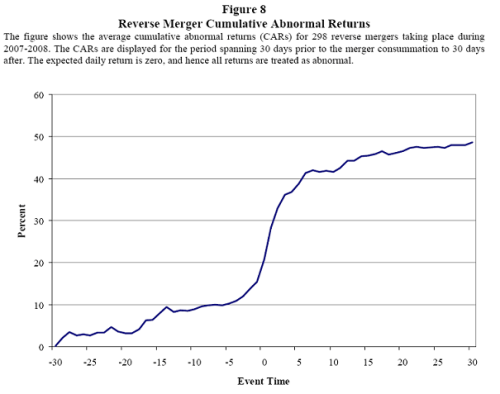
We find a three-month cumulative abnormal return of 48.1%, which far surpasses other target firm abnormal returns in the takeover literature.

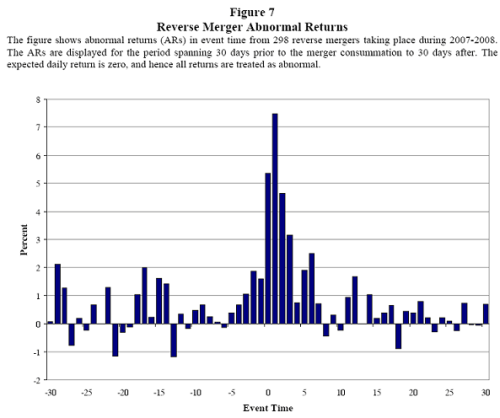
Here is a graph showing the abnormal returns for the period 30 days prior to the merger consummation to 30 days after:

Reverse merger abnormal returnsAnd a cumulative version of the same graph:

Reverse merger 2

Be careful of the longer-term performance:

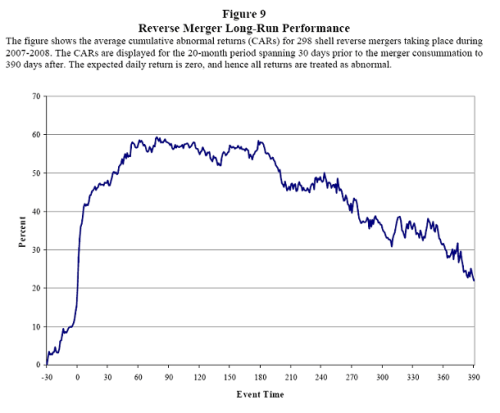
Following a RM, we find that the longer-term performance of the RM firms erases the high initial returns. The average surviving firm earns an annual post-event return of -91.2%. Shell companies engaging in RM transactions attract blockholder investment, largely from insiders or family trusts, which persists beyond lock-up periods. We find evidence suggesting that naked short-selling occurs, mainly after the lock-up period of six months, for at least one-fifth of these firms. We show that this helps explain the decline in returns that begins about nine months after the RM. We also examine liquidity and find increased trading volume and a significant decrease in the quoted spread following a RM.

Here’s a graph showing the long-run performance of the shells following a reverse merger:

Reverse merger 3

This is an interesting graph. It show a comparison of compound average returns from shells and Special Purpose Acquisition Companies (SPACs), which we previously discussed in the post, Blank checks: Fertile fishing grounds for liquidation value investors:

Shells v SPACs

Conclusion

Floros and Sapp conclude as follows:

Our results present a fascinating choice for investors. Namely, does it make sense to invest in an empty shell firm that has no assets or operations? Our results suggest that such an investment is rational as long as the probability of a RM happening soon is high. In the event of a RM deal, the shell firm returns are substantial. However, the wait can be painful. Over time, the shell burns cash to meet ongoing reporting costs and the share price tends to fall. Being able to identify shells that are more likely to consummate a deal sooner thus becomes key. Also, the extent to which shell firms are an investable alternative asset largely depends upon the depth of this rather illiquid market. Most shell firms have fewer than three market makers and trading tends to be thin and concentrated among a relatively small shareholder base. The median number of shareholders in our shell sample is 57 and on average 12% of shell outstanding shares are held by shell managers. Further, the median quoted half spread is 22.3%, showing that transaction costs for an investment in shell firms are non-trivial. We argue that the substantial average return surrounding a RM is compensation for shell stock illiquidity and the uncertainty of finding a reverse merger suitor. Further, the payoff from a shell investment is marginally sufficient to justify the growth in the number of shells alongside the growing RM industry.

Hat tip Wes and Andy.

Read Full Post »

In an August post, Applying value principles at a country level, we discussed The growth illusion, an article appearing in a Buttonwood’s notebook column of The Economist. In that article, Buttonwood argued that valuation, rather than economic growth, determined investment returns at a country or market level. Buttonwood highlighted research undertaken by Elroy Dimson, Paul Marsh and Mike Staunton from the London Business School, which suggested that chasing growth economies is akin to chasing growth stocks, and generates similarly disappointing results. Buttonwood concluded that higher valuations – determined on an earnings, rather than asset basis – led to lower returns:

What does work? Over the long run (but not the short), it is valuation; the higher the starting price-earnings ratio when you buy a market, the lower the return over the next 10 years. That is why buying shares back in 1999 and 2000 has provided to be such a bad deal.

It raised an interesting question for us: Can relative price-to-asset values be used to determine which countries are likely to provide the best investment returns? It took some time, but we’ve tracked down some research that answers the question.

In Fundamental Determinants of International Equity Returns: A Perspective on Conditional Asset Pricing (9.17MB .pdf) Journal of Banking and Finance 21, (1997): 1625-1665. (P42), Campbell Harvey and Wayne Ferson examined, among other things, the relationship between price-to-book value and future returns from a global asset pricing perspective. Harvey and Ferson found that “the price-to-book value ratio has cross-sectional explanatory power at the country level,” although they believe that its use is mainly in determining “global stock market risk exposure.”

An earlier – and slightly more readable – study by Leila Heckman, John J . Mullin and Holly Sze, Valuation ratios and cross-country equity allocation, The Journal of Investing, Summer 1996, Vol. 5, No. 2: pp. 54-63 DOI: 10.3905/joi.5.2.54, also examined the link between equity returns at a market level and valuation measures. Heckman et al found that, despite the substantial accounting differences across countries, price-to-book measures are useful for predicting the “cross-sectional variation of national index returns.”

The results are perhaps unsurprising given the various studies demonstrating the relationship between valuation determined on a price-to-earnings basis and country level returns. We believe they are useful nonetheless given the ease with which one can invest in many global markets and our own predisposition for assets over earnings valuations.

Read Full Post »

Dr. Chris Leithner has prepared a paper for the von Mises Institute, Ludwig von Mises, Meet Benjamin Graham: Value Investing from an Austrian Point of View, in which he argues that Grahamite value investors and economists from the Austrian School hold “compatible views about a range of fundamental economic and financial phenomena” and Austrian economics should therefore be compelling to value investors “because it subsumes real economic and financial events within justifiable laws of human action.”

This paper shows that value investors and Austrians hold compatible views not only about the price and value, but also about other vital economic and financial phenomena. These include risk and arbitrage; capital and entrepreneurship; and time-preference and interest. Indeed, with respect to these matters each group may have more in common with the other than each has with the mainstream of its respective field.

While we’ve never explicitly said so on this site, many of you will have guessed that we subscribe to the Austrian School of economics. We know that view is unpopular with some of our readers, but we ask that you read Leithner’s paper before inveighing in the comments or the mail bag. Leithner is the principal of Leithner & Company, a private investment company based in Brisbane, Australia, and a strict adherent to the “traditional “value” approach to investment pioneered by Benjamin Graham and adapted by his colleagues Warren Buffett, Thomas Knapp and Walter Schloss.” His paper is a tour de force on both Grahamite value investment and Austrian economics, and describes our views with a clarity that escapes us.

Set out below are some important excerpts from Leithner’s paper. The first describes the Austrian view of the operation of markets and its rejection of Efficient Market Theory, which is relevant given the discussion in the comments on Jim Hodge’s guest post several weeks ago:

A deep chasm separates the theory of entrepreneurial discovery from the mainstream model of perfect competition. To mainstream economists, the decisions to buy and sell in the market are mere mathematical derivations. A decision, in other words, is “made” by a “given” model, probability distribution and data. The mainstream model thus eliminates the real-life, flesh-and-blood decision-maker – the heart of the Austrian economics and value investing – from the market. Market automatons do not err; accordingly, it is unthinkable that an opportunity for pure profit is not instantly noticed and grasped. The mainstream economist, goes the revealing joke, does not take the $10 banknote lying on the floor because he believes that if it were really there then somebody would already have grabbed it.

In sharp contrast, Austrians recognise that decisions are taken by real people whose plans are imperfectly clear, indistinctly ranked, often internally-inconsistent and always subject to change. Further, at any given moment a market participant will be largely unaware of other market participants’ present and future plans. It is participation in the market that makes buyers and sellers a bit more knowledgeable about their own plans and slightly less unaware of others’ plans. Market participants will inevitably make mistakes; further, it is probable that they will not automatically notice them. Accordingly, it is not just possible – it is typical – that opportunities for gain (“pure profit”) appear but are not instantly detected. Recognising the obvious – namely that he has possibly been the first to notice it – the Austrian will therefore take the $10 note inadvertently dropped on the floor and ignored by his mainstream colleague. An “Austrian” act of entrepreneurial discovery, then, occurs when a market participant seeks and finds what others have overlooked.

It is important to emphasise that this discovery, like Buffett’s and Graham’s many others, did not derive from information that other buyers and sellers could not possess. These acts of entrepreneurial discovery stemmed from the alert analysis of publicly available information and the superior detection of opportunities that others had simply overlooked. On numerous occasions, Graham and his students and followers have found promising places to look and have been the first, in effect, to detect the piles of notes that others have disregarded and left lying on the floor. Anybody, for example, could have bought parts of American Express, The Washington Post, GEICO (whose enormous potential Graham was the first to find) and Coca-Cola when Mr Buffett did; but few saw what he saw, ignored the irrelevancies and reasoned so clearly. Instead, most were distracted by myriad worries – and economic and financial fallacies – and so very few followed Buffett’s lead.

In this second excerpt, Leithner discusses the Grahamite approach to investment in an uncertain world (as it ever is), and why Grahamites pay no heed to mainstream economists’ forecasts about macroeconomic aggregates such as inflation, exchange rates, joblessness, trade and budget deficits and the like:

Grahamites recognise that the future is inherently uncertain. That is to say, there is no probability distribution and there are no data that can “model” it. The future is not radically uncertain, in the sense that Ludwig Lachmann maintained, but it is largely so. Like many Austrians, Grahamites accept that one can know some things (such as historical data, relationships of cause and effect and hence the laws of economics), and therefore that to some extent the past does project into the future. Grahamites do not agree, in other words, that anything can happen; but they are acutely aware – because they have learnt from unpleasant personal experience – that the unexpected can and often does happen. They also acknowledge that forecasting the future is the job of entrepreneurs, not economists or bureaucrats, and therefore that the entrepreneur-investor-forecaster must be cautious and humble.

Market timers, commentators and mainstream economists, then, cannot foresee economic events and developments with any useful degree of accuracy. And even if they could, the aggregate phenomena upon which they fixate are typically of little interest to Grahamites. Hence value investors ignore analysts, economists and others who claim that they possess clear crystal balls. But Grahamite investors do not ignore the future per se. Quite the contrary: they plan not by making particular predictions about what will happen but by considering general scenarios – particularly pessimistic scenarios – of what might conceivably happen. They then structure their actions and investments in order to reduce the risk of permanent loss of capital in the event that undesirable eventsand developments actually occur.

Grahamites also recognise that if markets tend towards but never attain a state of equilibrium, and if profit-seeking entrepreneurs constitute the “oil” that enables the market mechanism to operate and adapt so smoothly, then over time particularly talented and shrewd and lucky entrepreneurs will tend, more often than not and relatively consistently, to accumulate capital. Less successful entrepreneurs, on the other hand, will consistently lose some – and eventually all – of their capital. It is for this reason that Grahamites search incessantly for businesses that possess consistently solid and relatively stable track records, and the demonstrated ability to surmount a variety of unexpected changes and vicissitudes.

In this final excerpt, Leithner discusses the calculation of desired rates of return, and the relationship to firm value:

On what bases, then, do Grahamites reason towards an assessment of a given security’s value? First, they assess the structure of the underlying firm’s capital and the stability of its earnings. Second, they ascertain their time preference (i.e., the extent to which they are prepared forego consumption today in order to consume more in the future) and thus their desired rate of return. Although value investors have never used the term “time preference,” embedded within the Grahamite approach to the valuation of securities is a notion of time preference and interest that is compatible with Austrian understandings of these concepts.

What is an appropriate payback period? The answer depends upon one’s time preference; and that, in turn, will vary from one investor to another. But a few general points can be made. First, a shorter payback period (i.e., a higher rate of return) is preferable to a longer one (i.e., lower rate of return). This is because the longer the time required in order to recoup an investment, the riskier that investment becomes. The longer the payback period, the more a decision to invest depends upon the veracity of its underlying assumptions, i.e., the more imperative it becomes that those assumptions correspond to reality. With each additional year of waiting, the chances increase that unforseen or uncontrollable factors – a recession, a decrease of the purchasing power of the currency, new competition, the loss of key contracts, employees and other innumerable and perhaps unimaginable factors – will decrease (or halt the rate of increase of) the size of the yearly coupon and hence prolong further the payback period.

Second, a high natural rate of interest implies a large required rate of return and a more stringent hurdle for potential investments to surmount. For example, a natural rate of 12-15% (which Leithner & Co. uses to conduct its investment operations) and a constant stream of coupons imply a payback period of 6-8 years. By that criterion, both the Telstra stock’s and the Commonwealth bond’s payback period is unacceptably long; and by this absolute, more challenging – and, to mainstream investors, virtually unknown – yardstick, neither of these securities are compelling. Since the late 1990s, in other words, wide swaths of the investment universe (i.e., most equities, bonds and real estate) have been unacceptably dear; and the five-year investment results of most mainstream investors confirm the sad consequences of buying securities at inflated prices.

Leithner’s paper is superb,and well worth reading. His explication of the concept of “capital goods” and capital, and the relationship to firm value should not be missed.

Read Full Post »
We’ll be in San Diego next week for the Hedge Fund Activism and Shareholder Value Summit. If you’re going too, and you’d like to catch up, we’d love to hear from you. You can reach us at greenbackd [at] gmail [dot] com.

We’ll be posting intermittently next week, but we’ll be back to our regular schedule starting from Monday, 28 September. Hopefully we’ll have some new insights to share.

Read Full Post »

« Newer Posts - Older Posts »