Feeds:
Posts
Comments

Archive for September, 2010

In a post in late November last year, Testing the performance of price-to-book value, I set up a hypothetical equally-weighted portfolio of the cheapest price-to-book stocks with a positive P/E ratio discovered using the Google Screener, which I called the “Greenbackd Contrarian Value Portfolio”.

The hypothetical portfolio is based on Josef Lakonishok, Andrei Shleifer, and Robert Vishny’s (“LSV”) Two-Dimensional Classification from their landmark Contrarian Investment, Extrapolation and Risk paper.

The portfolio has been operating for a little over 3 quarters, so I thought I’d check in and see how it’s going.

Here is the Tickerspy portfolio tracker for the Greenbackd Contrarian Value Portfolio showing how each individual stock is performing:

And the chart showing the performance of the portfolio against the S&P500:

The portfolio is up about 22.4% in total and 20.9% against the index. It’s volatile, but I’ll take volatility for a ~20% gain in an essentially flat market. The results are tracking approximately in line with the results one might expect from LSV’s research.

[Full Disclosure:  No positions. This is neither a recommendation to buy or sell any securities. All information provided believed to be reliable and presented for information purposes only. Do your own research before investing in any security.]

Read Full Post »

Michael R. Levin, who runs The Activist Investor website, has produced a white paper, Effective Activism, on the Cheap that identifies 36 undervalued companies that fit his profile for “effective activism, on the cheap.” Michael likens the list to the companies generated in an Endangered Species / Darwin’s Darlings strategy.

Says Michael of the target companies in his white paper:

  • These companies conceal significant potential value relative to their current market cap, with a potential to increase the average investment by about 75%.
  • They have a concentrated investor base (ten largest investors own at least half of the outstanding shares), which allows an activist to influence management in creative and low-cost ways.
  • They are also hardly micro- or small-cap investments, with an average market cap of $375 million (the highest at $1.8 billion), which should provide ample liquidity.

How cheap is “cheap”?

We estimate that an investor that confines its activism to companies with highly concentrated holdings can spend a tenth of the cost of a full proxy contest, and avoid the proxy solicitors, public relations firms, and legions of attorneys. For a fund manager that earns income in the form of fees (management and performance), this savings can make an activist strategy feasible, and even attractive.

Click here for more information on and to obtain a copy of the report.

Read Full Post »

Warren Buffett has long eschewed any ability to foresee the path of the markets or the economy, but according to this BusinessWeek article, he’s resolute that the economy will not slide back into recession:

Warren Buffett ruled out a second recession in the U.S. and said businesses owned by his Berkshire Hathaway Inc. are growing.

“I am a huge bull on this country,” Buffett, Berkshire’s chief executive officer, said today in remarks to the Montana Economic Development Summit. “We will not have a double-dip recession at all. I see our businesses coming back almost across the board.”

Berkshire bought railroad Burlington Northern Santa Fe Corp. for $27 billion in February in a deal that Buffett, 80, called a bet on the U.S. economy. The billionaire’s outlook contrasts with the views of economists such as New York University Professor Nouriel Roubini and Harvard University Professor Martin Feldstein, who have said the odds of another recession may be one in three or higher.

Now that the great man has prognosticated on the state of the economy, I have to ask, “Are we all macro investors now?”

Read Full Post »

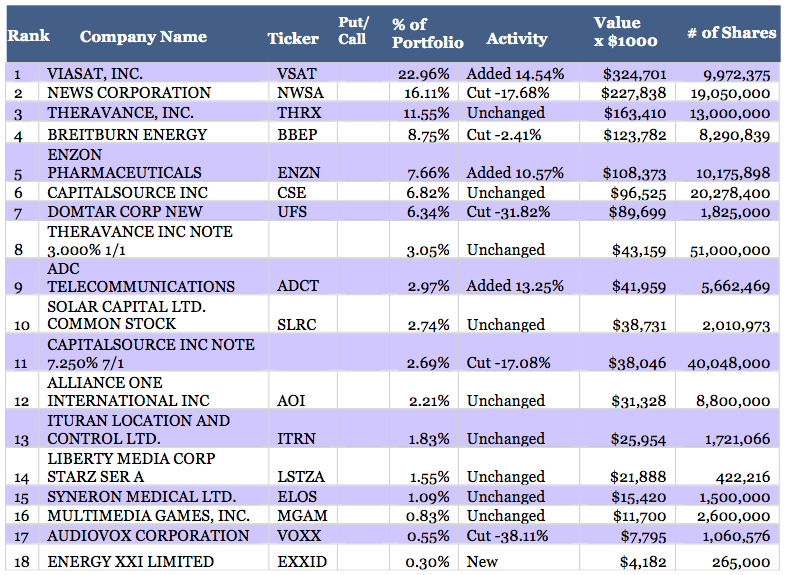
Jay at Market Folly has introduced a quarterly newsletter “Hedge Fund Wisdom,” which Jay bills as a “complete guide to what hedge funds have been buying and selling.” The newsletter includes:

  • Complete portfolio updates on 20 prominent hedge funds
  • Commentary and analysis of each fund’s moves
  • Consensus buys & sells among the hedge funds profiled
  • In-depth analysis of 3 stocks hedge funds were buying. We take you inside the head of a hedge fund manager to examine the investment thesis, upside & downside, potential catalysts, market valuation, contrarian viewpoint, company background & more

Here is an example of the holdings of Seth Klarman:

To celebrate the launch, Jay is providing two special introductory offers:

  • HFW Member – Annual (most popular choice! lock in additional cost savings before rates go up!) @ $199 / year
  • HFW Member – Quarterly (limited time offer, rates going up soon!)@ $60 / quarter

If you have any questions or issues, please send Jay an e-mail atinfo@hedgefundwisdom.com and he will get back to you.

Read Full Post »

While the WSJ is prepared to consign the PE ratio to the dustbin (see The Decline of the P/E Ratio and Is It Time to Scrap the Fusty Old P/E Ratio?) Barry Ritholtz is one of the few actually asking the question, “What does a falling P/E ratio mean?

Ritholz focuses on the expansion and contraction of the PE ratio as indicative of bull or bear markets:

We can define Bull and Bear markets over the past 100 years in terms of P/E expansion and contraction. I always show the chart below when I give speeches (from Crestmont Research, my annotations in blue) to emphasize the impact of crowd psychology on valautions.

Consider the message of this chart. It strongly suggests (at least to me) the following:

Bull markets are periods of P/E expansion. During Bulls, investors are willing to pay increasingly more for each dollar of earnings;

Bear markets are periods of P/E contraction. Investors demand more earnings for each dollar of share price they are willing to pay.

Hence, a falling P/E ratio is not indicia of its lack of utility. Nor is it proof of “Fustyness.” Rather, it suggests that crowd is still feeling burned by the recent collapse in prices and increase in volatility.

Here’s the chart:

I think Ritholz’s analysis is excellent as far as it goes, but I think it misses part of the story. The “E” in the PE ratio is also subject to expansion and contraction over the course of the business cycle. Earnings are still normalizing from a period of massive expansion. While the single-year market PE might be at 15.8, which is a little over the long-term average of 15, on a cyclically-adjusted basis, the PE ratio is over 20, which is historically expensive:

Click to View

Assuming that this time is not different, earnings will contract as they regress to the long-term mean, and the market PE ratio will contract along with earnings.

Read Full Post »

John Hussman’s excellent Weekly Market Comment for the week beginning September 6 has a superb chart showing the 10-year returns to the S&P500 implied by its present level. The news is sobering. John estimates returns for the coming decade of less than 6% per annum:

Though we use a variety of methods, the consensus estimate is at about 5.6% annually. I’ve detailed our estimation methodology in numerous weekly comments over the years. Below is a chart taking this analysis back to 1928. It would be nice, before quoting alternative valuation models, if Wall Street analysts would at least present similarly broad historical evidence that their methodology actually has a relationship with subsequent market returns. If a valuation opinion doesn’t come with extensive historical evidence, it’s noise.

Worse, the returns above are nominal returns. On an inflation-adjusted basis, John forecasts returns of just 1% per annum:

That said, one thing that does concern me about the foregoing model is that our “real” inflation-adjusted version projects a 10-year real total return for the S&P 500 of just over 1% annually. That suggests that about 4% of the nominal return projection represents implied inflation, which would be consistent with post-war U.S. history, but may or may not be accurate in this instance. My guess is that, in fact, we will observe significant CPI inflation in the latter half of this decade. Still, it is worth noting that our projection for real10-year returns is not compelling in any case. 10-year real returns for the S&P 500 have been predictably negative since 1998, but it is unfortunate that except for a few weeks in early 2009, we have not yet achieved a level of valuation from which we can expect a meaningfully different result.

John concludes:

To the extent that investors wish to compare our 5.6% estimate for 10-year S&P 500 total returns with the 2.7% yield on 10-year Treasuries, it is important to recognize that the higher 10-year expected return in the S&P 500 comes with a several-fold increase in risk, particularly over a shorter horizon. Moreover, the divergence between the two figures tends to expand, not contract, during economic downturns. Stocks are not cheap, and to the extent they may outperform bonds over the next 10 years, it will most likely be with extreme discomfort.

Read Full Post »

In Burry, Predictor of Mortgage Collapse, Bets on Farmland, Gold, Bloomberg has a great profile on Dr. Michael Burry and his recent investments. Says Bloomberg:

Michael Burry, the former hedge-fund manager who predicted the housing market’s plunge, said he is investing in farmable land, small technology companies and gold as he hunts original ideas and braces for a weaker dollar.

“I believe that agriculture land — productive agricultural land with water on site — will be very valuable in the future,” Burry, 39, said in a Bloomberg Television interview scheduled for broadcast this morning in New York. “I’ve put a good amount of money into that.”

Burry points to market correlation as “problematic”:

Burry, who now manages his own money after shuttering the fund in 2008, said finding original investments is difficult because many trades are crowded and asset classes often move together.

“I’m interested in finding investments that aren’t just simply going to float up and down with the market,” he said. “The incredible correlation that we’re experiencing — we’ve been experiencing for a number of years — is problematic.”

He likes Asian tech stocks:

Still, it’s possible to find opportunities among small companies because large investors and government officials focus on bigger ones, he said. He is particularly interested in small technology firms.

“Smaller companies in Asia, I think, are neglected,” he said. “There are some very cheap companies there.”

And gold:

Gold is also a favored investment as central banks issue debt and devalue their currencies, he said. Governments haven’t adequately addressed the causes of the financial crisis and may be sowing the seeds for future problems by borrowing, he said. In the U.S., lawmakers showed they didn’t understand how to prevent another crisis when they gave the Federal Reserve and Chairman Ben S. Bernanke additional authority, he said.

“The Federal Reserve, in my view, hadn’t seen this coming and in some ways, possibly contributed to the crisis,” he said. “Now, Bernanke is the most powerful Fed chairman in history. I’m not sure that’s the right response. The result tends to tell me they’re not getting it right.”

Read the post.

Burry continues to be a very popular topic on Greenbackd (for more, see my posts Michael Lewis’s The Big Short, the Vanity Fair article Betting on the Blind SideBurry’s techstocks.com “Value Investing” thread and Burry’s Scion Capital investor letters)

Read Full Post »

Sham Gad has provided an update on his earlier guest post on Paragon Technologies (OTCBB: PGNT), which Daniel Rudewicz of Furlong Samex also covered in January. Sham is the managing partner of Gad Capital Management, a value-focused investment firm modeled after the Buffett Partnerships based in Athens, Georgia. Gad is also the author of the recently released,  ”The Business of Value Investing: Six Essential Elements to Buying Companies Like Warren Buffett.” He earned his BBA and MBA at the University of Georgia. Here’s the update:

Gad Capital Initiates Proxy Contest for Control of Paragon Technologies

Today, Gad Capital iniated a proxy contest to nominate a new board of directors for Paragon Technologies at the company’s annual meeting on December 15, 2010.

The board Gad Capital has nominated, including himself, consists of:

Jack Jacobs, age 65, has been a principal of The Fitzroy Group, Ltd., a firm that specializes in the development of residential real estate in London and invests both for its own account and in joint ventures with other institutions, for the past five years. He has held the McDermott Chair of Politics at West Point since 2005 and has served as an NBC military analyst since 2002. Mr. Jacobs was a co-founder and Chief Operating Officer of AutoFinance Group Inc., one of the firms to pioneer the securitization of debt instruments, from 1988 to 1989; the firm was subsequently sold to KeyBank. He was a Managing Director of Bankers Trust Corporation, a diversified financial institution and investment bank, where he ran foreign exchange options worldwide and was a partner in the institutional hedge fund business. He retired in 1996 to pursue investments.

Mr. Jacobs’ military career included two tours of duty in Vietnam where he was among the most highly decorated soldiers earning three Bronze Stars, two Silver Stars and the Medal of Honor, the nation’s highest combat decoration. He retired from active military duty as a Colonel in 1987. Since January 2007, Mr. Jacobs has served as a member of the Board of Directors of Xedar Corporation, a public company; since June 2006, he has been a director of Visual Management Systems, a private company; and since 2009 to the present, he has been a director of Premier Exhibitions(Nasdaq: PRXI).

Michael Levin, age 48, is an independent investor and advisor with substantial expertise in corporate governance and corporate finance, with significant experience in U.S. public companies as a finance executive and independent management consultant. Mr. Levin is currently the Chief Financial Officer of AbaStar MDx, a start-up medical diagnostics company. Mr. Levin has served as a Risk Executive Nicor, natural gas utility from 2003-2006. He was the Chief Risk and Credit Officer, CNH Capital, farm and construction equipment manufacturer from 2002-2003. Prior to that was a corporate finance and risk consultant with global management consulting firm BearingPoint and global accounting firm Deloitte & Touche. Mr. Levin holds a B.A. and M.A. from the University of Chicago.

Samuel Weiser, age 50, served as a member and Chief Operating Officer of Sellers Capital LLC, an investment management firm from 2007-2010. From 2005-2007, he was a Managing Director responsible for the Hedge Fund Consulting Group within Citigroup’s Inc. Global Prime Brokerage Division. From 2002 to April 2005, he was the President and Chief Executive Officer of Foxdale Management, LLC, a consulting firm founded by Mr. Weiser that provided operational consulting to hedge funds and litigation support services in hedge fund related securities disputes. Mr. Weiser also served as Chairman of the Managed Funds Association, a lobbying organization for the hedge fund industry, from 2001 to 2003. Mr. Weiser is also a former partner in Ernest and Young. He received his B.A in Economics from Colby College and a M.Sc. in Accounting from George Washington University.

Paragon Technologies, a material handlings systems compnay based in Easton, PA, curren sports a market cap of $3.7 million, $5.4 million in cash, and over $5 milion in tangible net equity.

Interested shareholders should contact Gad Capital at shamgad@gmail.com.

No position.

Read Full Post »

Cal Dive International Inc. (NYSE:DVR) is an interesting play on the offshore oil and gas service industry. It was trading through a cyclical and seasonal low before the Macondo well blowout. The blowout has had a significant impact on the offshore oil and natural gas industry, and saw DVR suffer one of its worst quarters in several years. As a result, DVR’s stock price has recently dropped to a new 52-week low. With Earl and several other hurricanes bearing down on the US, and the offshore oil and gas industry close to long-term lows, DVR looks like a bargain to me.

About DVR

DVR is a marine contractor providing manned diving, pipelay and pipe burial, platform installation and platform salvage services to a diverse customer base in the offshore oil and natural gas industry. It has operations in the Gulf of Mexico Outer Continental Shelf, the Northeastern U.S., Latin America, Southeast Asia, China, Australia, the Middle East, India and the Mediterranean. It owns and operates a diverse fleet of 29 vessels, including 19 surface and saturation diving support vessels, six pipelay/pipebury barges, one dedicated pipebury barge, one combination derrick/pipelay barge and two derrick barges.

Prior to December 2006, DVR was a wholly-owned by Helix Energy Solutions Group, Inc..  In December 2006, Helix transferred to DVR all of the assets and liabilities of its shallow water marine contracting business, including 23 surface and diving support vessels capable of operating in water depths of up to 1,000 feet and three shallow water pipelay vessels. DVR, through an initial public offering, became a separate company. Helix now owns less than 1% of DVR’s common stock.

Hurricanes, winter and energy prices

DVR is cyclical. It does well when oil and gas drillers drill. It’s also seasonal. The first quarter of the year is typically a slower period due to winter in the Gulf of Mexico. DVR’s 2010 “off-season” was particularly poor. Customer spending levels were significantly less during the first half of 2010 compared to the first half of 2009. The decline in demand for DVR’s services in the first half of 2010 was due to a reduction in hurricane repair work, the lag effect of decreased offshore drilling in 2009, and uncertainty regarding energy prices, specifically natural gas prices for Gulf of Mexico customers. Demand for DVR’s services generally lags behind successful drilling activity by a period of six to 18 months. Vessel utilization for its saturation diving vessels and construction barges – its two most profitable asset classes – declined significantly during 2010 as compared to the same period in 2009 (from the June 30 10Q):

The onset of the global recession in the fall of 2008 and the resulting decrease in worldwide demand for hydrocarbons caused many oil and natural gas companies to curtail capital spending for exploration and development. Despite this financial market and economic environment, we experienced steady demand for our services during the first three quarters of 2009. This demand was driven in part by the need for inspection, repair and salvage of damaged platforms and infrastructure following hurricanes Gustav and Ike, which passed through the Gulf of Mexico in the third quarter 2008, and increased domestic and international new construction activities, the capital budgets for many of which had already been committed prior to the end of 2008. However, demand for our services during the fourth quarter of 2009 and the first six months of 2010 was reduced for the following main reasons:

· reduced urgency by customers in completing the remaining hurricane repair and salvage work in the Gulf of Mexico;

· reduced new construction work due to significantly less drilling activity in 2009 and the first half of 2010; and

· fewer large integrated construction projects utilizing multiple vessels planned for 2010 as compared to the projects that were ongoing during the first six months of 2009.

Although there is some evidence that the worldwide economy is emerging from recession and we began to see signs of recovery in the market as we moved into the improved weather months, we still expect challenging market conditions for the remainder of 2010 compared to 2009. The Macondo well accident has significantly and adversely disrupted oil and gas exploration activities in the Gulf of Mexico and there is increased uncertainty in the market and regulatory environment for our industry which will likely have a negative effect on our customer’s spending levels for some time. The duration that this disruption will continue is currently unknown. Generally, we believe the long-term outlook for our business remains favorable in both domestic and international markets as capital spending will be required to replenish oil and natural gas production, which should drive long-term demand for our services.

Vessel utilization

Vessel utilization is a key metric. From the June 30 10Q:

We believe vessel utilization is one of the most important performance measurements for our business.  Utilization provides a good indication of demand for our vessels and, as a result, the contract rates we may charge for our services.  As a marine contractor, our vessel utilization is typically lower during the winter and early spring due to weather conditions in the Gulf of Mexico.  Accordingly, we attempt to schedule our drydock inspections and routine and preventive maintenance programs during this period.  The seasonal trend for vessel utilization can be disrupted by hurricanes, which have the ability to cause severe offshore damage and generate significant demand for our services from oil and natural gas companies to restore shut-in production.  This production restoration focus has led to increased demand for our services for prolonged periods following hurricanes, as was the case in the first half of 2009 following hurricanes Gustav and Ike in 2008.  Beginning in the fourth quarter of 2009, and reflected in our results for the first half of 2010, we once again returned to more customary seasonal conditions in the Gulf of Mexico.  The effect of this return to customary seasonal conditions on our utilization in these already historically slow periods was exacerbated by particularly weak demand for our services in the first half of 2010, resulting in a 27% decrease in vessel utilization across the entire fleet for the first half of 2010 as compared to the same period of 2009.

A small  increase in vessel utilization will see a huge increase in revenues, profitability and cash flow.

Valuation

DVR’s $4.63 close yesterday gives it a market capitalization of $436M and an enterprize value of around $574M (long-term debt net of cash is $138M). DVR’s most recent quarter was a difficult one. Free cash flow turned negative for the first quarter since the same quarter in 2008. Through very difficult business conditions, DVR has still managed to generate over $100M in FCF over the last twelve months, which means it trades on a EV/FCF ratio of 5.7, and a P/CF ratio of 2.8.

Conclusion

This post is intended only to be a quick look at DVR. The key points are thus:

  • DVR was trading through a cyclical and seasonal low before the Macondo well blowout turned what would have been a bad quarter into a disastrous quarter.
  • The stock has been unduly punished, and now trades at a EV/FCF ratio of 5.7, and a P/CF ratio of 2.8, which is cheap, especially so given the difficult trading conditions it is presently enduring.
  • A small improvement in vessel utilization will have an outsized impact on revenues, profitability and cash flow.

Hat tip Mariusz Skonieczny.

Long DVR.

Read Full Post »

My post on the Shiller PE10 ratio calculated using Shadowstats’ alternate to the BLS CPI generated some great discussion about the various flaws in the market-level PE and PE10 – using BLS CPI or Shadowstats’ CPI – ratios. Brett Arends’s WSJ.com ROI blog has a timely post Why Stocks Still Aren’t Cheap examining other measures of stock market valuation. Says Arends:

There’s no one perfect guide to whether the market is cheap or not, but here are a few measures that may give you pause.

Take the so-called “Cyclically-Adjusted Price-to-Earnings” ratio, which compares share prices, not simply with one year’s profits, but with average earnings across an economic cycle of about 10 years. (This CAPE is often known as the “Shiller PE” after Yale economics professor Robert Shiller, one of its leading proponents.)

The CAPE has been a pretty good guide for investors over a very long period of time. It told you, correctly, to get out of stocks in the late 1920s, the mid-1960s, and the bubble a decade ago. It told you to buy aggressively after the second world war, and in the “death of equities” period of the 1970s and early eighties.

Over the past century or so, the stock market has, on average, been about 16 times cyclically-adjusted earnings. Today, it’s about 20 times. Make of it what you will. But it’s not cheap.

Or take the lesser-known “Tobin’s q.” A calculation, named for the late economist James Tobin, that compares stock prices with the replacement cost of company assets. It has a very similar track record to the Shiller PE.

The q on the market is about 1 today, says economic consultant Andrew Smithers. The historic average is just 0.64. By this measure, the market would have to fall a third just to reach its average. Again: This is cheap?

Or take another measure, “price to sales.” This compares stock prices to corporate revenues, rather than earnings. The rationale is that sales tend to be less volatile from year to year. This data, from FactSet, goes back to 1984. By this measure, shares certainly look a lot cheaper than they were in 2000 or 2007. But they are still much higher than they were before the bubble began in 1995. Ominously, they are higher today than they were just before the crash of 1987.

Still hungry for more? Consider another measure, “enterprise value to EBITDA.” This compares the value of all company stocks and debts with earnings before interest, taxes, depreciation and amortization–a key measure of operating cashflow. Many companies recently have been levering themselves up, borrowing more in the bond market. But all shares and bonds must, ultimately, be supported by cashflows. By this measure, share prices are still way above levels seen prior to the last 13 years.

Finally, you could try comparing the market value of equities with total U.S. gross domestic product. Once again, that’s been a reasonable guide to some of the great buying and selling opportunities of the past. Data from Ned Davis Research show that U.S. stocks are valued at about 85% of GDP today. The historic average, says Ned Davis Research, has been about 60%.

None of these measures is conclusive. None is perfect on its own. And, critically, none is any kind of guide to short-term movements. The market could jump 1,000 points next year just as easily as it could fall 1,000 points.

The four charts in the article are worth viewing.

Jeff Miller weighs in at A Dash of Insight with a critique of the Shiller PE10 as an alternative to forward earnings estimates:

There is a constant drumbeat of criticism about market valuation using forward earnings. The most common criticism, that estimates are too optimistic, is open to challenge. If the estimates are too high, why is the beat rate consistently in the 65% range?

The fans of the Shiller 10-year past earnings method take pride in having solid data. Then they make a wild guess about whether the trend will continue. Those praising this method point to a few notable successes, mostly times when P/E ratios were very low since interest rates were very high.

Those interested in forward earnings are taking the aggregate work of dozens of specialists. If you think they are a little high, you can feel free to add an error range. If you do so, you should look at past data — especially that of recent years.

These points are blindingly obvious, yet widely ignored.

Here is an offer for anyone who thinks that using ten years of past data is the best method: Send me an email and I’ll show you how to enter a nice football pool. The smart money will welcome you and Dr. Shiller.

I prefer Arends’s conclusion:

One should usually give stocks some benefit of the doubt. After all, over the long term they have produced better returns on average than other assets. From that it follows that they have generally been undervalued in the past.

So maybe today stocks are very expensive. Or maybe they’re just no great bargain. But it is almost impossible to argue that they are very cheap. If this were a great contrarian moment to buy stocks, they’d be very cheap.

Read Full Post »

« Newer Posts - Older Posts »