Sahm Adrangi and Jeff Borack of Kerrisdale Capital have provided a guest post on Coventree Inc. (TSXV:COF.H). Kerrisdale Capital is a private investment manager that focuses on value and special situations investments. Here’s their take on COF.H:
Coventree Inc. is a liquidation-oriented investment. When it was operational, the company was a Canadian specialty finance company that would package and sell non-bank asset-backed commercial paper. When the asset-backed commercial paper market shut down in August 2007 because of the credit crunch, Coventree ceased operations and announced that it would wind down its business. Management intends to distribute net proceeds to shareholders. Before it can do that, however, it must resolve ongoing litigation with the Ontario Securities Commission. Based on our estimates of Coventree’s potential liability from the lawsuits, ongoing expenses and timing of the litigation / distributions, we think that shares of Coventree are attractive.
Accounts managed by Kerrisdale currently hold Coventree stock, and we may buy or sell shares at any time. We will not disclose our sale if and when we sell, and we will not necessarily disclose that we have changed our thesis if we discover something faulty with our analysis at a later date.
All dollar amounts in this analysis are in Canadian dollars. Coventree trades on the Toronto Stock Exchange.
Assets
Coventree most recently published financial statements on May 6th for the period ending March 31, 2010:

The company has $84mm of cash. It has $5mm of Other Investments which are comprised of shares of Xceed Mortgage Corp., a publicly traded company on the Toronto Stock Exchange. The $3mm of promissory notes on the assets side of the balance sheet are offset by $3mm of limited recourse debentures on the liabilities side.
To be conservative, we’ll use a zero value for restricted cash, accounts receivable, other assets and income taxes receivable. That leaves us with a Net Asset Value of $85mm for Coventree. Here are the relevant adjustments and pro forma “Shareholders equity”, which equates to our Net Asset Value as of March 31, 2010.

Potential Losses
Our net asset value will be reduced by potential losses from the Ontario Securities Commission (OSC) case, legal expenses, and ongoing administrative costs. The potential loss from the OSC case will likely be lump-sum, while the legal expenses and administrative costs will probably be ongoing until distributions are made.
First we’ll deal with the lump-sum litigation expenses regarding the outcome of the OSC trial. In the Statement of Allegations, we see four primary allegations, two of which are substantially the same.
- Coventree failed to disclose the fact that the third party rating service it relied upon for credit ratings “adopted more restrictive credit rating criteria”.
- Coventree misled investors regarding exposure to US subprime housing markets.
- Coventree failed to disclose liquidity-related disruptions to the market in a timely fashion.
We can see in the Canadian Securities Act that the maximum penalty for these offenses is the greater of $5mm or triple the profit made or losses avoided as a result of prohibited actions. It would be difficult to prove that the allegations resulted in Coventree making a profit or avoiding losses, so it seems like even in the worst case scenario, Coventree would be penalized $20mm ($5mm for four allegations). If this results in a $20mm loss, the equity per share is still ~$4.30. Coventree would therefore need to incur an additional $10mm of legal and liquidation expenses (compared to $2.2mm of legal expenses in the first quarter) for Coventree investors to realize a loss.
Here is a link to an article from the Canadian Press claiming that Coventree refused a $12mm settlement offer. As our base-case scenario, we’re going to assume that losses (excluding legal fees) total $12mm. Upside scenarios exist, including the possibility that COF is acquitted of all charges and is awarded a restitution payment to cover at least a portion of their legal fees. Reporters at the hearing have indicated to us that the facts of the case as presented in the opening hearings seem to favor Coventree. But the hearings are ongoing and will continue for the next few weeks. A schedule can be found on the OSC website.
Other expenses include legal fees, which will likely continue for the next few quarters, and some managerial fees. We will assume (and we believe this is conservative) that legal expenses continue to be $2mm per quarter until the end of 2010, and then subside. We estimate managerial fees will continue to be $530k per quarter for as long as the company takes to liquidate.
On the upside, one source of funds for the company is a pair of insurance policies protecting the directors and officers against securities claims. One policy provides coverage for $1mm minus a $35k retention, and the other provides $5mm with a $500k retention. The insurer with the $1mm limit has advised that it will provide coverage for a portion of the defense expenses up to the limit of the policy. Negotiations with both insurers are ongoing. Because of this D&O insurance, it is possible that a portion of the legal fees will be returned even if COF loses the case.
Timing
Coventree has agreed not to make any distributions until the OSC case has been settled and they have redundantly agreed to give the OSC 45 days notice before any distributions are made. Proceedings are expected to continue into October and November of this year.
Valuation
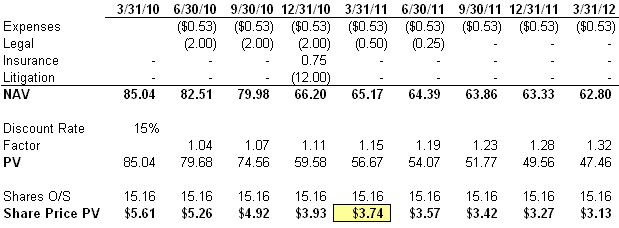
The assumptions behind our valuation table below include $2mm quarterly legal fees for the next 3 quarters and then smaller fees in subsequent quarters; a $530k quarterly expense indefinitely; a lump-sum litigation loss of $12mm; the smaller insurance policy paying out; and a discount rate of 15%. Below is the per-share present value of COF based on the quarter in which a distribution occurs (note that distributions will probably be made in multiple installments, whereas we are assuming a single lump-sum distribution):

If a distribution occurs in the first quarter of 2011, investors who buy at $3.74 will realize a 15% return on investment. But we also see that the NAV never falls below the present market cap of approximately $57mm, meaning investors wouldn’t suffer a real loss unless a) litigation losses are greater than we expect or b) this drags on far beyond 2012. If COF is acquitted, legal fees are returned by a cost order or insurance payout, and liquidation comes in the first quarter of 2011, shareholders could see a nearly 50% annualized return. Not bad for an investment uncorrelated with the rest of the market and with limited downside risk.
Conclusion
In conclusion, we’re expecting a return in the range of 15% with limited risk of loss and some respectable upside scenarios. The main risk is the opportunity cost as this is an illiquid investment and investors might not have an easy time getting out, especially if negative news is released regarding proceedings. But for investors with a 2-year+ time horizon, COF is a nice alternative to cash.
As usual, this email does not constitute investment advice or a recommendation of any sorts. Kerrisdale Capital may buy, sell or short any of the stocks mentioned at any time. I may be wrong; it would not be the first or last time.
LEGAL:
THIS COMMUNICATION IS FOR INFORMATIONAL AND EDUCATIONAL PURPOSES ONLY AND SHALL NOT BE CONSTRUED TO CONSTITUTE INVESTMENT ADVICE. NOTHING CONTAINED HEREIN SHALL CONSTITUTE A SOLICITATION, RECOMMENDATION OR ENDORSEMENT TO BUY OR SELL ANY SECURITY OR OTHER FINANCIAL INSTRUMENT OR TO BUY ANY INTERESTS IN ANY INVESTMENT FUNDS OR OTHER ACCOUNTS. THE AUTHOR HAS NO OBLIGATION TO UPDATE THE INFORMATION CONTAINED HEREIN AND MAY MAKE INVESTMENT DECISIONS THAT ARE INCONSISTENT WITH THE VIEWS EXPRESSED IN THIS COMMUNICATION. THE AUTHOR MAKES NO REPRESENTATIONS OR WARRANTIES AS TO THE ACCURACY, COMPLETENESS OR TIMELINESS OF THE INFORMATION, TEXT, GRAPHICS OR OTHER ITEMS CONTAINED IN THIS COMMUNICATION. KERRISDALE CAPITAL MANAGEMENT, LLC OR AFFILIATED ENTITIES MAY OWN SECURITIES OF OR OTHERWISE HAVE AN INVESTMENT RELATED TO ANY COMPANIES MENTIONED IN THIS COMMUNICATION. THE SENDER EXPRESSLY DISCLAIMS ALL LIABILITY FOR ERRORS OR OMISSIONS IN, OR THE MISUSE OR MISINTERPRETATION OF, ANY INFORMATION CONTAINED IN THIS COMMUNICATION.
[Full Disclosure: I do no hold COF.H. This is neither a recommendation to buy or sell any securities. All information provided believed to be reliable and presented for information purposes only. Do your own research before investing in any security.]
Read Full Post »



 Greenbackd