Feeds:
Posts
Comments

Archive for June, 2010

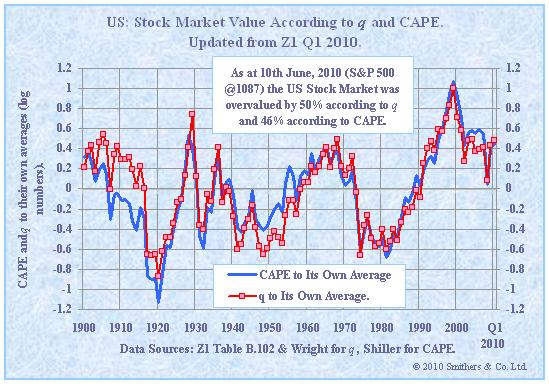
Smithers & Co. has updated its calculations for US market valuations according to cyclically-adjusted price earnings (CAPE) and Tobin’s q. CAPE is the Graham PE10, of which I am so fond. Tobin’s q compares the market value and replacement value of the same physical assets. Here’s Smithers & Co.’s chart:

Says Smithers & Co. of the market:

Non-financial companies, including both quoted and unquoted, were 62% overvalued according to q at 31st March 2010, when the S&P 500 index was 1169. Adjusting for the subsequent decline to 1087(10th June, 2010), the overvaluation had fallen to 50%. Revisions to data had little impact on q, with downward revision to net worth for Q4 2009 of 2.9% being offset by a downward revision to the market value of non-financial equities of 2.1%. Net worth for Q1 2010 fell slightly as equity buy-backs exceeded profit retentions.

The listed companies in the S&P 500 index, which include financials, were 58% overvalued at 31st March 2010, according to our calculations for CAPE, based on the data from Professor Robert Shiller’s website. Adjusting for the subsequent decline to 1087 (10th June, 2010), the overvaluation had fallen 46%. (It should be noted that we use geometric rather than arithmetic means in our calculations.)

H/T ZeroHedge.

Read Full Post »

In MarketBeat’s Stocks Too Cheap? Or Earnings Estimates Too Rosy? (subscription required), Matt Phillips has an interesting article on forward price-to-earnings ratios:

The forward-earnings in question are really consensus forward-earnings estimates, churned out by Wall Street’s broker dealers,  the so-called “sell side.” And the “sell-side” as a whole tend to be a bullish bunch.

Phillips takes Oppenheimer Asset Management analysts to task for their Monday report:

With that in mind, we turn to the question of whether stocks are cheap right now, or not. Some look at the numbers and argue, of course they are.  On a price-to-forward-earnings basis, you can make that argument. Oppenheimer Asset Management analysts did so Monday. They write:

The S&P 500’s current forward multiple of 12.9x represents the lowest level for the index since early 1995. According to our analysis, market performance has been relatively strong in all periods following similar forward P/E levels. The S&P 500 averaged a roughly 12% 12-month return in all periods since 1960 when the forward P/E was between 10x and 15x.

In the same note, Oppenheimer says that some clients are starting to wonder whether analyst expectations being too high could be the reason stocks look so cheap. “Based on our client conversations, there appears to be a growing concern that 2010 earnings expectations have become too optimistic and that forward price multiples are thereby understated,” Oppenheimer writes. Oppenheimer analysts counter this concern saying the firm doesn’t “find earnings expectations out of context from a normalized growth perspective,” writing that after a recession as sharp as the one we had, it’s reasonable to expect the earnings growth rate to be a bit higher than usual as the economy recovers.

Phillips points to Robert Shiller’s calculation of Graham’s P/E10 ratio as evidence that stocks are not be as cheap as Oppenheimer’s one-year forward estimates might have us believe:

Prof. Shiller tracks P/E ratios back to the 19th century, smoothing out short-term ups and downs in profits by using a 10-year earnings average. Even after the May declines, his P/E ratio still is almost 20, well above the historical average of about 16.

Read Full Post »

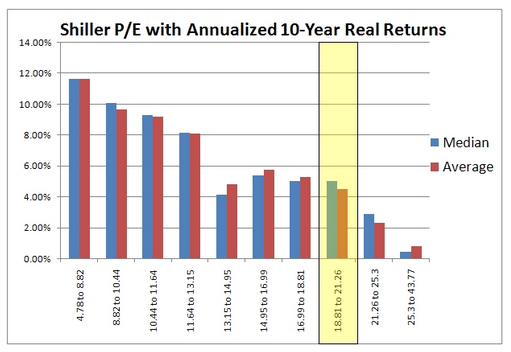
Mebane Faber has an interesting analysis of the expected ten-year annualized real returns to investors in the various Shiller / Graham P/E10 deciles:

I’ve discussed the Graham / Shiller PE10 metric before (see my April 9 post Graham’s PE10 ratio). In that article, Doug Short described the PE10 ratio thus:

Legendary economist and value investor Benjamin Graham noticed the same bizarre P/E behavior during the Roaring Twenties and subsequent market crash. Graham collaborated with David Dodd to devise a more accurate way to calculate the market’s value, which they discussed in their 1934 classic book, Security Analysis. They attributed the illogical P/E ratios to temporary and sometimes extreme fluctuations in the business cycle. Their solution was to divide the price by the 10-year average of earnings, which we’ll call the P/E10. In recent years, Yale professor Robert Shiller, the author of Irrational Exuberance, has reintroduced the P/E10 to a wider audience of investors. …  The historic P/E10 average is 16.3.

I assume that the 8th decile – the decile highlighted by Mebane – is the decile in which the market presently sits (although it’s right on the threshold between the 8th and the 9th decile). This would suggest that the median expected annualized real return for the market over the next decade is between 3% and 5%. Not great, but better than it was in April, when Dylan Grice was anticipating returns of 1.7%.

Read Full Post »

Whitney Tilson of T2 Partners has been making the rounds in the media talking up his position in BP Plc (LSE:BP). Here’s Tilson on Fast Money late last week:

Market Folly has a great summary of Tilson’s rationale here. In short, it’s a case of being greedy while others are fearful. Tilson compares BP to the Texaco v Pennzoil litigation in the 80s. Tilson makes the point that shareholders in Texaco “weren’t harmed” when Texaco filed for bankruptcy protection following Joe Jamail’s $12 billion judgement against the company. Here’s Icahn describing the negotiations to settle the litigation:

Icahn made out like a bandit on his holding in Texaco. One wrinkle to this comparison is that BP is a British stock, and so it’s not subject to the same bankruptcy regime as Texaco. The Texaco matter also wasn’t as politically sensitive as the BP spill.

The Wall Street Journal has an interesting analysis discussing various scenarios for BP (subscription required).

Read Full Post »

Jon Heller at Cheap Stocks has a great post on The Downside of Net/Net Investing- Lazare Kaplan (LKI). Says Jon:

In July of 2009,we initiated a new position in the $1.15 range. The shares subsequently ran up to $2.50, but in September, trading was halted,and not a share has traded since.

The company has repeatedly delayed filing it’s financial reports with the SEC, due to:

a material uncertainty concerning (a) the collectability and recovery of certain assets, and (b) the Company’s potential obligations under certain lines of credit and a guaranty (all of which, the “Material Uncertainties”).

The NYSE AMEX granted the company several extensions to regain compliance; the latest on April 26th, which gave the company until May 31st to regain compliance with listing standards.

Pretty standard fare in net net world. Here’s where the going gets weird. LKI is a diamond vendor. It seems that it has been in a trading halt because some of its diamonds have gone missing. Quite a few of them. When the going gets weird, as Hunter S. Thompson used to say before he was shot out of a cannon, the weird turn pro: LKI is suing its insurers for $640M. From the May 20 press release:

LAZARE KAPLAN INTERNATIONAL SUES ITS INSURERS FOR $640 MILLION

New York, NY – May 20, 2010 – Lazare Kaplan International Inc. (AMEX:LKI) (“Lazare Kaplan”) announced today that in a federal lawsuit filed on Monday, May 17, 2010, it sued various Lloyds of London syndicates and European insurers for $640 million in damages arising out of the disappearance of diamonds that were insured by the defendants, including consequential damages. The lawsuit alleges that the insurers breached two “all risk” New York property insurance policies, and an Agreement for Interim Payment under which the insurers made a non-refundable interim payment of $28 million to Lazare Kaplan in January of this year. After making the $28 million payment, the insurers abruptly reversed course and refused to acknowledge coverage or to pay any covered losses under the policies. The complaint alleges, among other things, that the insurers, which also issued separate policies to Lazare Kaplan under English law, created a virtual coverage “whipsaw” by denying coverage under the English policies on the ground that Lazare Kaplan does not have an insurable interest in the largest portion of the property at issue while at the very same time asserting under the New York policies that there is no coverage because Lazare Kaplan insured the same property under the English policies. Lazare Kaplan expects to conduct broad-ranging discovery around the world in the course of the lawsuit.

Jon asks the obvious questions:

What happened to the diamonds? Why isn’t the company willing to speak with it’s shareholders on the issue? Why are the insurers unwilling to pay? And again, what happened to the diamonds?

This is why investing in net nets will always be pure Gonzo investing. Even though the situation with the missing diamonds is ugly, if LKI trades again it might be an interesting lottery ticket. With a market capitalization of $21M, success in the $640M suit represents a 30:1 payout.

Read Full Post »

On Tuesday last week I ran a post on Lawndale Capital Management’s campaign to have P & F Industries Inc (NASDAQ:PFIN), among other corporate governance initiatives, rein in the compensation paid to PFIN’s Chairman and CEO, Richard Horowitz for poor performance.

Lawndale’s May 26 amended 13D exhibited its May 25 letter to PFIN board, which also annexed Proxy Governance’s Comparative Performance Analysis of PFIN. Both are worth reading for the background.

PFIN held its annual meeting on June 3, 2010. Lawndale voted its fund’s shares to “Withhold” on all of PFIN’s director nominees. Lawndale’s President, Andrew Shapiro, attended the meeting and met with PFIN’s board to discuss Lawndale’s many concerns, including but not limited to, excessive executive compensation, the need for greater independent composition and functioning of PFIN’s board and oversight of management’s unsuccessful acquisition strategy and operational execution.

PFIN reported the results of the annual meeting late afternoon on June 8:

Departure of Directors or Certain Officers; Election of Directors; Appointment of Certain Officers; Compensatory Arrangements of Certain Officers.

On June 3, 2010, the Board of Directors (the “Board”) of P&F Industries, Inc. (the “Registrant”) held a Meeting (the “Board Meeting”) immediately following the Registrant’s 2010 Annual Meeting of Stockholders. At the Board Meeting, the Board reconstituted the composition of the Board’s Compensation Committee and Stock Option Committee, so that, effective immediately, the members of such committees were Kenneth M. Scheriff (who was appointed as Chairman of each such committee) and Jeffrey D. Franklin, who also remained Chairman of the Audit Committee. All other committees of the Board remained unchanged.

At the Board Meeting, the Board also established the position of Lead Independent Director to preside at executive sessions of the non-employee directors and to serve as the principal liaison between the non-employee directors and the Chairman of the Board. The Board appointed Marc A. Utay to serve as the initial Lead Independent Director in addition to his continuing role as Chairman of the Nominating Committee of the Board.

Voting results from PFIN’s annual meeting were as follows: Robert Dubofsky, Alan Goldberg and Chairman/CEO Richard Horowitz had 31.9%, 29.9% and 29.5% of the votes cast as “Withheld”, respectively.

[Full Disclosure:  I do no hold PFIN. This is neither a recommendation to buy or sell any securities. All information provided believed to be reliable and presented for information purposes only. Do your own research before investing in any security.]

Read Full Post »

Jason Zweig has unearthed an original typewritten text of a speech Benjamin Graham gave in San Francisco one week before John F. Kennedy was assassinated. Says Zweig:

In this brilliant presentation, Graham explores how an investor should go about determining whether the market is overvalued, how to tell what asset allocation is right for you, and how to pick stocks wisely. This speech is a rare opportunity to see the workings of Graham’s mind in the raw.

Click here to see “A rediscovered Graham Masterpiece” at Jason’s site.

Read Full Post »

Mario Gabelli has long been criticized for his outsized remuneration at Gamco Investors Inc (NYSE:GBL). In 2005, a large investor in Gabelli Group Capital Partners, or G.G.C.P., Gabelli’s private company, sued him for, among other things, “looting the assets of the company.” According to this New York Times article, document disclosure in the case revealed that Gabelli “pays himself 20 percent of G.G.C.P.’s pretax revenue as a “management fee.” As recently as yesterday, the Wall Street Journal noted in its “Heard on the Street” column (subscription required):

… Mr. Gabelli’s compensation package has been a severe drag on earnings. In 2008, Gamco’s assets fell by a third and net income totaled $25 million. Even so, Mr. Gabelli received $46 million in cash compensation, 13 times as much as the second-highest-paid executive.

Gamco took an activist position in Biglari Holdings Inc (NYSE:BH) back when it was the humble Steak n Shake Company. Gamco’s most recent amendment to its 13D filing is an interesting change in direction. From Item 4 Purpose:

GAMCO has announced that, to the extent it has voting authority over its investment advisory accounts, GAMCO intends to vote AGAINST approval of the Incentive Bonus Agreement between the Issuer and Sardar Biglari, dated April 30, 2010 (the “Agreement”) at a special meeting of shareholders of the Issuer at which the Agreement will be submitted for approval by the shareholders of the Issuer. Consistent with applicable laws and regulations, GAMCO may discuss its plans to so vote with a limited number of institutional shareholders and others.

What’s in the Incentive Bonus Agreement? This:

Company shall pay to Executive, determined as of the last day of each fiscal year of Company (including any fiscal year in which any of the events set forth in Section 4(a) occur) (“Incentive Compensation Calculation Date”), incentive compensation equal to the Incentive Compensation Amount (as defined below) as of such Incentive Compensation Calculation Date; provided, however, that no duplicate Incentive Compensation Amount shall be paid to Executive in any fiscal year. The Incentive Compensation Amount shall be paid to Executive as promptly as practicable after each Incentive Compensation Calculation Date, and in no event later than 75 days thereafter (the “Payment Date”), subject to Section 6(c). The “Incentive Compensation Amount” means the amount computed (subject to proration with respect to any fiscal year during the term of this Agreement in which any of the events set forth in Section 4(a) occurs, determined based on the date of such event) using the following formula where “x” equals 1.05 (subject to proration for the 2010 fiscal year and any short fiscal year during the term of this Agreement) and “n” equals the number of years between the most recent Incentive Compensation Calculation Date and the Incentive Compensation Calculation Date on which the High Water Mark was achieved:

(0.25)(New Book Value – ((High Water Mark)(x)n))

In summary, Biglari gets 25% of the annual gain in book value over 5%. Gabelli gets 20% of pretax revenue. Mario thinks Sardar is going to be paid too much. Isn’t this a case of  the pot calling the kettle greedy? Or is this just gamesmanship on Gabelli’s part?

Read Full Post »

In The value of Seth Klarman (free registration required), Absolute Return has a rare interview with the president and portfolio manager of the 28-year-old Baupost Group. In the interview, Klarman discusses several of Baupost’s positions over the last twelve months, including the fund’s stake in Facet Biotech, which I fumbled last year:

Around the same time the CIT deal was playing out, Klarman took a sizable stake in Facet Biotech—a small biotech company spun off in December 2008 from PDL BioPharma—for an average cost of $9 even though it had $17 per share in net cash at the time of the spinoff. “We liked the discount and pipeline of products,” Klarman recalls. “We knew that when small caps are spun off, they are frequently ignored and become cheap.”

Biogen Idec tried to acquire Facet in a hostile deal for $14.50 per share, raising the offer later to $17.50. When Facet allowed its largest shareholder, Biotech Value Fund, to buy up to 20% of the company, Baupost asked for identical terms, essentially becoming a poison pill. Baupost then told Facet it did not intend to tender its shares in the $17.50 per share offer. Eventually Biogen backed off, and Facet accepted a $27 per share offer from Abbott Laboratories.

Here Klarman discusses his strategy more broadly:

Value investors are typically thought of as stock investors, but Klarman says most of the time he prefers to buy bonds. Bonds are a senior security, offering more safety, and they have a catalyst built into them. Unlike equity, debt pays current principal and interest. If the issuer doesn’t make that timely payment, an investor can take action. “Catalysts can reduce your dependence on the level of the market or action of the market,” he explains. For example, defaults are specific incidents affecting the company regardless of what is going on in the overall market.

Over the past two years, Klarman’s preference for debt has been even more pronounced. After peaking at just $2 billion in June 2008, Baupost’s total equity assets shrank to around $1.2 billion from the fourth quarter of 2008 to the first half of 2009, before turning up slightly at year-end 2009 to nearly $1.6 billion. That puts equities at just a little more than 7% of total assets under management.

And his view on the market

The value pro is still looking at troubled companies, mortgage securities and select equities. But he is not buying much at the moment. Klarman says there are some opportunities in commercial real estate on the private side, but not as much as would be expected, given the depressed levels of the market. “That’s why we want to be patient,” he stresses.

Baupost is 30% in cash now, its long-time average. Klarman stresses that the cash position is residual—the result of a search for opportunity and not the result of a macro view. He says he can find great opportunities to buy at the same time he has a bearish view on the world. “We’re good at finding bargains, good at doing analysis,” he emphasizes. “We’re not good at calling short-term movements in the markets.”

And when the markets started to crumble in mid-May, he mostly stood pat, asserting that the 5% to 8% drop in prices did not unleash a torrent of bargains, mostly because of the market’s surge from its March 2009 bottom. “The market has gone up so much that, based on valuation, it is overvalued again to a meaningful degree where the expected returns logically from here can be as low as the low single digits or zero for the next several years,” he says.

Click here to see the remainder of the interview (free registration required).

Read Full Post »

In his 2003 Annual Meeting, Mohnish Pabrai discussed his thesis for his investment in Frontline Ltd (USA) (NYSE:FRO). I see a number of parallels between HAWK now and FRO then. Here is an extract from the transcript:

Frontline (FRO) is company I’d like to talk about because it is an interesting datapoint on how I look at businesses. Frontline is in the crude oil shipping business. About 2 and half years ago if you asked me if I had any competency or knowledge of the crude oil shipping business, I would say that I knew nothing about the business or industry. In 2001, I was just looking at a list of companies that had high dividend yields. One of the screens I look at is companies with high dividend yields, which sometimes means some sort of overhang which is dropping the price below where it should be.

If I looked at Value Line today, I would probably find three or four companies that have a dividend yield of 10%-12%. In 2001 I noticed there were two companies with a dividend yield over 15%. Both were in the crude oil shipping business. One was called Knightsbridge (VLCCF). I wanted to understand why they had such a high dividend yield. So I spent about a month studying the crude oil shipping business.

When Knightsbridge was formed a few years ago, they ordered a few oil tankers from a Korean ship yard. Each of these VLCCs (Very large Crude Carrier) and Suezmaxes costs about $50-70 million a piece and it takes 2-3 years to build one. The day the tankers were delivered they had a long term lease with Shell Oil. The deal was that Shell would pay them a base lease rate (say $10,000 a day per tanker) regardless of whether they used them or not. On top of that, they paid them a percentage of the delta between a base rate and the spot price for VLCC rentals.

For example, if the spot price went to $30,000/day, they might collect $20,000 a day. If the spot was $50,000/day, they’d collect say $35,000/day etc. The way Knightsbridge was set up, at $10,000 a day; they were able to cover their principal and interest payments and had a small positive cash flow. As the rates went above $10,000, there was a larger positive cash flow and the company was set up to just dividend all the excess cash out to shareholders – which is marvelous. I wish all public companies did that.

When tanker rates go up dramatically, this company’s dividends goes through the roof. This happened in 2001 when tanker rates which are normally $20,000-$30,000 a day went to $80,000 a day. They were making astronomical profits at the time and the dividend yield went through the roof – but of course it was not durable or sustainable.

That’s why the stock didn’t jump up significantly. Then next week it could drop. It is a very volatile business. But I studied the business because I was just curious. But in investing, all knowledge is cumulative and makes the analytics much faster the next time around. At the time I studied Knightsbridge I also took a look at half a dozen other publicly traded pure plays in oil shipping.

Last year, we had an interesting situation take place with one of these oil shipping companies called Frontline (FRO). Frontline is a company that is the exact opposite business model of Knightsbridge. They have the largest oil tankers fleet in the world, amongst all the public companies. The entire fleet is on the spot market. There are very few long term leases. They ride the spot market on these tankers.

Because they ride the spot market on these tankers, there is no such thing as earnings forecasts or guidance. The company’s CEO himself doesn’t know tomorrow what the income will be quarter to quarter. This is great because whenever Wall Street gets confused, it means we can make money. This is a company that has widely gyrating earnings.

Oil tanker rates have varied historically between $6,000 a day to $80,000 a day. The company needs about $18,000 a day to break even. Once rates go below $18,000 a day, they are bleeding red ink. Once they go above $18,000, about $30,000-$35,000, they are making huge profits. In the third quarter of last year, oil tanker rates collapsed. There was a recession in the US, and a few other factors causing a drop in crude oil shipping volume. Rates went down to $6,000 a day. At $6,000 a day, Frontline is bleeding red ink badly. The stock appropriately went from $11 a share to about $3, in about 3 months.

If you spent some time studying Frontline, you would find that they have 60 or 70 ships, and while the rates had collapsed for daily rentals, the price per ship hadn’t changed much, dropping about 10% or 15%. There was a small drop in price per ship, but nowhere near the price the stock had dropped; the stock had dropped over 70%.

Slide 27

Frontline has a liquidation book value of about $16.50 per share, which means if they simply shut down the business sell all their ships, shareholders would get about $16 a share. If you take the collapsed ship price, you would still get $11 per share. If one could buy the entire business for $3/share, one could turn around the next day and sell the ships and clean up. While the stock was at $3, the company insiders were furiously buying shares.

When you looked at the numbers, they had plenty of cash. They could handle $6000/day rates for several months without a liquidity crunch. Also, if they sell a ship, they raise $60-70 million. The total annual interest payments are $150 million. If the income went to $0, they could sell a few ships a year and keep the company going.

In addition there is a feedback loop in the tanker market. There are two kinds of tankers. There double hull and single hull tankers. After the Exxon Valdez spill, all sorts of maritime regulations were instituted requiring all new tankers to be double hull after 2006 because they are less likely to spill oil. The entire Frontline fleet is double hull tankers.

But there’s a huge number of these single hull rust buckets built in the 1970s. If the double hull tanker spot rate is at $30,000 a day, the single hull tanker is at $20,000 a day. Oil that gets shipped from the Middle East to China or India, for example, is on single hull tankers. But Shell or Mobil, etc., will avoid leasing a single hull tanker because it is an enormous liability if they have a spill. The third world is nonchalant about importing oil on single hull tankers, and all the double hull tankers come to Europe and the West. But when rates go to $6,000 a day, the delta between single and double hull disappears.

The single hull tankers stop being rented because there’s no significant delta in the daily rate. Everyone shifts to double hull tankers at that point. The single hull tanker fleet goes to zero revenue in a $6,000 a day rate environment. When it goes to zero revenue, all these guys who own the single hull tankers get jittery; they can sell these tankers to the ship breakers and get a few million dollars instantly. They know that by 2006 their ability to rent them will decline substantially. There is a dramatic increase in scrapping rate for single hulled tankers whenever rates go down.

It takes four years to build a new tanker, so when demand comes back up again, inventory is very tight. There is a definitive cycle. When rates go as low as $6,000 and stays there for a few weeks the rise to astronomically high levels – say $60,000/day is very fast. With Frontline, for about seven or eight weeks, the rates stayed at under $10,000 a day and then spiked to $80,000 a day in Q402.

Slide 28

I started buying around here ($5.90). Again, not smart enough to buy at the very bottom. I bought on average price at a price of $5.90 per share, which is about half of the $11/$12 per share you would get in a liquidation. Now Frontline’s price is about $20 a share because tanker rates are at $60,000 a day – people are in a euphoric/greedy state. But once we got past $9, approaching $10, I started to unload of the shares. The whole thing happened in a very short time period – resulting in a very high annualized rate of return.

Slide 29

We had a 55% return on the Frontline investment and an annualized rate of return of 273%. Frontline is a good example of why I am hesitant to share ideas because we will see this again. Oil tanker rates will go down and at the last meeting a bunch of investors told me, “We are watching now.” The more people that are tuned in, once it gets to $8 or $9, the more the buying – reducing our gains. But that is an example of a Special Situation investment in a company with negative cash flow.
Read Full Post »

« Newer Posts - Older Posts »